

Table of Contents
7 min read |
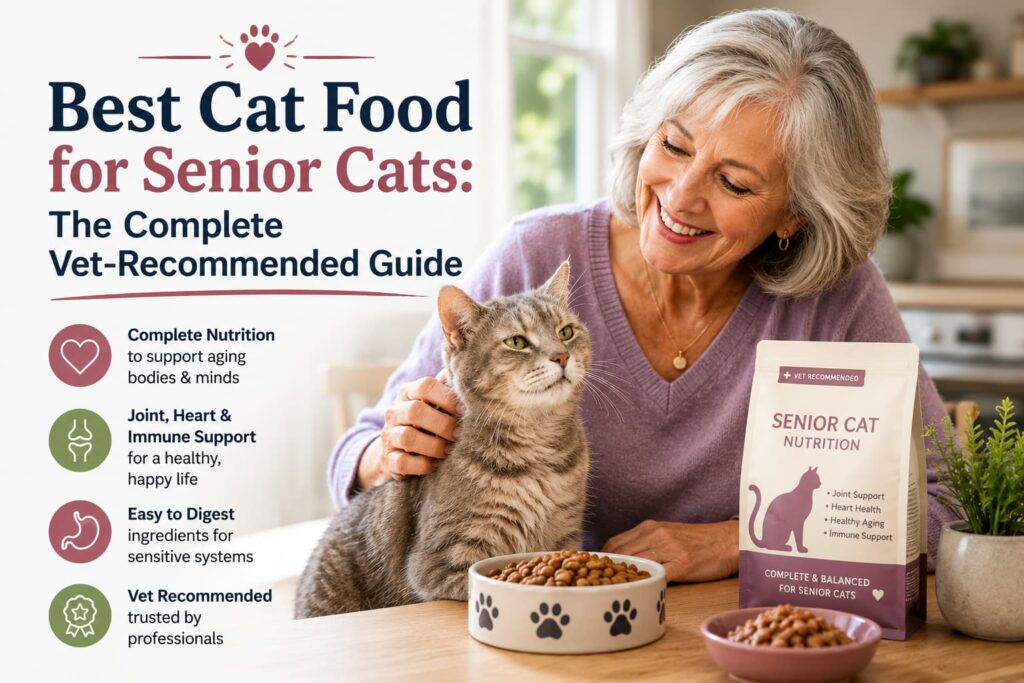
Choosing the best cat food for senior cats requires understanding what actually changes nutritionally as cats age — and some of it is genuinely counterintuitive. The best cat food for senior cats is not simply a regular adult food with a different label — it addresses specific age-related changes in protein metabolism, digestive efficiency, and calorie needs that generic adult formulas do not account for.
That key point is protein. Most people assume senior cats need less protein — that it is gentler on ageing organs. For cats without diagnosed kidney disease, this is wrong. Healthline’s 2026 senior cat nutrition guide is clear: senior cats need more protein, not less, to combat the progressive loss of lean body mass that comes with ageing. The low-protein senior advice belongs specifically to cats with diagnosed kidney disease, not healthy seniors.
This guide covers what senior cats actually need, the protein myth explained properly, the calorie paradox that surprises most owners, the top vet-recommended brands, and when a standard senior food needs to become a prescription diet.
For more on this, see our guide on kidney disease in cats.
You might also find our guide on hyperthyroidism in cats helpful.
When Is a Cat Senior? The Official Definition
The Feline Veterinary Medical Association (FelineVMA) considers cats over 10 years old to be senior, though some breeds may be considered senior from around 8 years old. By 11 years, cats are classified as geriatric. This is later than many owners realise — a cat at 8 is not yet senior in the same sense as a cat at 11 or 12.
The transition to a senior food is not mandatory at a specific age — it should be based on your individual cat’s health, body condition, and any diagnosed conditions. A healthy 9-year-old with excellent body condition may not need a senior formula. A 9-year-old with muscle loss and reduced digestive efficiency probably does. Your vet can assess body condition at annual check-ups and advise on timing.
The Protein Myth — Debunked
The most important nutritional fact about senior cats: healthy senior cats do not need low-protein diets. Pooler Veterinary Clinic’s 2026 senior cat guide is direct: senior cats still need plenty of protein to maintain muscle mass. Contrary to old myths, healthy senior cats do not need low-protein diets unless they have kidney disease.
The reason this matters: progressive muscle wasting (sarcopenia) is one of the most significant health challenges of ageing in cats. Providing adequate protein helps counter this. A senior cat on a low-protein diet without kidney disease is losing muscle mass faster than necessary.
The distinction: cats with diagnosed CKD do need phosphorus restriction and sometimes protein adjustment under veterinary guidance. But this restriction should follow a kidney disease diagnosis, not be applied to all senior cats as a general preventive measure. If your senior cat has not been diagnosed with kidney disease, keep protein levels appropriate for a healthy adult cat — which means high and from quality animal sources.
The Calorie Paradox
Here is the counterintuitive finding that surprises most cat owners: Healthline’s 2026 review, citing the Feline Veterinary Medical Association, notes that unlike humans and dogs, elderly cats experience an increase in the calories needed to maintain their energy rather than a continued decline.
As cats age, their digestive efficiency decreases — they absorb fewer nutrients per calorie consumed. This means maintaining body weight actually requires more calories, not fewer. Senior cats that are losing weight despite eating normally need calorie-dense, highly digestible food — not a calorie-restricted senior formula.
This creates two distinct senior cat scenarios that need different food:
- Overweight Senior Cats — need a calorie-controlled food to achieve gradual weight loss without muscle loss
- Underweight or weight-losing senior cats — need calorie-dense, highly digestible food with high-quality protein to maintain body condition
A vet assessment of body condition score is the starting point for deciding which applies to your cat.
Key Nutrients for Senior Cats
When evaluating the best cat food for senior cats, these are the nutritional markers that actually matter — and the ones worth checking on any label before buying.
- High-quality animal protein— minimum 30% on a dry matter basis, from specifically named meat sources — essential for maintaining muscle mass
- Easily digestible ingredients— senior cats have reduced digestive efficiency. Highly digestible food maintains nutrient absorption as digestive capacity decreases.
- Omega-3 fatty acids (EPA and DHA)— Hawcreek Animal Hospital’s senior cat guide notes that cats with joint stiffness benefit from diets containing omega-3 sources. Anti-inflammatory effect supports mobility and coat health.
- Controlled phosphorus— not the aggressive reduction needed for CKD, but moderate control to avoid unnecessary kidney strain in ageing kidneys
- Antioxidants— vitamins E and C support immune function, which is often compromised in older cats
- Moisture— senior cats are at higher risk of dehydration. Wet food becomes increasingly important as cats age.
Top Vet-Recommended Senior Cat Food Brands
These are the brands that veterinary panels consistently identify as the best cat food for senior cats across multiple 2026 reviews — all meeting AAFCO feeding trial standards and formulated by veterinary nutritionists.
Hill’s Science Diet Senior — the overall pick
For owners looking for the best cat food for senior cats from a single trusted brand, Hill’s covers every scenario — healthy seniors, weight management, and therapeutic conditions — making it the most versatile choice.
Hill’s Science Diet Age Defying 11+ and Healthy Longevity formulas are specifically designed for the nutritional challenges of very senior cats. They provide highly digestible protein, controlled phosphorus, and are backed by Hill’s extensive feeding trials and veterinary nutritionist formulation. Chewy’s veterinary panel consistently places Hill’s at the top of senior food recommendations.
Purina Pro Plan Senior
Purina Pro Plan Prime Plus, formulated for cats 7 years and older, provides higher protein and reduced phosphorus compared to their adult formula. Purina’s research team has specifically studied senior feline nutrition, and the formula reflects that investment. Both dry and wet formats are available.
Royal Canin Aging
Royal Canin’s Ageing 12+ formula is specifically designed for cats over 12 — one of the few formulas that targets very senior cats rather than grouping all cats over 7 together. It accounts for the reduced digestive efficiency and muscle maintenance needs of genuinely geriatric cats.
When to move to a prescription diet
Any senior cat with a diagnosed health condition — kidney disease, hyperthyroidism, diabetes, heart disease, inflammatory bowel disease — needs a therapeutic prescription diet tailored to that condition rather than a general senior food. Discuss with your vet which therapeutic diet takes priority if multiple conditions are present.
Frequently Asked Questions
| Q: When should I switch my cat to senior food?A: The best cat food for senior cats is not determined by age alone — it should be based on body condition and health status. Most vets suggest considering a senior formula from age 7 to 10, with the actual transition depending on your individual cat’s assessment. |
| Q: My senior cat is losing weight — what should I do?A: Senior weight loss is not simply ageing. Farmington Vet Hospital’s guide is clear: this could be due to loss of bone and muscle mass associated with ageing, or an underlying issue such as kidney disease, hyperthyroidism, or cancer. A vet visit with blood work is the appropriate first step — do not increase food quantity without knowing why weight is being lost. |
| Q: Is wet food better for senior cats?A: Yes, increasingly as cats age. Hydration becomes more important as kidney function gradually decreases. Wet food’s higher moisture content reduces dehydration risk and urinary concentration. Dental disease — common in older cats — also makes wet food more comfortable to eat. Most vets recommend wet food as the primary diet for cats over 10. |
You may also want to read our guide on best wet cat food.
PetMd – > https://www.petmd.com/cat/vet-verified/best-cat-food
Frequently Asked Questions About Best Cat Food for Senior Cats
At what age should I switch to the best cat food for senior cats? Most vets recommend transitioning to the best cat food for senior cats around the age of 7–10 years, though this can vary depending on your cat’s individual health. Cats age faster than humans — a 10-year-old cat is roughly equivalent to a 56-year-old person. Senior-specific formulas typically have adjusted protein and phosphorus levels to support ageing kidneys, added joint-supporting nutrients like glucosamine, and a calorie profile suited to a less active lifestyle. If your older cat is still in excellent health, your vet may recommend staying on an adult formula until clear signs of ageing appear.
What nutrients matter most in the best cat food for senior cats? The best cat food for senior cats should deliver high-quality, easily digestible protein to prevent muscle loss — a common issue in older cats called sarcopenia. Phosphorus should be moderate to avoid stressing ageing kidneys, and omega-3 fatty acids (EPA and DHA) support joint health, coat condition, and cognitive function. Antioxidants such as vitamin E and C help combat cellular ageing. Some best cat food for senior cats formulations also include added taurine for heart health and prebiotics or probiotics for gut support, as digestive efficiency naturally declines with age.
Should the best cat food for senior cats be wet or dry? Wet food is often the preferred choice when selecting the best cat food for senior cats, for several reasons. Older cats are prone to dehydration and kidney disease, and the high moisture content of wet food helps maintain hydration and reduce the kidneys’ workload. Senior cats may also have dental issues or reduced jaw strength that make chewing dry kibble uncomfortable. That said, a good-quality dry formula can still be the best cat food for senior cats if it is specifically formulated for older cats and your cat stays well-hydrated. Many owners feed a mix of both.
Can the best cat food for senior cats help with weight management? Yes — weight management is one of the most important reasons to choose the best cat food for senior cats. Older cats are more prone to both obesity (due to reduced activity) and unintentional weight loss (due to hyperthyroidism, dental disease, or kidney issues). A senior formula with a controlled calorie density and high protein-to-fat ratio helps maintain lean muscle while avoiding excess weight gain. If your cat is losing weight despite eating normally, this is a red flag that warrants a vet visit, as no cat food — even the best cat food for senior cats — can substitute for treating an underlying medical condition.
Finding the best cat food for senior cats comes down to matching the food to your cat’s specific condition — a healthy senior with good body condition needs something very different from a senior managing kidney disease or significant muscle loss. Your vet’s annual assessment is the most reliable guide for getting this right.
| Disclaimer This article reflects the personal experience and research of the author and is for informational purposes only. Always consult your veterinarian before making significant changes to your pet’s diet, particularly if they have an existing health condition. |
For a complete overview of cat nutrition and feeding, visit our complete cat nutrition guide.
This article is written for informational purposes and reflects the personal experience and research of the author. It does not replace professional veterinary or dog training advice. Always consult your veterinarian or a certified trainer for individual guidance.