


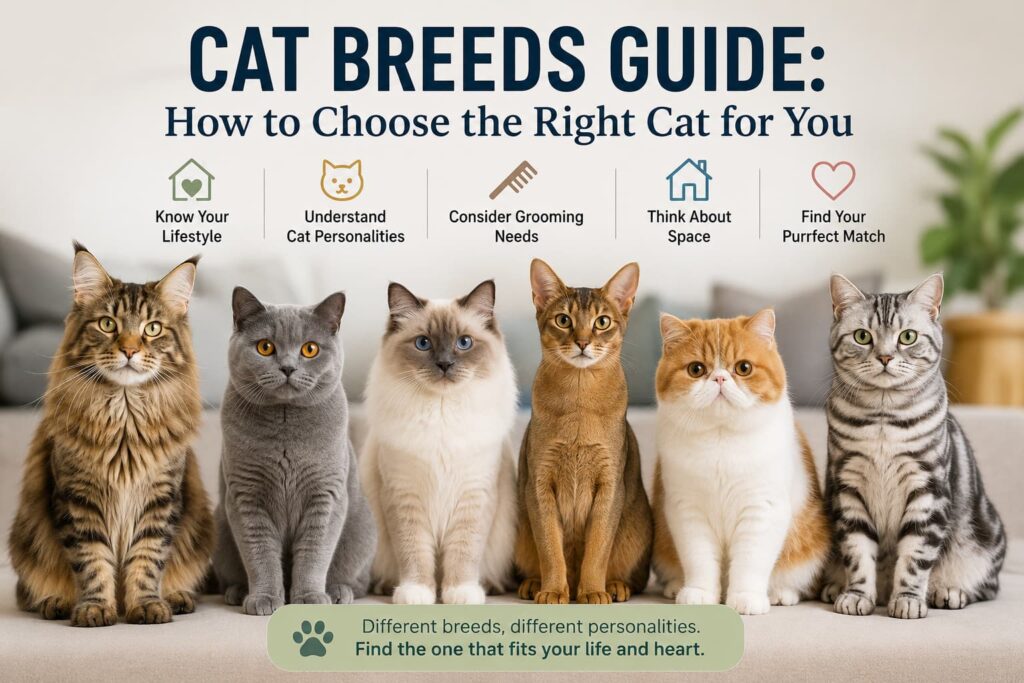
Choosing the right cat breed is one of the most important decisions a new cat owner can make. The cat you choose will share your home for 12–20 years, so personality fit matters as much as appearance. This guide covers the most popular cat breeds — large and small, calm and energetic, family-friendly and independent — with everything you need to compare them clearly and choose the right cat for your lifestyle.
Popular Cat Breeds at a Glance
Here’s a quick overview of the most common cat breeds to help you compare them before diving deeper:
| Breed | Size | Energy Level | Good for Families | Suits Busy Owners |
|---|---|---|---|---|
| Maine Coon | Large | Medium | Yes | Yes |
| Bengal | Medium | Very High | With older children | No |
| Russian Blue | Medium | Medium-Low | Yes | Yes |
| Savannah | Large | Very High | With caution | No |
| Ragdoll | Large | Low | Yes | Yes |
| British Shorthair | Medium-Large | Low | Yes | Yes |
| Siamese | Medium | High | Yes | With effort |
| Persian | Medium | Low | Yes | Grooming time needed |
Large Cat Breeds: Maine Coon and Savannah
If you want a big, impressive cat with a personality to match, large cat breeds like the Maine Coon and Savannah are hard to beat — but they come with very different ownership requirements.
The Maine Coon is one of the largest domestic cat breeds, with males regularly reaching 15–25 lbs. Despite their size, they’re gentle, sociable, and famously patient with children. They adapt well to most households, including those with dogs, and they’re known for dog-like loyalty — following their owners from room to room and often enjoying games of fetch. Maine Coon cat care is relatively straightforward once you account for their thick coat, which benefits from weekly brushing. Learn more in our guide to fascinating Maine Coon facts.
The Savannah cat is a hybrid breed — part domestic cat, part African serval. Early-generation Savannahs (F1 and F2) can weigh up to 20 lbs and have extremely high energy and territorial instincts. They’re not suited to the average household. Before committing to one, read our honest look at the reasons to pause before getting a Savannah cat — this is a breed that demands dedicated space, enrichment, and an experienced owner.
According to International Cat Care, large cat breeds tend to mature more slowly than smaller breeds, meaning they often remain playful and kitten-like well into adulthood — something to consider when planning your home setup.
Energetic and Exotic Cat Breeds: The Bengal
For owners who want an active, wild-looking cat with a big personality, the Bengal is the most popular exotic cat breed available. Their leopard-spotted coats are stunning — but the personality that comes with them is equally intense.
Bengals are highly intelligent, vocal, and intensely curious. They require significant daily interactive play and consistent mental stimulation. Without it, they become destructive — turning on taps, raiding cupboards, and picking fights with other pets. They’re also one of the most opinionated cat breeds you’ll encounter. Understanding Bengal cat behaviour before bringing one home could save you a great deal of frustration.
It’s also worth knowing that the Bengal cat breed is not for everyone. They’re a poor fit for quiet households, first-time owners, or anyone who works long hours without enrichment arranged for their cat. For the right owner, though, a Bengal is an extraordinary, rewarding companion unlike any other.
Calm and Affectionate Cat Breeds
Not every cat owner wants high energy and drama. Several cat breeds are prized specifically for their calm, gentle temperaments — ideal for apartments, quieter households, and owners who want a relaxed companion.
The Russian Blue is one of the most reliably calm and loyal cat breeds. They’re plush-coated, quiet, and known for forming a deep bond with one primary person. They’re also relatively low-allergen compared to most cat breeds, making them a popular choice for mild allergy sufferers. There are many reasons why Russian Blue cats are considered the best — their serene temperament, minimal grooming needs, and steady loyalty make them particularly well-suited to calmer households.
The Ragdoll earns its name by going completely limp when picked up. These large, blue-eyed cats are docile, affectionate, and extraordinarily tolerant of children. They rarely scratch, tend to get along well with other pets, and are among the most consistently gentle cat breeds available.
The British Shorthair is another excellent calm breed — stocky, independent, and unpretentious. They don’t demand constant attention, are happy to entertain themselves, and suit busy households particularly well. Their short, dense coat also requires minimal grooming compared to longer-haired cat breeds.
The Persian rounds out this category — quiet, gentle, and deeply affectionate. They’re not energetic cats, but their long coats require significant daily grooming to prevent matting.
Small Cat Breeds
If you want a compact cat that stays small throughout its life, several recognised cat breeds fit the bill. The Singapura is one of the tiniest — typically weighing just 4–8 lbs — followed by the Devon Rex and Cornish Rex, both known for their curly coats and elfin features.
Small cat breeds suit apartments and smaller living spaces well, though don’t assume small means low energy — many compact breeds are highly active. The Devon Rex and Cornish Rex in particular are energetic, mischievous, and demanding of interaction. Before choosing a smaller breed, read our guide to which cats stay small, including their personalities and whether they’ll suit your home.
Best Cat Breeds for Families With Children
When choosing cat breeds for a family with children, temperament matters far more than looks. The best cat breeds for family life tend to share a set of core traits: patience, sociability, resilience, playfulness, and a high tolerance for noise and unexpected handling.
Top choices consistently include the Maine Coon, Ragdoll, Abyssinian, and Burmese. According to our guide to the best cat breeds for families, the Ragdoll is particularly well suited to households with young children because of its non-aggressive, calm temperament and high tolerance for being carried.
The ASPCA also recommends considering a cat’s individual history and early socialisation alongside its breed, since personality varies significantly even between cats of the same breed.
Cat breeds to be more cautious with around small children include Bengals, Siamese, and Abyssinians — not because they’re dangerous, but because they’re easily overstimulated and more likely to scratch when stressed.
Cat Breeds for People Who Work Full Time
One of the most common questions prospective owners ask is whether it’s fair to own a cat if they’re out of the house all day. The honest answer is: it depends on the breed.
Independent cat breeds like the British Shorthair, Russian Blue, and Norwegian Forest Cat handle time alone much better than highly social breeds. They’re self-sufficient, less prone to separation anxiety, and generally content with a window perch, toys, and a quiet environment during the day.
Bengals, Siamese, and Sphynx cats, on the other hand, need regular interaction and become bored and destructive without it. Our guide on whether you should get a cat if you work full time explores this in detail and offers practical strategies — including adopting in pairs — for busy owners who still want a feline companion.
How to Choose the Right Cat Breed for You
Before selecting a cat breed, work through these five questions:
- How much daily time can you give a cat? High-energy cat breeds like Bengals and Siamese need 30–60 minutes of interactive play every day. Calmer breeds like British Shorthairs are more self-sufficient.
- What’s your living space like? Large, active cat breeds need more room to roam. For a small apartment, a calmer, smaller breed is the better match.
- Do you have children or other pets? Prioritise patient, sociable cat breeds over territorial or easily overstimulated ones.
- Can you commit to grooming? Long-haired cat breeds like Maine Coons and Persians require regular brushing. Short-haired breeds like British Shorthairs need far less.
- What’s your budget? Exotic cat breeds like Bengals and Savannahs cost significantly more upfront — and can come with higher veterinary needs too.
Once you’ve answered these honestly, the right cat breed becomes much clearer — and so do the ones you should avoid.
Frequently Asked Questions About Cat Breeds
What is the most popular cat breed in the world?
The Ragdoll has ranked as one of the most popular cat breeds globally for several years running, followed closely by the Maine Coon, British Shorthair, and Persian. Popularity varies by region, but these four cat breeds consistently appear in the top ten worldwide.
Which cat breed is best for first-time owners?
The British Shorthair and Ragdoll are widely considered the best cat breeds for first-time owners. Both are calm, tolerant, low-maintenance, and easy to socialise. Avoid Bengals and Savannahs for your first cat — they’re beautiful but demanding in ways that can overwhelm new owners.
What is the friendliest cat breed?
Ragdolls, Maine Coons, and Burmese cats are consistently rated the friendliest cat breeds. They actively seek human attention, enjoy being held, and tend to be welcoming of strangers — traits that are less common than most people assume in the cat world.
Which cat breed lives the longest?
Among recognised cat breeds, the Siamese is one of the longest-lived, frequently reaching 15–20 years. Russian Blues and British Shorthairs also tend to have long, healthy lives with proper care. Mixed-breed cats (domestic shorthairs) often outlive purebreds due to greater genetic diversity.
What is the most hypoallergenic cat breed?
No cat breed is truly hypoallergenic — all cats produce the Fel d 1 protein that triggers most allergies. However, the Siberian, Balinese, and Russian Blue are often reported to cause fewer reactions. If allergies are a concern, spend time with the specific cat before adopting and consult an allergist.
Should I get a kitten or an adult cat?
Kittens are easier to socialise but require significantly more time and supervision in their first year. Adult cats have established personalities — what you see is largely what you get. For busy households or first-time owners, adopting an adult cat from a rescue can be the smarter, lower-stress choice.
Are purebred cats healthier than mixed-breed cats?
Not typically. Many purebred cat breeds are predisposed to specific genetic health conditions — Maine Coons can be prone to heart disease, Persians to respiratory issues, and Scottish Folds to joint problems. Mixed-breed cats tend to be more genetically diverse and often live longer, healthier lives. Whichever cat breed you choose, regular veterinary care is essential.
DogsAndCatsHQ is reader-supported. Our content is reviewed for accuracy but always consult your vet for personalised advice about your specific cat.
This article is written for informational purposes and reflects the personal experience and research of the author. It does not replace professional veterinary or dog training advice. Always consult your veterinarian or a certified trainer for individual guidance.
This article is written for informational purposes and reflects the personal experience and research of the author. It does not replace professional veterinary or dog training advice. Always consult your veterinarian or a certified trainer for individual guidance.


