

Table of Contents
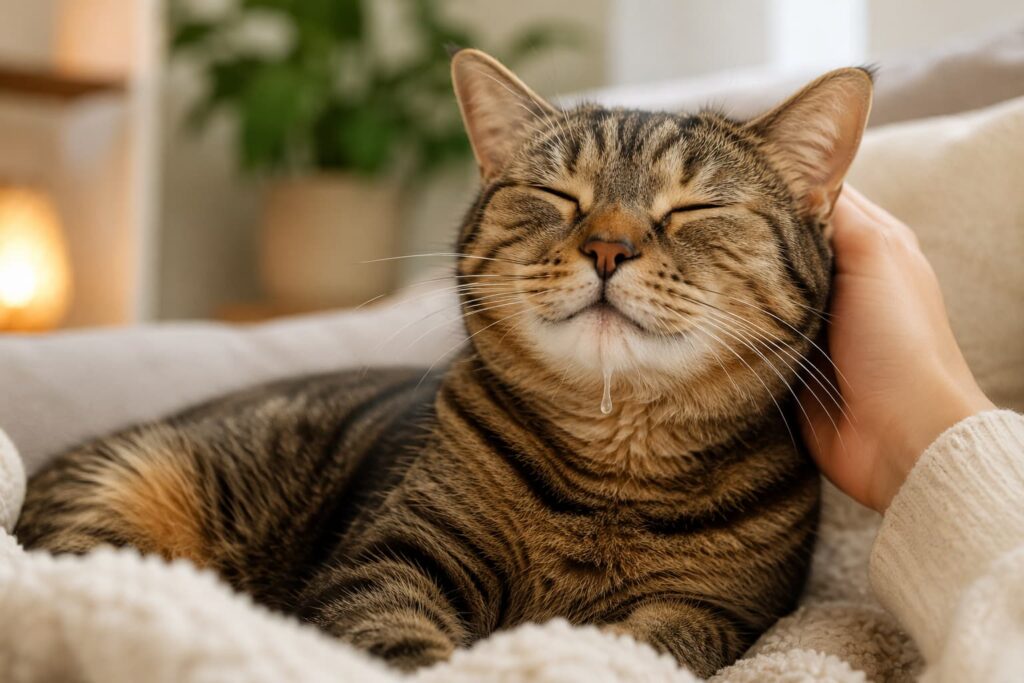
Cat drooling when purring surprises a lot of new cat owners — there is a persistent idea that only dogs drool, so the first time a deeply content cat starts leaving a small wet patch on your lap mid-purr, it can feel like something might be wrong. In the overwhelming majority of cases, it is not.
One of my cats has been a happy drooler her entire life — a few drops every single time she settles into a deep, rumbling purr on the sofa. My other cat has never done it once. Both are perfectly healthy. The variation between individual cats is genuinely wide, and that alone tells you most drooling while purring is simply a personality quirk rather than a symptom.
That said, drooling is not always harmless, and the context around it matters. This guide gives you a clear way to tell the difference between contented drooling and the kind that deserves a vet visit. It pairs well with our guides on why cats purr and why cats knead, since drooling often shows up alongside both behaviours.
Why Happy Drooling Happens
When it comes to cat drooling when purring, PetMD’s explanation is the clearest available: drooling during purring or kneading is likely caused by endorphins, similar to those released when kittens nurse from their mother. As a cat relaxes deeply, the muscles throughout their body — including those in the mouth — loosen, and if the mouth hangs open even slightly, saliva that would normally be swallowed can simply escape instead.
Some cats also blow tiny saliva bubbles while drooling during an intense purr, a slightly comical but entirely benign side effect of the vibration combined with loose saliva. None of this indicates discomfort — quite the opposite.
Telling Happy Drool Apart From a Problem
Context is everything when a cat drooling when purring turns from charming into concerning. The same small amount of drool means something completely different depending on what surrounds it.
| Drool Type | What It Looks Like | What It Means |
|---|---|---|
| Happy drool | Small amount, clear, appears during purring, kneading, or petting, cat is relaxed and loose-bodied | Normal — endorphin response, same mechanism as kittenhood nursing. No action needed. |
| Pain drool | Thick or stringy, often one-sided, accompanied by bad breath, dropping food, pawing at mouth | Likely dental disease — gingivitis, tooth resorption, or an abscess. Vet dental check needed. |
| Nausea drool | Watery, accompanied by lip-smacking, swallowing hard, may precede vomiting or hairball | Digestive upset — usually resolves on its own but watch for repeated episodes. |
| Emergency drool | Sudden onset, profuse, foaming, with distress, panting, or known access to a toxin | Possible poisoning or acute injury. Contact an emergency vet immediately. |
When to See a Vet
Most cat drooling when purring never needs a vet visit at all. A few specific patterns are worth checking regardless of whether they happen during purring or at random.
- Drooling that is new and was never part of your cat’s normal behaviour — a sudden change in a cat that has never drooled before is worth a check, even without other symptoms.
- Drooling accompanied by bad breath — one of the most reliable early indicators of dental disease, which affects a significant proportion of cats by adulthood.
- Drooling alongside reduced appetite or dropping food — suggests the mouth itself may be painful.
- Drooling that occurs outside of relaxed moments — while eating, during stressful situations, or seemingly at random, rather than specifically during purring or kneading.
- Any sudden, profuse drooling with visible distress — particularly if there is any possibility of access to a toxic plant or substance, this warrants emergency attention.
Tools That Can Help
For a cat with a consistent pattern of drooling when purring, a soft absorbent cat bed cover saves your furniture and laundry a lot of grief, and a cat-safe bib or towel works well if you like holding your cat during purr sessions. Dental treats can support oral health between check-ups, though they are not a substitute for a proper vet dental check if pain drool is suspected.
For anything beyond ordinary cat drooling when purring, the PetMD guide to feline drooling is a solid starting point, the Cornell Feline Health Center covers dental disease in detail, and VCA Animal Hospitals has broader guidance on when drooling signals an emergency.
Frequently Asked Questions
Is it normal for only one of my cats to drool when purring and not the other?
Yes, completely. Individual variation in cat drooling when purring is wide — some cats do it consistently their entire lives, others never do it at all, and many fall somewhere in between depending on how deeply relaxed they are in a given moment. This is a personality trait, not a health indicator, provided the drooling cat shows no other symptoms.
My cat has started drooling more than usual as they’ve gotten older — should I be concerned?
An increase in drooling in an older cat is worth a dental check specifically, since dental disease becomes considerably more common with age. It does not necessarily indicate anything serious, but because cats are skilled at masking discomfort, a vet examination is the most reliable way to rule out a painful cause before assuming it is simply ageing.
Can stress cause a cat to drool?
Yes — stress-related drooling is a recognised pattern, often accompanied by other signs like panting, yowling, or hiding, and it typically happens in clearly stressful contexts like car rides or vet visits rather than during relaxed moments like purring. If stress-related drooling continues after the stressful event has passed, it is worth discussing with your vet, and our broader cat behavior guide covers other stress signals worth watching for.
Should I wipe my cat’s mouth every time they drool while purring?
It is not necessary for your cat’s comfort, but a quick wipe with a soft cloth can protect your lap, bedding, or furniture. Most cats tolerate this well when they are already relaxed, though it is worth stopping if your cat seems bothered by it, since the goal is to keep the moment pleasant rather than interrupt the purr.
| Disclaimer: This article reflects the personal experience and research of the author and is for informational purposes only. It does not replace guidance from a licensed veterinarian, particularly for cats showing signs of pain, distress, or sudden behavioural change. |