
Table of Contents
8 min read |
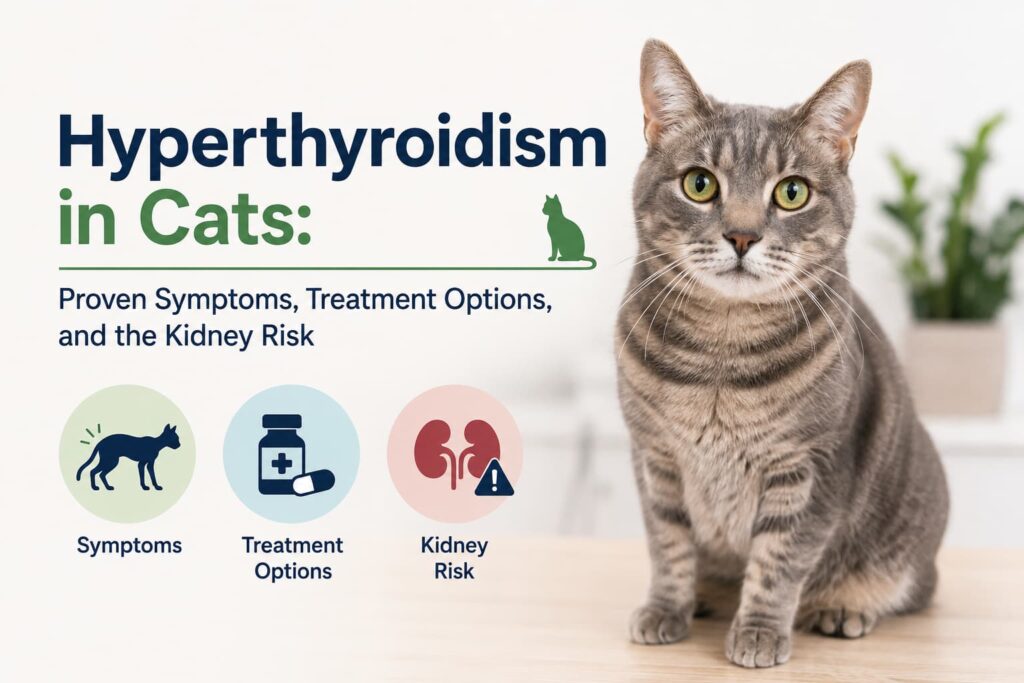
Hyperthyroidism in cats is the most common hormonal disorder in older cats — according to MedVet, nearly 10% of cats develop the disease. That makes it more common than feline diabetes, and significantly more treatable. Yet it remains one of the conditions most frequently attributed to ‘just getting old’ for far too long before diagnosis.
I have seen this misattributed to ageing twice in my lifetime with cats. An older cat losing weight despite eating voraciously, becoming increasingly restless and vocal, drinking more than usual. Easy to file under ‘senior cat behaviour.’ The vet finds elevated T4 on a routine blood test and the diagnosis is hyperthyroidism — a condition that, treated, can add years to a cat’s comfortable life.
VetLens’ 2026 hyperthyroid guide offers a clinical rule of thumb worth committing to memory: weight loss with ravenous appetite in cats over 8 years old is hyperthyroidism until proven otherwise. If your older cat is eating enthusiastically but losing weight, that is the combination that warrants a vet visit.
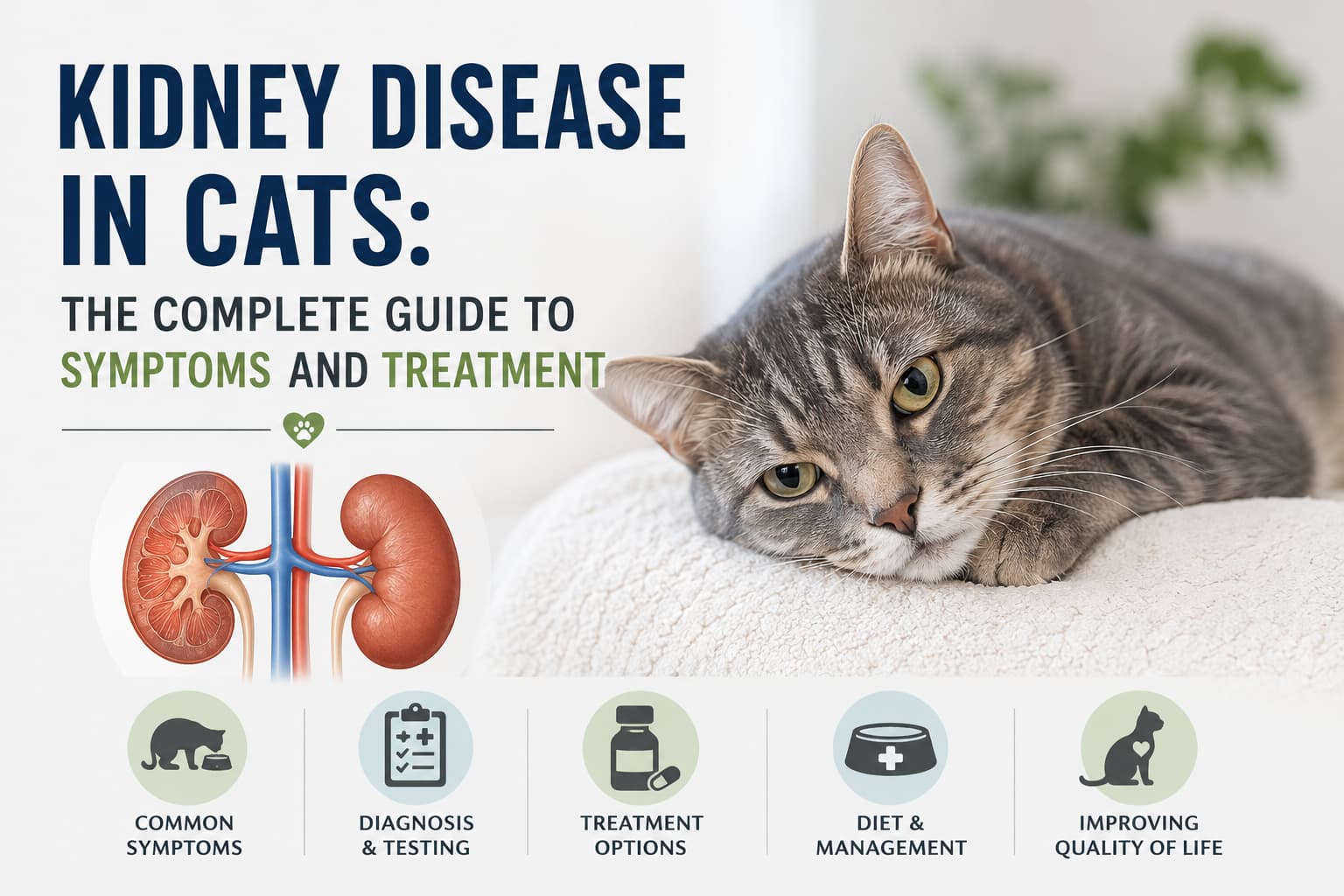
We also have a complete guide on kidney disease in cats.
For more on this, see our guide on why is my cat lethargic?.
What Hyperthyroidism Does to Your Cat
The thyroid gland produces thyroxine (T4) — the hormone that regulates metabolism. PetMD explains the mechanism: hyperthyroidism is caused by a benign tumour (adenoma) of the thyroid gland producing excess thyroxine. This accounts for over 95% of cases. The remaining 2% are thyroid carcinoma.
Excess thyroxine accelerates every bodily function. The metabolism runs at a sustained overclock — the cat burns calories faster than they can eat them, the heart beats faster, the kidneys filter faster, the gut moves faster. The result is a cat that is simultaneously hyperactive and deteriorating.
The average age of diagnosis is approximately 13 years, according to PetMD. It can occur from age 4 onwards, but young hyperthyroid cats are unusual. About 70% of cats have both lobes of the thyroid gland affected.
Symptoms — What to Watch For
Cornell Feline Health Center lists the symptoms comprehensively:
- Weight loss despite voracious appetite — the most consistent finding. The cat eats well but loses condition progressively.
- Increased thirst and urination — the metabolic acceleration increases fluid demand.
- Hyperactivity and restlessness — the cat seems anxious, unable to settle, agitated.
- Excessive vocalisation — particularly at night, in cats that were previously quiet.
- Vomiting and diarrhoea — the accelerated gut motility causes digestive instability.
- Poor coat quality — despite eating, the body cannot maintain coat condition.
- Rapid or irregular heart rate — palpable on examination, sometimes audible to the owner.
- High blood pressure symptoms — restlessness, sudden vision changes, difficulty walking (see section below)
Diagnosis — The T4 Blood Test
Diagnosis is confirmed with a blood test measuring T4 (thyroxine) levels. VCA Animal Hospitals confirms: in most cats with hyperthyroidism, T4 is clearly elevated. Some cats with early hyperthyroidism have T4 in the upper normal range on standard testing — for these cats, a free T4 (fT4) test or repeat testing after a few weeks confirms the diagnosis.
VetLens’ T4 reference ranges provide useful context: normal is 0.8 to 4.7 micrograms per decilitre. Values above 4.7 with compatible symptoms confirm hyperthyroidism. Values above 10 indicate severe hyperthyroidism requiring aggressive treatment.
The Kidney Disease Complication — What Most Guides Miss
This is the most clinically important issue in feline hyperthyroidism management, and it is inadequately covered in most guides. Hyperthyroidism increases blood flow through the kidneys, which artificially improves apparent kidney function. A cat may have underlying kidney disease that is being masked by the hyperthyroid state — because the increased renal blood flow keeps creatinine values in the normal range.
When hyperthyroidism is treated and thyroid hormone levels normalise, renal blood flow decreases — and previously masked kidney disease can become apparent. Purina’s veterinary guidance on this is clear: before starting treatment, your veterinarian will check kidney function, blood pressure and urine protein to help determine the safest option.
The practical implication: some cats are treated for hyperthyroidism and then appear to develop kidney disease. In reality, the kidney disease was present before treatment. This is not a treatment failure — it is the underlying condition becoming visible. It does mean that hyperthyroid cats need careful post-treatment monitoring of kidney values.
The Four Treatment Options — Compared
1. Radioactive iodine (I-131) — the gold standard
Purina describes I-131 as most often a one-time treatment that safely destroys overactive thyroid tissue. The cat receives a single injection, the radioactive iodine is taken up specifically by hyperactive thyroid tissue, and the tissue is destroyed. Success rates exceed 95%. The cat requires a period of isolation (typically 2 to 3 weeks) after treatment as they pass small amounts of radioactive material. This is the preferred treatment for cats who can tolerate it as it is curative rather than lifelong management.
2. Methimazole — daily medication
VCA Animal Hospitals confirms: lifelong administration of methimazole can control the effects of an overactive thyroid gland. It takes several weeks for methimazole to restore thyroid hormone levels to normal. Methimazole requires regular blood monitoring (every 3 to 6 months when stable) and some cats experience side effects including reduced appetite, itching at the face, and rarely bone marrow suppression. A transdermal gel applied to the inner ear flap is available for cats who resist oral medication.
3. Prescription diet (Hill’s y/d)
Hill’s Prescription Diet y/d is formulated with severely restricted iodine — the thyroid gland cannot produce excess thyroxine without iodine. Cats fed exclusively y/d show normalised T4 levels within 3 weeks. The limitation: the cat must eat only y/d — no other food, treats, or hunting. A single mouse can provide enough iodine to undermine the diet. For indoor-only cats who accept the food, it is a medication-free option.
4. Surgery
Surgical removal of the overactive thyroid tissue is effective but has largely been replaced by radioactive iodine where available. It requires general anaesthesia (which carries higher risk in older cats with cardiac involvement) and expertise to avoid damaging the adjacent parathyroid glands.
Cardiac Complications — The Urgency of Treatment
VCA Animal Hospitals documents the cardiac consequences of untreated hyperthyroidism: thyrotoxic cardiomyopathy develops because the heart enlarges and thickens to meet increased metabolic demands. About 20% of hyperthyroid cats develop hypertension. In some of these cats, blood pressure becomes high enough to cause retinal detachment and sudden blindness — which can occur within hours of a hypertensive crisis.
These are the reasons that hyperthyroidism in cats should not be monitored and managed conservatively without treatment — the cardiac and vascular consequences of sustained excess thyroxine cause real, permanent damage. Early treatment is not just quality of life improvement, it is disease prevention.
Frequently Asked Questions
This post is part of our complete pet health library — visit our pet health guide for the full collection.
| Q: What happens if hyperthyroidism in cats is left untreated?A: Progressive cardiac disease, severe hypertension, possible sudden blindness from retinal detachment, and continuing weight loss leading to muscle wasting and weakness. Cornell Feline Health Center confirms that untreated hyperthyroidism can lead to heart disease, high blood pressure, and even death. With treatment, the prognosis is generally good — cats treated early live comfortable, normal lives for years after diagnosis. |
| Q: How quickly does treatment work?A: Methimazole typically restores normal T4 levels within 2 to 3 weeks of starting treatment. Radioactive iodine produces resolution within 1 to 3 months in most cats. During treatment, your vet will recheck T4 levels and kidney values. Dose adjustments may be needed to reach the optimal T4 level — too low can unmask kidney disease, too high means the hyperthyroidism is undertreated. |
| Q: My cat has both hyperthyroidism and kidney disease — is treatment still recommended?A: Yes, with careful management. Purina confirms: treatment for hyperthyroidism is recommended even for cats with other conditions like kidney disease. The approach involves careful monitoring of both thyroid hormone levels and kidney values after treatment begins, with adjustments to maintain the balance between controlling hyperthyroidism and preserving kidney function. |
Frequently Asked Questions About Hyperthyroidism in Cats
What are the earliest warning signs of hyperthyroidism in cats? The earliest signs of hyperthyroidism in cats often include unexplained weight loss despite a dramatically increased appetite, increased thirst and urination, and restlessness or hyperactivity. Many owners notice their cat vocalising more than usual or showing unusual agitation. Because these symptoms develop gradually, they are easy to overlook until the disease has progressed. A routine blood test — including a T4 thyroid hormone level — is the most reliable way to catch hyperthyroidism in cats early.
How is hyperthyroidism in cats diagnosed? Diagnosis of hyperthyroidism in cats is confirmed with a blood test that measures total T4 (thyroxine) levels. Elevated T4, combined with the classic clinical signs, is usually sufficient for diagnosis. In borderline cases, vets may run a free T4 or a T3 suppression test. A full blood panel is also important to check kidney function, since hyperthyroidism in cats can mask underlying chronic kidney disease — and treatment that normalises thyroid levels can unmask it.
What treatment options are available for hyperthyroidism in cats? There are four main treatments for hyperthyroidism in cats: daily anti-thyroid medication (methimazole), radioactive iodine therapy (I-131), surgical removal of the thyroid gland, and a prescription iodine-restricted diet (Hill’s y/d). Radioactive iodine is widely considered the gold-standard cure, as it permanently resolves hyperthyroidism in cats with a single treatment and no ongoing medication. Medication is a good long-term option for cats who are not surgical candidates, though it requires consistent twice-daily dosing and regular monitoring.
Can hyperthyroidism in cats be prevented? There is no guaranteed way to prevent hyperthyroidism in cats, but some research suggests a link to certain environmental factors — including flame retardants in household furnishings and high fish or liver-based diets consumed over many years. Feeding a varied, balanced diet and having your cat’s thyroid levels checked annually after age 10 gives the best chance of catching hyperthyroidism in cats before it causes serious harm. Early detection leads to better outcomes and simpler treatment choices.
You might also find our guide on why is my cat not eating? helpful.
| Medical Disclaimer : This article is written for informational purposes based on the research and personal experience of the author. It is not a substitute for professional veterinary advice, diagnosis, or treatment. Always consult your veterinarian with concerns about your pet’s health. |
This article is written for informational purposes and reflects the personal experience and research of the author. It does not replace professional veterinary or dog training advice. Always consult your veterinarian or a certified trainer for individual guidance.