

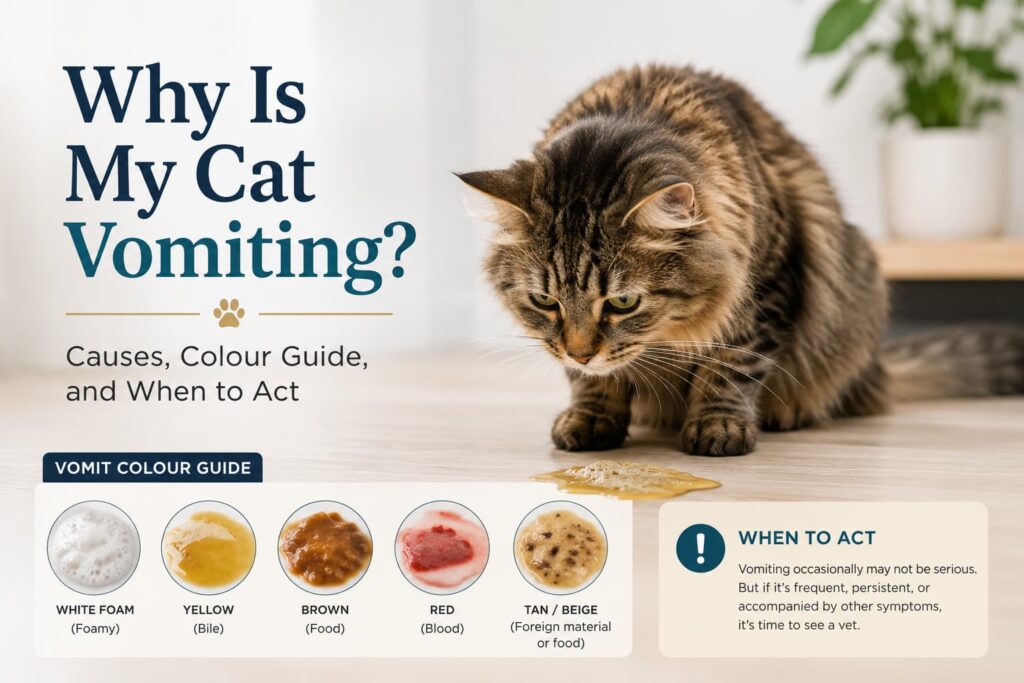
Figuring out why is my cat vomiting is something every cat owner eventually faces — often at 3am on a hard floor. Cats vomit more frequently than most other pets, and for a wider range of reasons: from completely harmless hairballs to serious systemic illness requiring urgent care. The challenge is knowing which situation you are in.
There is a persistent and genuinely dangerous myth in cat ownership that vomiting is normal for cats. WebMD Pets addresses this directly: if your cat is throwing up more than once a week or consistently every few weeks, you should see your vet. Frequent or repeated vomiting is not normal behaviour for your cat, even if it happens regularly and your cat seems otherwise fine.
This guide covers the causes, the colour diagnostic guide, the critical distinction between vomiting and regurgitation, and the distinction between acute and chronic vomiting that determines both urgency and treatment approach.
We also have a complete guide on why is my cat not eating?.
Vomiting vs Regurgitation in Cats — A Critical Distinction
PetMD is precise about this: vomiting is the active motion of ejecting contents from a cat’s stomach and small intestines out through their mouth. Regurgitation is a passive motion where no force is needed to eject contents.
Regurgitation in cats typically occurs soon after eating. The material looks like undigested food or a tubular shape (because it has come from the oesophagus, not the stomach). The cat may barely seem to notice — they often turn around and eat the regurgitated food. Regurgitation is commonly caused by eating too fast or a hairball moving through the oesophagus.
True vomiting involves visible abdominal heaving, nausea signs (drooling, lip-licking, swallowing repeatedly), and material that contains partially digested food, bile, or other stomach contents. It typically happens some time after eating.
This distinction matters because regurgitation from eating too fast is addressed with a slow feeder bowl and smaller more frequent meals. Repeated true vomiting requires veterinary investigation.
What the Vomit Looks Like — The Colour Guide
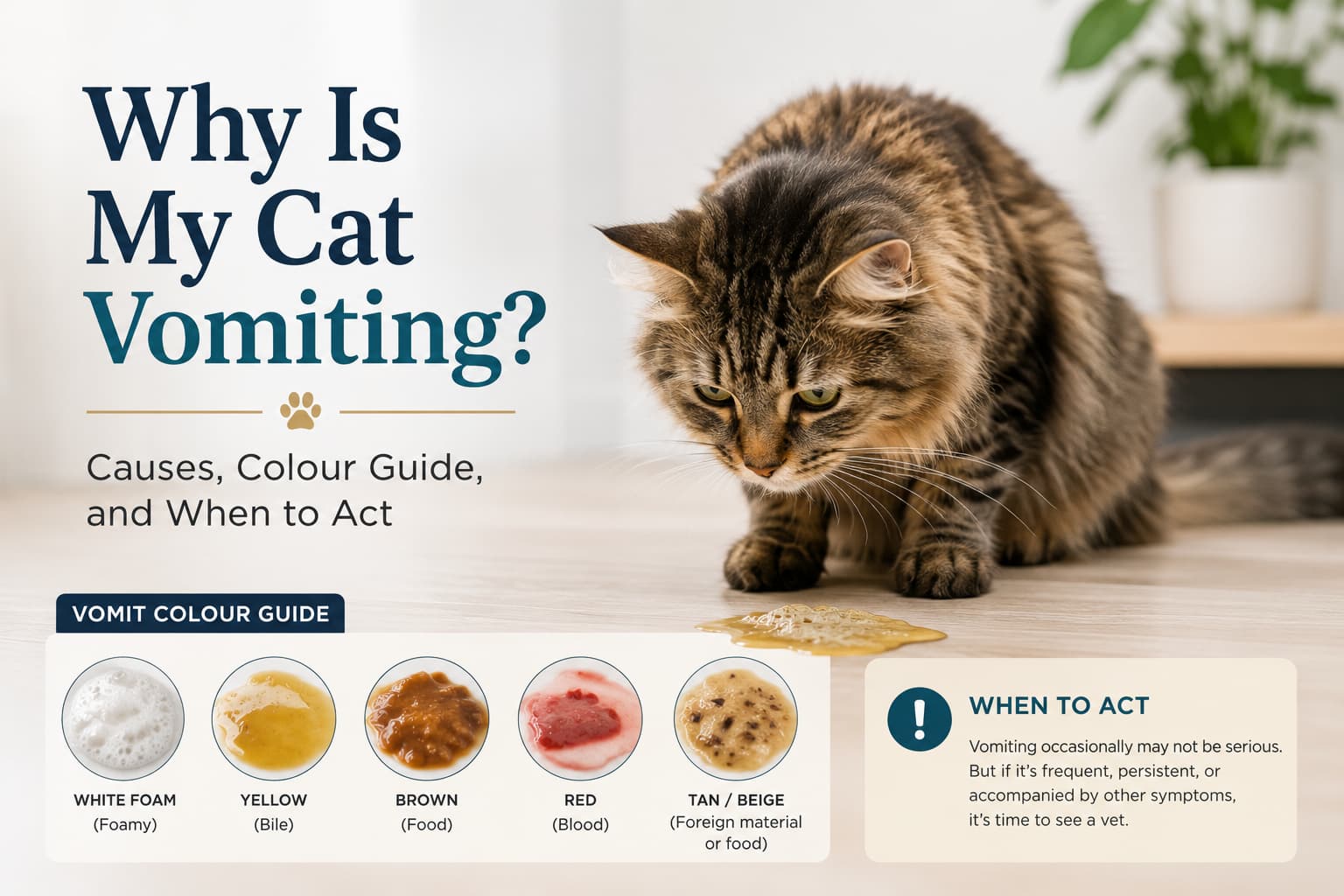
Purina’s veterinary team and PetMD both confirm that cat vomit colour and texture provide diagnostic information. This guide is the practical tool most owners need:
This post is part of our complete pet health library — visit our pet health guide for the full collection.
| Vomit appearance | What it likely means | Action |
| Hairball — cylindrical, dark, hair-containing | Normal hairball; cat’s self-grooming | Regular brushing; hairball remedy if frequent |
| Yellow bile — no food content | Empty stomach; chronic hunger | Feed smaller more frequent meals; vet if persistent |
| White foam | Nausea, stomach acid, or hairball attempt | Monitor; vet if repeated or with other symptoms |
| Undigested food — immediately after eating | Eating too fast or regurgitation | Slow feeder; vet if repeated |
| Partially digested food | Gastric upset, intolerance, or IBD | Vet appointment — especially if recurring |
| Bright red blood | Active bleeding in mouth, throat, or stomach | Vet today |
| Dark or coffee-ground appearance | Digested blood — upper GI bleeding | Emergency vet immediately |
| Green liquid | Bile or plant material — may indicate obstruction | Vet today |
Acute vs Chronic Vomiting — Two Very Different Situations
Best Friends Animal Society makes a distinction that most guides blur: acute vomiting and chronic vomiting require different diagnostic urgency and different responses.
Acute vomiting — sudden onset
A cat who suddenly starts vomiting and has not vomited before, or not recently, has acute vomiting. Best Friends guidance: more urgent care is usually required for a cat with acute vomiting. The exception is a cat who has vomited one to three times and is otherwise completely normal — still eating, still alert, no other symptoms. If this resolves within 24 hours, it is likely benign.
If a cat vomits more than three times, cannot keep food down, and seems tired, they should be seen by a vet as soon as possible.
Chronic vomiting — recurring pattern
A cat vomiting with regularity — at least monthly but potentially daily — for a long period has chronic vomiting. Best Friends notes the cat usually only vomits once or twice with each occurrence. Chronic vomiting sounds less alarming than acute but requires just as much veterinary attention — it typically indicates an underlying condition that will not resolve on its own.
Common causes of chronic vomiting include inflammatory bowel disease (IBD), hyperthyroidism, kidney disease, food intolerance, and intestinal lymphoma. Chronic vomiting treated only with anti-emetics without addressing the underlying cause is one of the most common delays in diagnosing serious illness in cats.
Common Causes: Why Is My Cat Vomiting?
Hairballs — the most common benign cause
Purina describes hairballs as a by-product of a cat’s self-grooming: swallowed hair accumulates in the stomach and eventually comes up. Occasional hairballs — every week or two — are normal for cats, particularly long-haired breeds. The vomit contains a cylindrical, hair-containing mass often covered in yellow or clear liquid.
Frequent hairballs (more than once a week) or a cat that is retching and straining without producing anything warrants a vet visit — the latter can indicate a hairball is lodged rather than passing.
Eating too fast
A cat that gulps food and regurgitates it immediately has eaten too fast — not a medical problem but a behavioural one. Slow feeder bowls, puzzle feeders, and smaller more frequent meals all resolve this. The Livingston Veterinary Hospital blog notes that some cats eat so fast they inhale their food rather than chewing.
Dietary issues and food intolerance
A sudden change in cat food, eating spoiled food, or a food intolerance or allergy can all trigger vomiting. Food intolerance vomiting often involves partially digested food, sometimes with mucus, and may recur specifically in relation to mealtimes. A dietary elimination trial under veterinary guidance is the definitive diagnostic approach.
Gastrointestinal infection and parasites
Bacterial infections, viral illness, and intestinal parasites all cause vomiting, typically alongside diarrhea, weight loss, or lethargy. These require veterinary diagnosis and targeted treatment.
Serious systemic conditions
Gardens Animal Hospital identifies the systemic conditions that cause chronic vomiting in cats: kidney disease, hyperthyroidism, liver disease, diabetes, inflammatory bowel disease, and cancer. Any cat with recurring vomiting alongside weight loss, increased thirst, lethargy, or behavioural change needs a full veterinary workup.
The Hepatic Lipidosis Connection — Vomiting and Food Refusal
This is the cat-specific risk that most vomiting guides miss. If a cat is vomiting and consequently not eating, the hepatic lipidosis (fatty liver disease) risk is real. As covered in the cat not eating guide: cats that stop eating — including because they feel too nauseous to eat — can develop fatty liver disease within 2 to 7 days, particularly in overweight cats.
A cat vomiting repeatedly who also stops eating needs veterinary attention within 24 hours, not because the vomiting alone is necessarily serious, but because the combination of vomiting and food refusal creates a genuinely dangerous metabolic situation.
When to See the Vet — Decision Framework
Monitor at home if: vomited once or twice, is otherwise alert and active, is still eating normally, no blood, no other symptoms.
Call the vet today if: vomited more than 3 times, seems lethargic or unwell, stopped eating alongside vomiting, vomiting has been happening regularly for weeks.
Emergency vet immediately if: blood in vomit (any amount), dark or coffee-ground coloured material, suspected toxic ingestion, complete inability to keep water down, extreme lethargy alongside vomiting, straining to urinate alongside vomiting.
Frequently Asked Questions
| Q: Is it normal for cats to vomit regularly?A: No — despite how common it is in cats, regular vomiting is not normal. WebMD Pets is direct: if your cat is vomiting more than once a week or consistently every few weeks, see your vet. Regular vomiting that owners accept as normal is frequently an undiagnosed chronic condition — IBD, food intolerance, or early kidney disease — that responds well to treatment when caught. |
| Q: My cat vomits a hairball every few days — should I be worried?A: Every few days is more frequent than typical and worth addressing. Increase brushing to reduce ingested hair. Add a hairball remedy or cat grass. Feed a hairball control formula diet. If these do not reduce frequency within a month, see your vet — very frequent hairballs can indicate reduced gut motility rather than simply excess hair. |
| Q: My cat vomits food immediately after eating — is this vomiting or regurgitation?A: Almost certainly regurgitation. Material that comes up immediately and looks like undigested food typically came from the oesophagus rather than the stomach. Try a slow feeder bowl, smaller more frequent meals, and feeding from a slightly elevated surface. If it persists after these adjustments, see your vet to rule out oesophageal dysfunction. |


Frequently Asked Questions: Why Is My Cat Vomiting?
Why is my cat vomiting but acting normal?
When a cat is vomiting but otherwise seems alert, eating, and behaving normally, the cause is usually benign — hairballs, eating too quickly, or mild food sensitivity. Cats are notorious for vomiting after gulping down food, and this is rarely a cause for concern if it happens infrequently. However, if your cat is vomiting more than once or twice a week while still acting normal, a vet check is worthwhile to rule out underlying issues like inflammatory bowel disease or hyperthyroidism.
Why is my cat vomiting white foam?
White foamy vomit in cats is usually stomach acid mixed with mucus — an empty stomach sign similar to the yellow bile seen in dogs. If your cat is vomiting white foam regularly, particularly in the morning or before meals, it may have a condition called gastritis or be going too long between feeds. A late-evening small meal can reduce overnight stomach acid production. If your cat is vomiting white foam alongside lethargy or weight loss, see your vet promptly.
How many times a week is too much for a cat to vomit?
Occasional vomiting — once every week or two — is common and often harmless in cats. But if your cat is vomiting more than once or twice a week, that frequency warrants investigation. Chronic vomiting (recurring over weeks or months) in cats is never truly “normal” and can signal chronic kidney disease, hyperthyroidism, food intolerance, intestinal parasites, or inflammatory bowel disease. A vet visit including bloodwork and possibly an ultrasound will help identify the cause.
When should I take my vomiting cat to the vet immediately?
Seek emergency vet care if your cat is vomiting blood, cannot keep water down, is vomiting continuously for more than an hour, shows signs of abdominal pain, or is unresponsive or weak. A cat that is vomiting repeatedly and also not eating for more than 24 hours is at risk of hepatic lipidosis — a serious liver condition. When in doubt about why your cat is vomiting, it is always better to call your vet for guidance rather than wait.
For more on this, see our guide on best cat food recommended by vets.
| Medical Disclaimer :This article is written for informational purposes based on the research and personal experience of the author. It does not replace professional veterinary advice, diagnosis, or treatment. Always consult your veterinarian with concerns about your pet’s health — especially with YMYL health symptoms described here. |
This article is written for informational purposes and reflects the personal experience and research of the author. It does not replace professional veterinary or dog training advice. Always consult your veterinarian or a certified trainer for individual guidance.