

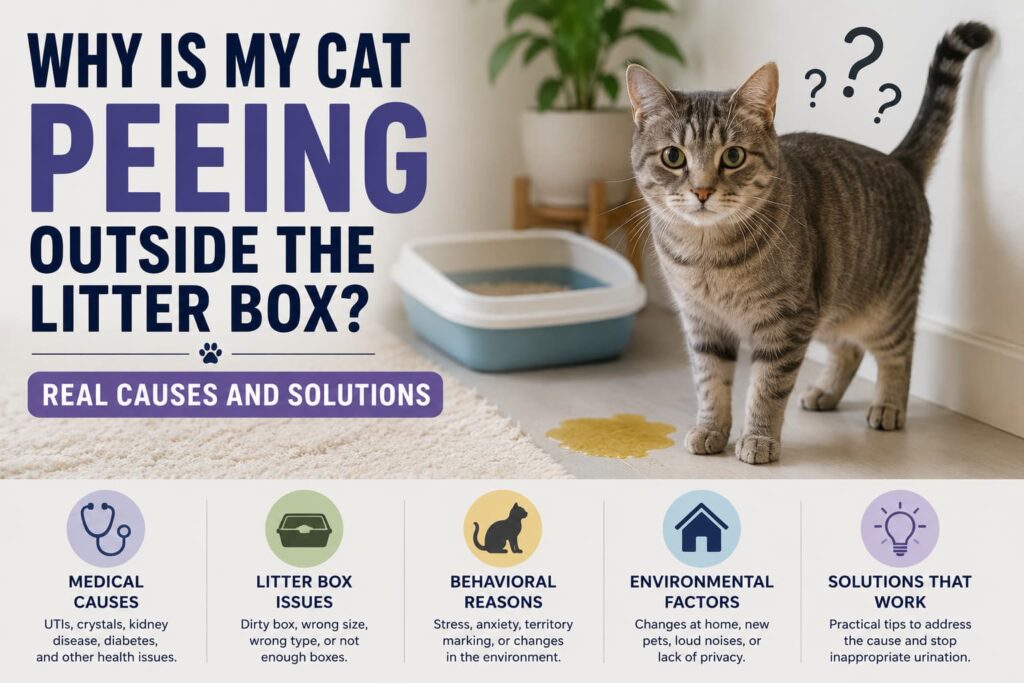
A cat peeing outside the litter box is one of the most distressing things a cat owner can deal with — and one of the most common reasons cats are surrendered to shelters. Catster reports it directly: inappropriate urination is a common reason cats are surrendered, making it vital to figure out what is going on fast.
I went through this with one of my cats two years ago. She had been perfectly litter-trained for four years and then suddenly started avoiding the box entirely, urinating on a specific rug near the bathroom. The vet found feline idiopathic cystitis — a stress-related bladder inflammation with no infection. She was not doing it deliberately or out of spite. She was in genuine discomfort, and the location happened to feel safer to her than a covered litter box she could not see around.
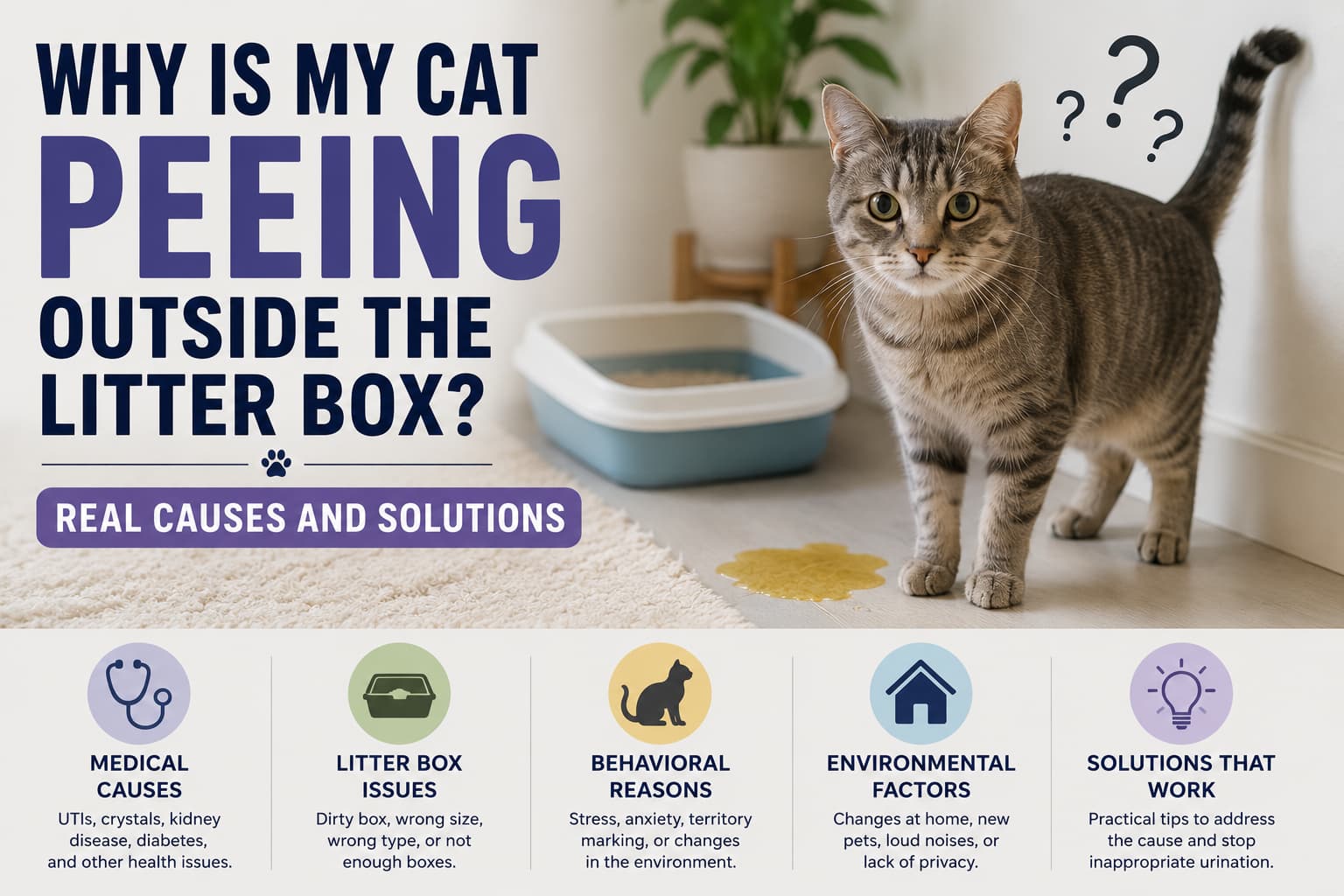
That experience taught me the most important principle in this guide: when a cat stops using their litter box, something is wrong. PetMD veterinarian Dr Lund says exactly this: if your cat is suddenly urinating outside the litter box, consult your veterinarian to rule out medical problems first. Medical causes must be excluded before assuming the issue is behavioural.
If you want to dig deeper, check out our guide on why is my cat not eating?.
We also have a complete guide on best cat food for urinary health.
Rule Out Medical Causes First — Every Time
PetMD lists the medical conditions that commonly cause inappropriate urination in cats:
- Urinary tract infection (UTI)— bacterial infection causing bladder inflammation, urgency, and pain on urination. More common in older females.
- Urinary crystals and bladder stones— PetMD explains that crystals can form from abnormal urine pH, causing microscopic bladder inflammation and urgency. Stones physically irritate the bladder wall.
- Feline idiopathic cystitis (FIC)— discussed in detail below. Stress-induced bladder inflammation with no bacterial infection. Very common, particularly in younger cats.
- Kidney disease— increased urine production from failing kidneys may overwhelm the cat’s ability to reach the box in time.
- Diabetes— similarly causes increased urination volume and frequency.
- Arthritis in older cats— a cat with arthritic joints may find a high-sided litter box too painful to enter. PetMD notes that an older cat with severe arthritis might have trouble getting into a box with high sides.
A vet visit with a urinalysis is the starting point for any cat with sudden onset of inappropriate urination. It costs little and rules out the most important causes before embarking on behavioural solutions.
Feline Idiopathic Cystitis — The Cause Nobody Explains Well Enough
Feline idiopathic cystitis (FIC) is the most commonly diagnosed cause of lower urinary tract signs in cats under 10 years old, according to Gardens Animal Hospital. It is stress-induced inflammation of the bladder with no identifiable bacterial infection. Stress triggers neurological pathways that inflame the bladder lining, making the cat urinate frequently, urgently, and sometimes outside the litter box.
The Expert Cat Care guide explains it plainly: pain relief is required, as is taking care of their general wellbeing, increasing water intake, and addressing litter box problems. FIC is not treated with antibiotics — there is no infection. Treatment focuses on pain management, hydration, stress reduction, and environmental modification.
FIC commonly affects indoor male cats on dry food diets — the reduced water intake concentrates urine, which irritates the bladder further. Stress triggers include moving house, a new pet, changes in routine, building work, and even seasonal changes. Identifying and mitigating the stressor is part of treatment.
This post is part of our complete pet health library — visit our pet health guide for the full collection.
| 🚨 Urinary blockage is different and is an emergency: A male cat that is straining to urinate but producing very little or no urine may have a urethral blockage — different from FIC and life-threatening. Catster is explicit: if your cat is frequently stepping in and out of the box, straining, crying, passing very little or no urine, or has blood in urine, they need to see the vet urgently. A blocked male cat needs emergency care within hours. |
Urine Marking vs Inappropriate Urination — An Important Distinction
Not all cats peeing outside the litter box are eliminating inappropriately. Some are marking — leaving deliberate scent signals. The distinction matters for treatment:
- Inappropriate urination— the cat is trying to urinate normally but avoiding the litter box. Typically squatting position, larger volume. Usually a medical or litter box problem.
- Urine marking— the cat is spraying to communicate territory. Usually vertical surfaces. Standing position, small volume. More common in unneutered cats and multi-cat households with territorial tension.
Catster notes that multi-cat households with territorial clashes can trigger both behaviours. If one cat is monopolising the litter boxes, other cats may mark or avoid the boxes entirely.
Litter Box Problems — Often the Simplest Fix
Before investing in veterinary workups, check the basics. Many cats stop using their box for straightforward reasons:
- Not enough litter boxes— the rule is one per cat plus one extra. A single box for three cats is inadequate.
- Infrequent cleaning— most cats will not use a box that has not been scooped since their last use. Once daily minimum; twice daily is better.
- Wrong litter type— unscented clumping litter is preferred by most cats. Heavily fragranced litters are off-putting to cats despite the human logic behind them.
- Box too small— Expert Cat Care notes that cats commonly outgrow the box they used as kittens. The box should be 1.5 times the length of your cat.
- Wrong location— boxes placed near the food bowl, in high-traffic areas, or in locations where the cat cannot see approaching threats will be avoided. Quiet, low-traffic corners are preferred.
- Box with a lid— some cats dislike covered boxes because they trap odours and limit escape visibility. Try removing the lid.
The Enzyme Cleaner Rule — Often the Reason Problems Persist
This is the most commonly overlooked practical fix. Cat urine contains pheromones that signal ‘this is an appropriate toilet location’ to your cat. Standard cleaning products do not break down these compounds. If you clean a urine-marked area with anything other than an enzyme-based cleaner, your cat can still smell the residue and will continue returning to that spot.
Expert Cat Care makes this explicit: the area where your cat pees must be effectively cleaned with an enzyme solution so your cat cannot detect any urine odour. Products specifically designed for pet urine (containing proteolytic enzymes) are available at pet stores and online. Use them on every area where your cat has urinated inappropriately.
Stress Reduction — For FIC and Behavioural Cases
- Feliway pheromone diffusers— synthetic feline facial pheromones create a calming environment. Particularly useful during environmental changes.
- Predictable routine— feeding, play, and interaction at consistent times reduces ambient anxiety
- Vertical space— cat trees, shelves, and high perches give cats escape options and control over their environment
- Play sessions— daily active play reduces stress and provides important mental stimulation
- Multiple resource points— in multi-cat households, duplicate food bowls, water stations, beds, and litter boxes reduce competition
Frequently Asked Questions
| Q: My cat is peeing on the same spot repeatedly — how do I stop this?A: Two-step approach: clean the area thoroughly with an enzyme cleaner (not standard household cleaner), then make the spot unappealing. Place a food bowl, water bowl, or the cat’s bed on the cleaned spot — cats rarely eliminate where they eat or sleep. Alternatively, move a litter box to that exact location temporarily, then gradually move it once the cat is using it reliably. |
| Q: My cat was perfectly litter-trained and started this suddenly — why?A: Sudden onset almost always has a cause. A vet visit to rule out medical issues is the first step. If health checks out, look for any environmental changes in the two weeks before the behaviour started: new pet, house move, new furniture, change in your schedule, building or renovation work, new household member. Cats are sensitive to changes that seem minor to their owners. |
| Q: Is this fixable or will it continue forever?A: In most cases, yes it is fixable once the cause is identified. Medical causes resolve with treatment. Litter box problems resolve with the right setup. FIC improves with stress management and dietary changes. Behavioural marking responds to environmental modification and sometimes medication. Getting the cause right is the key variable — treating a FIC cat for behavioural issues, or treating a litter box aversion case as a medical issue, produces no results. |

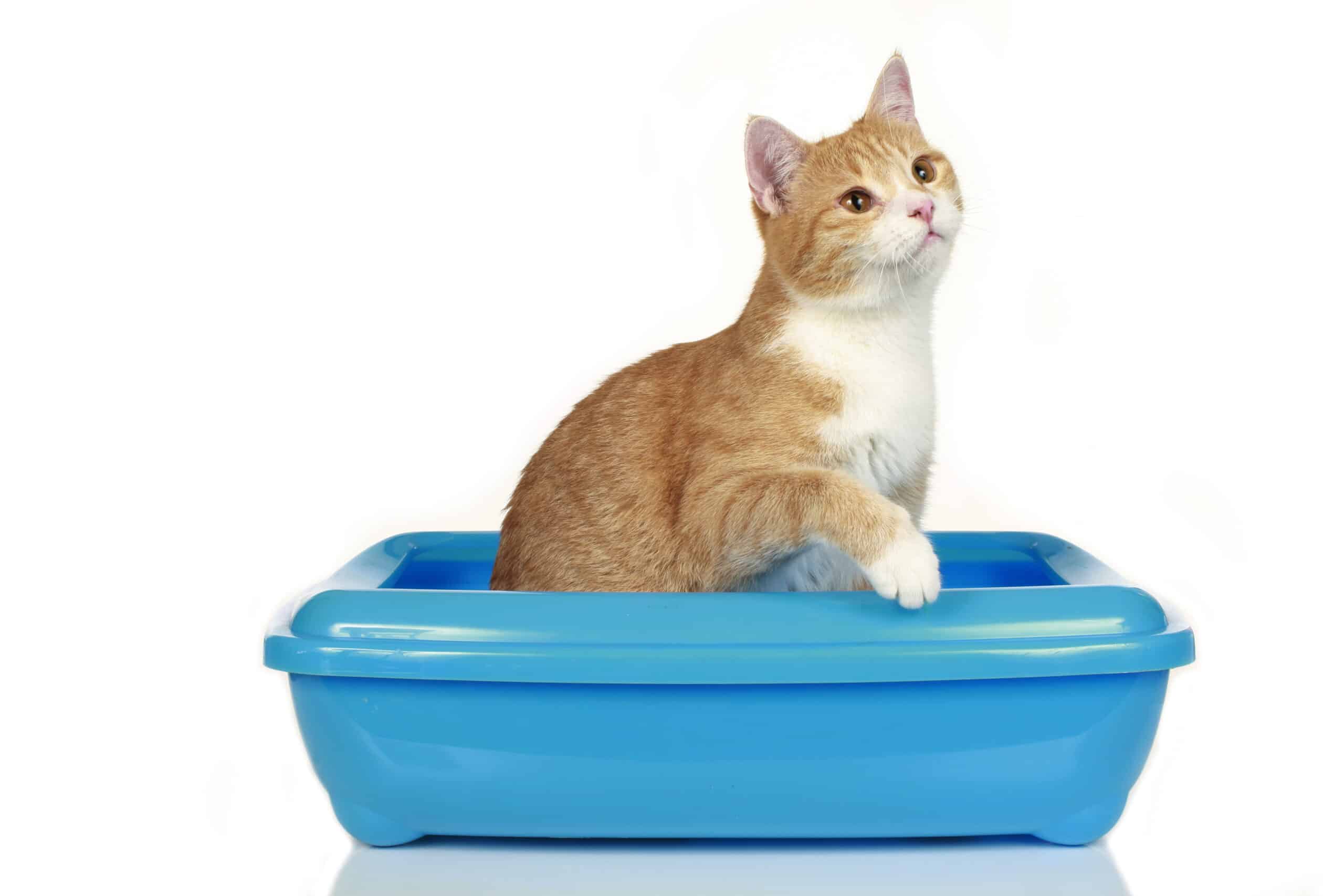
Frequently Asked Questions: Litter Box Problems
How many litter boxes do I need for one cat?
The general rule is one litter box per cat, plus one extra. So for a single cat, two litter boxes are ideal. This gives your cat options and reduces the chance of one litter box becoming too dirty before it’s cleaned. Cats are fastidious and will often avoid a litter box that doesn’t meet their cleanliness standards — providing an additional litter box elsewhere in the home can resolve many litter box avoidance issues without any other changes.
What type of litter box do cats prefer?
Most cats prefer a large, open litter box with unscented, fine-grained clumping litter at a depth of about 5 centimetres. Covered or hooded litter boxes are popular with owners for odour control, but many cats find them confining and avoid them — particularly if the litter box already has a strong smell inside. If your cat is avoiding their litter box, switching to a larger uncovered option with unscented litter is often one of the first adjustments worth trying.
Could a medical issue be causing my cat to avoid the litter box?
Yes — medical causes should always be ruled out first when a cat suddenly stops using the litter box. Urinary tract infections, bladder stones, kidney disease, constipation, and arthritis (which makes getting in and out of the litter box painful) are all common culprits. If your cat is straining in the litter box, crying while urinating, or producing no urine at all — especially a male cat — this is a veterinary emergency that requires immediate attention.
For more on this, see our guide on cat behavior explained.
| Medical Disclaimer :This article is written for informational purposes based on the research and personal experience of the author. It is not a substitute for professional veterinary advice, diagnosis, or treatment. Always consult your veterinarian with concerns about your pet’s health. |
This article is written for informational purposes and reflects the personal experience and research of the author. It does not replace professional veterinary or dog training advice. Always consult your veterinarian or a certified trainer for individual guidance.