


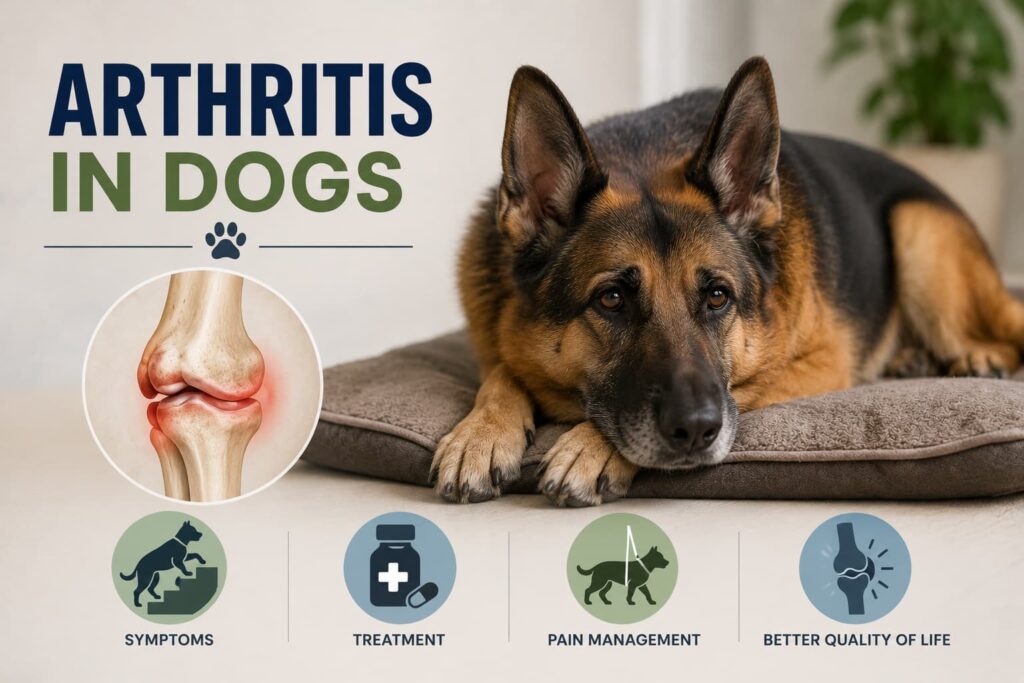
Arthritis in dogs is one of the most common and most underdiagnosed conditions in canine medicine. Estimates suggest it affects approximately 1 in 5 adult dogs, with the number rising to around 80% of dogs over 8 years of age. It is also one of the conditions where owners most commonly accept avoidable suffering as inevitable ageing — because the signs come on gradually and the dog adapts so well that the pain is easy to miss.
I watched this happen with my own Labrador. The slowing down, the reluctance to jump in the car, the stiffness getting up from sleep — I attributed all of it to simply getting older. The vet diagnosed moderate osteoarthritis at his annual check-up and put him on a management plan. Within three weeks of treatment he was moving in a way I had not seen in two years. He had been in pain for far longer than I realised.
The most important thing to understand about arthritis in dogs: there is no cure, and joint damage cannot be reversed. But with the right multimodal management plan, dogs with arthritis can live comfortable, mobile, high-quality lives for years after diagnosis.
You might also find our guide on signs a dog is in pain helpful.
You may also want to read our guide on why is my dog lethargic?.
Recognising Arthritis in Dogs — The Signs Most Owners Miss
AKC Chief Veterinarian Dr Jerry Klein outlines the signs of arthritis in dogs. The obvious ones — limping, difficulty standing — are the late presentation. The early signs are subtler:
- Difficulty or reluctance to get up from lying down — particularly noticeable after rest or in the morning
- Reluctance to jump onto furniture, into the car, or up stairs
- Slowing down on walks — shorter distances, less enthusiasm, sitting down mid-walk
- Stiffness that improves with gentle movement — the dog warms into their walk
- Personality changes — becoming quieter, less playful, more irritable when touched in certain areas
- Licking or chewing at specific joints
- Muscle loss — particularly in the hind quarters, as the dog compensates by shifting weight
This post is part of our complete pet health library — visit our pet health guide for the full collection.
| 💡 The morning stiffness test A dog with arthritis typically shows their worst symptoms first thing in the morning or after prolonged rest. If your dog struggles to get up from sleep but seems to ease into movement after a few minutes, this warm-up pattern is a classic arthritis indicator. Note whether it is improving or worsening over weeks. |
Weight Management — The Most Critical Part of Treatment
Chewy veterinarian Dr Marc Smith, owner of Natchez Trace Veterinary Services, is direct about this: keeping your dog at a healthy weight is the most critical aspect of arthritis treatment. Carrying excess weight strains the joints, accelerates wear and tear, and increases overall body inflammation.
This is not merely supportive advice. Every extra kilogram of body weight places roughly 4 to 5 kilograms of additional force on a dog’s joints during normal movement. A dog that is 2 kilograms overweight is placing approximately 10 extra kilograms of strain on already damaged joint surfaces with every step.
Weight loss in overweight arthritic dogs consistently produces measurable improvements in mobility — often comparable to adding a pain medication to the regime. For overweight arthritic dogs, weight management may be the highest-yield single intervention available.
The Treatment Approach — Why Multimodal Matters
Colorado State University’s veterinary orthopaedic medicine team is clear: treating arthritis in dogs works best with a combination of treatments rather than relying on just one medication. This multimodal approach combines:
1. Pain medications — NSAIDs first line
Non-steroidal anti-inflammatory drugs (NSAIDs) — carprofen, meloxicam, grapiprant — are the most common first-line prescription medications. UrgentVet confirms these work quickly, and most dogs feel better within a few hours. They require baseline blood testing before starting (to check liver and kidney function) and periodic monitoring during long-term use.
The critical warning: ibuprofen and naproxen are toxic to dogs. AKC is explicit: NSAIDs meant for humans are toxic to dogs and should never be given to them for pain relief. Never give human pain medication for arthritis or any other condition.
2. Librela — the 2026 breakthrough worth knowing about
Healthline’s 2026 arthritis review highlights Librela (bedinvetmab) — a monthly monoclonal antibody injection administered by your vet. This represents a genuinely different mechanism of action from NSAIDs: it targets nerve growth factor (NGF), a protein that amplifies pain signals in arthritic joints, rather than simply reducing inflammation. Emergen Research notes that some research shows this can improve quality of life for older dogs with osteoarthritis.
Librela is particularly valuable for dogs who cannot take NSAIDs due to kidney disease, liver disease, or gastrointestinal sensitivity. It is also increasingly used alongside NSAIDs for dogs with moderate to severe arthritis who need additional pain control.
3. Additional pain medications
Gabapentin — for nerve-related pain components. Amantadine — reduces central sensitisation, used when NSAIDs alone are insufficient. These are adjunct medications used alongside rather than instead of NSAIDs for more complex pain presentations.
4. Joint supplements
Glucosamine and chondroitin supplements are widely used and generally considered safe, though the evidence for significant clinical benefit is moderate rather than strong. Omega-3 fatty acids (EPA and DHA from fish oil) have more consistent evidence for reducing joint inflammation. Both are reasonable additions to a comprehensive management plan but are not substitutes for veterinary-prescribed pain medication.
5. Physical therapy and controlled exercise
Regular gentle exercise maintains muscle mass (which supports arthritic joints) and prevents complete inactivity (which worsens stiffness). Hydrotherapy — swimming or underwater treadmill — is excellent for arthritic dogs as it allows movement with dramatically reduced joint load. Physiotherapy and specific exercises recommended by a veterinary physiotherapist can meaningfully improve mobility.
6. Environmental modifications at home


Frequently Asked Questions: Arthritis in Dogs
At what age does arthritis in dogs typically develop?
Arthritis in dogs can develop at any age, but it is most common in middle-aged to senior dogs — typically those aged seven and older. Larger breeds tend to develop arthritis in dogs earlier than smaller breeds, often showing signs from as young as five years old. Dogs with a history of joint injuries, hip dysplasia, or obesity are at higher risk of developing arthritis in dogs at an earlier age. Regular vet check-ups from middle age allow for early detection and management.
Can arthritis in dogs be cured?
Arthritis in dogs cannot be cured, but it can be very effectively managed. The goal of treatment is to reduce pain, slow joint deterioration, and maintain quality of life. A combination of veterinary-prescribed anti-inflammatory medication, joint supplements (particularly glucosamine and omega-3 fatty acids), weight management, and gentle exercise can significantly improve the daily comfort of a dog with arthritis. Many dogs with well-managed arthritis in dogs lead happy, active lives for years.
Is swimming good for dogs with arthritis?
Yes — hydrotherapy and swimming are among the best exercises for dogs with arthritis. Water supports the dog’s body weight, allowing movement without impact on painful joints. Many veterinary physiotherapy centres offer hydrotherapy specifically for managing arthritis in dogs. Even gentle wading in calm, warm water provides therapeutic benefit. Always consult your vet before starting a hydrotherapy programme to ensure the exercise level is appropriate for your dog’s condition.
What home adjustments help dogs with arthritis?
Several simple home modifications can significantly improve comfort for a dog with arthritis. Place orthopedic or memory foam beds in warm, draught-free areas. Use ramps or steps to help your dog access furniture or the car without jumping. Raise food and water bowls to neck height to reduce strain on the neck and shoulders. Non-slip mats on hard floors prevent painful slipping. These adjustments complement medical treatment and help a dog with arthritis in dogs maintain independence and dignity at home.
These small changes make a meaningful difference to daily comfort:
- Orthopedic memory foam bed — reduces pressure point discomfort during the long rest periods dogs need
- Ramps for cars and furniture — eliminates high-impact jumping for dogs who cannot be kept off beds or sofas
- Non-slip flooring — dogs with arthritic limbs struggle to walk on smooth floors; rubber mats in movement areas prevent slipping and the associated muscle strain
- Raised food and water bowls — reduces neck strain for dogs with cervical arthritis
- Warmth — arthritic joints are more painful in cold conditions; a warm sleeping area, a dog coat outdoors in winter
Frequently Asked Questions
| Q: At what age do dogs typically develop arthritis?A: Arthritis can technically develop at any age — large breed puppies can develop developmental orthopaedic disease. But clinically significant osteoarthritis most commonly presents from middle age onward, with prevalence increasing significantly after age 7. The earlier it is identified and managed, the better the long-term outcome. |
| Q: Can arthritis in dogs be prevented?A: The disease process cannot be fully prevented, but its severity and age of onset can be influenced. Maintaining a healthy weight throughout life is the most evidence-based preventive measure. Joint supplements started in predisposed breeds at middle age may slow progression. Avoiding repetitive high-impact activities (like constant jumping) in young large-breed dogs during skeletal development also reduces later joint damage. |
| Q: My dog has been diagnosed with arthritis — how long can they live comfortably?A: With appropriate multimodal management, many dogs with arthritis live comfortable, mobile lives for years after diagnosis. The condition itself is not life-threatening. Quality of life is the key outcome metric — a dog whose pain is well-managed, who maintains a healthy weight, and who gets appropriate daily exercise can have excellent quality of life for their remaining years. |
| Medical Disclaimer :This article is written for informational purposes based on the research and personal experience of the author. It is not a substitute for professional veterinary advice, diagnosis, or treatment. Always consult your veterinarian with concerns about your pet’s health. |
This article is written for informational purposes and reflects the personal experience and research of the author. It does not replace professional veterinary or dog training advice. Always consult your veterinarian or a certified trainer for individual guidance.