

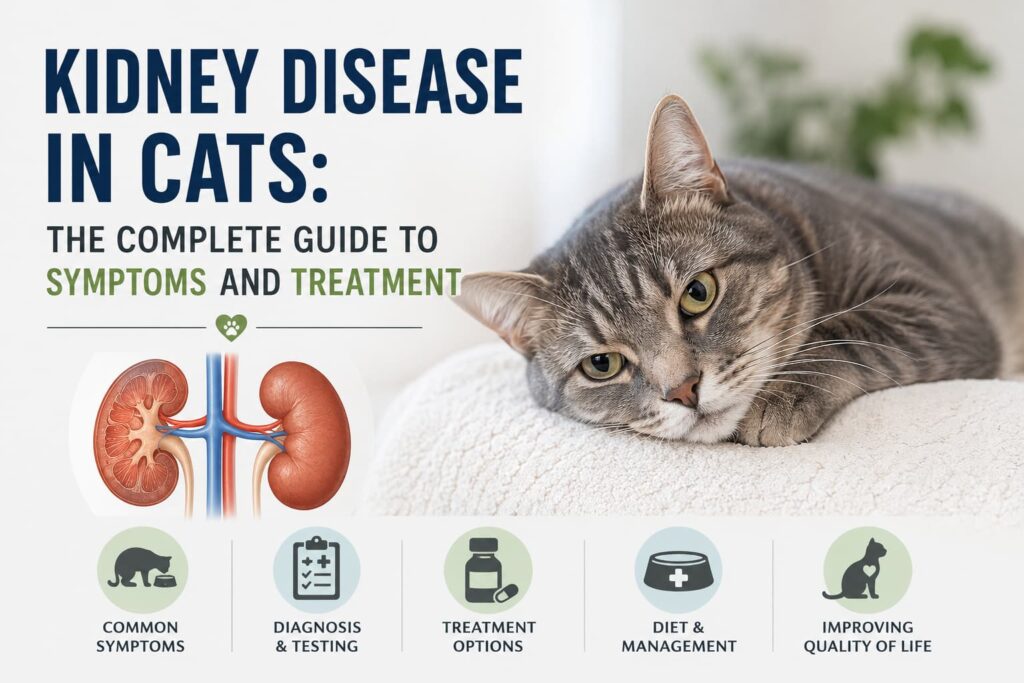
Kidney disease in cats is one of the most important health conditions for any cat owner to understand — particularly once their cat passes the age of ten. Morris Animal Foundation describes it plainly: CKD is one of the most prevalent conditions of aging cats, and one of the most serious. It is also one of the most treatable when caught early, and one of the most difficult when caught late.
I watched my cat go through this. She was diagnosed at Stage 2 during a routine annual check-up — no obvious symptoms, nothing that would have prompted a vet visit on its own. The diagnosis came from a blood test. Two years later, with the right management, she is stable. The reason I am telling you this is that the outcome for a Stage 2 diagnosis is dramatically better than the outcome for a Stage 3 or 4 diagnosis. The difference between those outcomes is often just routine blood testing.
This guide covers what kidney disease actually is, the IRIS staging system that determines treatment, the symptoms that should prompt an urgent vet visit, the treatments that genuinely extend and improve life, and two things most guides miss entirely: the SDMA early detection test and the hypertensive blindness risk.
You may also want to read our guide on why is my cat not eating?.
What Kidney Disease Does to Your Cat
The kidneys are responsible for filtering waste from the bloodstream, regulating fluid balance, maintaining electrolyte levels, producing hormones that stimulate red blood cell production, and controlling blood pressure. Morris Animal Foundation explains the mechanism: as CKD develops gradually, the kidneys lose their ability to concentrate urine effectively, and subtle changes begin to appear.
The critical clinical fact: PetMD notes that clinical signs of chronic kidney disease show up when about two-thirds of normal kidney tissue has been lost. This means a cat can lose half their kidney function with no visible symptoms. By the time obvious signs appear, significant damage has already occurred — which is why early detection through routine blood testing matters so much.
CKD is distinguished from acute kidney injury (AKI), which comes on suddenly and can sometimes be reversed. CKD is gradual, progressive, and irreversible — but its rate of progression can be significantly slowed with the right management.
The IRIS Staging System — Why Your Vet Stages the Disease
Veterinarians use the IRIS (International Renal Interest Society) four-stage staging system to classify CKD severity and guide treatment decisions. Chewy’s veterinary guidance summarises the stages as running from 1 (mild, often no clinical signs) through 4 (severe, significant systemic illness). Each stage has specific treatment targets.
This post is part of our complete pet health library — visit our pet health guide for the full collection.
| Stage | Kidney function | Typical symptoms | Management focus |
| 1 | Mild loss — kidney abnormalities present | Usually none — diagnosis typically on routine blood work | 6-monthly check-ups, begin monitoring |
| 2 | Moderate loss — waste beginning to accumulate | Possible increased thirst, slight weight loss, mild lethargy | Transition to renal diet, phosphorus monitoring, blood pressure check |
| 3 | Significant loss | Vomiting, weight loss, poor coat, reduced appetite, lethargy | Renal diet, phosphorus binders if needed, anti-nausea medication, subcutaneous fluids possibly |
| 4 | Severe — approaching failure | All above plus severe weakness, mouth ulcers, severe anaemia | Intensive supportive care, quality of life management |
The SDMA Test — Early Detection Before Symptoms Appear
GoodRx identifies a key advance in CKD detection that most cat owners have never heard of: the SDMA test. SDMA (symmetric dimethylarginine) is a newer blood biomarker that can detect abnormal kidney function significantly earlier than standard creatinine tests — potentially identifying kidney dysfunction before it progresses to Stage 1 on standard tests.
Standard creatinine-based tests begin showing abnormal results when approximately 75% of kidney function has been lost. SDMA testing can detect dysfunction when as little as 40% of kidney function has been lost. This earlier detection window allows intervention before significant irreversible damage has occurred.
Ask your vet specifically whether SDMA testing is included in your cat’s annual blood panel. Many practices now include it routinely for cats over 7 years old, but not all. For senior cats, an annual blood panel that includes SDMA alongside creatinine, BUN, and phosphorus provides the best possible early detection.
Symptoms — What to Watch For at Each Stage
Early stages (1 and 2) — often nothing visible
The frustrating reality of early CKD: most cats show no obvious symptoms. Some may have slightly increased thirst and slightly more frequent urination. Weight may begin to decline gradually. These changes are easy to attribute to ageing.
Stage 3 — symptoms become apparent
Vomiting (particularly morning nausea from accumulated waste products), reduced appetite, weight loss, poor coat quality, bad breath (sometimes described as ammoniac or fishy), increased thirst and urination, and lethargy. These are the symptoms that most commonly bring cats to the vet for a CKD diagnosis.
Stage 4 — serious systemic illness
All Stage 3 symptoms plus severe weakness, oral ulcers, severe anaemia causing extreme pallor and weakness, and episodes of collapse. GoodRx notes that Stage 4 treatment also includes giving the cat fluids under their skin to maintain hydration — subcutaneous fluids administered at home become part of daily management at this stage.
The Hypertensive Blindness Risk — Critical and Rarely Discussed
This is one of the most serious and least-discussed complications of feline CKD. VCA Animal Hospitals explains the mechanism: kidney disease impairs blood pressure regulation. Approximately 20% of cats with CKD develop hypertension (high blood pressure). In some of these cats, blood pressure can become so high that retinal bleeding or retinal detachment occurs, resulting in sudden blindness.
This sudden blindness can occur rapidly — within hours. A cat with CKD that suddenly seems disoriented, bumps into objects, has dilated pupils that do not respond to light, or appears to have lost visual tracking should be seen by a vet immediately as a suspected hypertensive crisis.
Blood pressure monitoring is now a standard part of CKD management in cats. If your cat has been diagnosed with kidney disease, ask your vet whether blood pressure is being monitored at each visit. Amlodipine is the most commonly prescribed antihypertensive for cats with CKD-related hypertension.
Treatment — What Actually Extends Survival
Dietary management — the cornerstone
Chewy veterinarian Mandi Shearhart DVM confirms that dietary management is the cornerstone of CKD treatment. Prescription kidney diets (Hill’s k/d, Royal Canin Renal Support, Purina NF) are formulated with reduced phosphorus, controlled protein, and enhanced omega-3 fatty acids. VetLens’ 2026 CKD survival guide cites research showing cats that eat prescription kidney food have 30 to 50% slower disease progression.
The practical challenge: many cats with CKD lose their appetite and resist prescription diets. Warming food to body temperature, trying different flavours and textures within the same range, and asking your vet about appetite stimulants are all part of management. Eating any appropriate food is better than refusing the ideal food.
Hydration — subcutaneous fluids
CKD cats lose their ability to concentrate urine and are chronically at risk of dehydration. Wet food provides significant hydration benefit over dry food. For Stage 3 and 4 cats, subcutaneous fluids administered at home — saline solution given under the skin with a needle, typically daily or every other day — is one of the most impactful supportive treatments available and can be learned by most cat owners with veterinary guidance.
Phosphorus management
Phosphorus accumulates in the blood as kidney function declines and directly accelerates kidney damage. Dietary phosphorus restriction through kidney diets is the first intervention. When phosphorus levels remain elevated despite diet change, phosphorus binders (aluminium hydroxide or lanthanum carbonate given with meals) trap phosphorus in the gut before absorption. Target blood phosphorus levels are stage-specific — your vet will advise on the goal for your cat’s current stage.
Anaemia management
Kidneys produce erythropoietin, the hormone that stimulates red blood cell production. As kidney function declines, anaemia develops. Iron supplementation and erythropoiesis-stimulating agents can be used for moderate to severe anaemia. Anaemia significantly contributes to the weakness and lethargy of advanced CKD — treating it measurably improves quality of life.
Frequently Asked Questions
| Q: How long can a cat live with kidney disease?A: It depends heavily on the stage at diagnosis and management quality. VetLens’ survival data indicates Stage 1 to 2 cats often live for years with minimal intervention. Stage 3 cats typically survive 1 to 3 years with good management. Stage 4 cats have a much shorter prognosis measured in weeks to months. These are averages — some Stage 3 cats stabilise for 2 to 3 years with aggressive management. Work with your vet and do not lose hope based on statistics alone. |
| Q: My cat has been diagnosed with CKD — what should I do first?A: Get the IRIS stage clarified, ask about blood pressure measurement, discuss transitioning to a prescription kidney diet, and establish a monitoring schedule (typically every 3 to 6 months for stable cases). Ask about SDMA if not already included in the blood panel. Implement wet food immediately if your cat is currently on dry food only. |
| Q: Can CKD in cats be cured?A: No. Chronic kidney disease involves permanent loss of kidney tissue that cannot regenerate. The goal is slowing progression, managing symptoms, and maintaining quality of life. Acute kidney injury from toxins (such as lily ingestion) can sometimes be reversed with aggressive early treatment — this is different from CKD. |
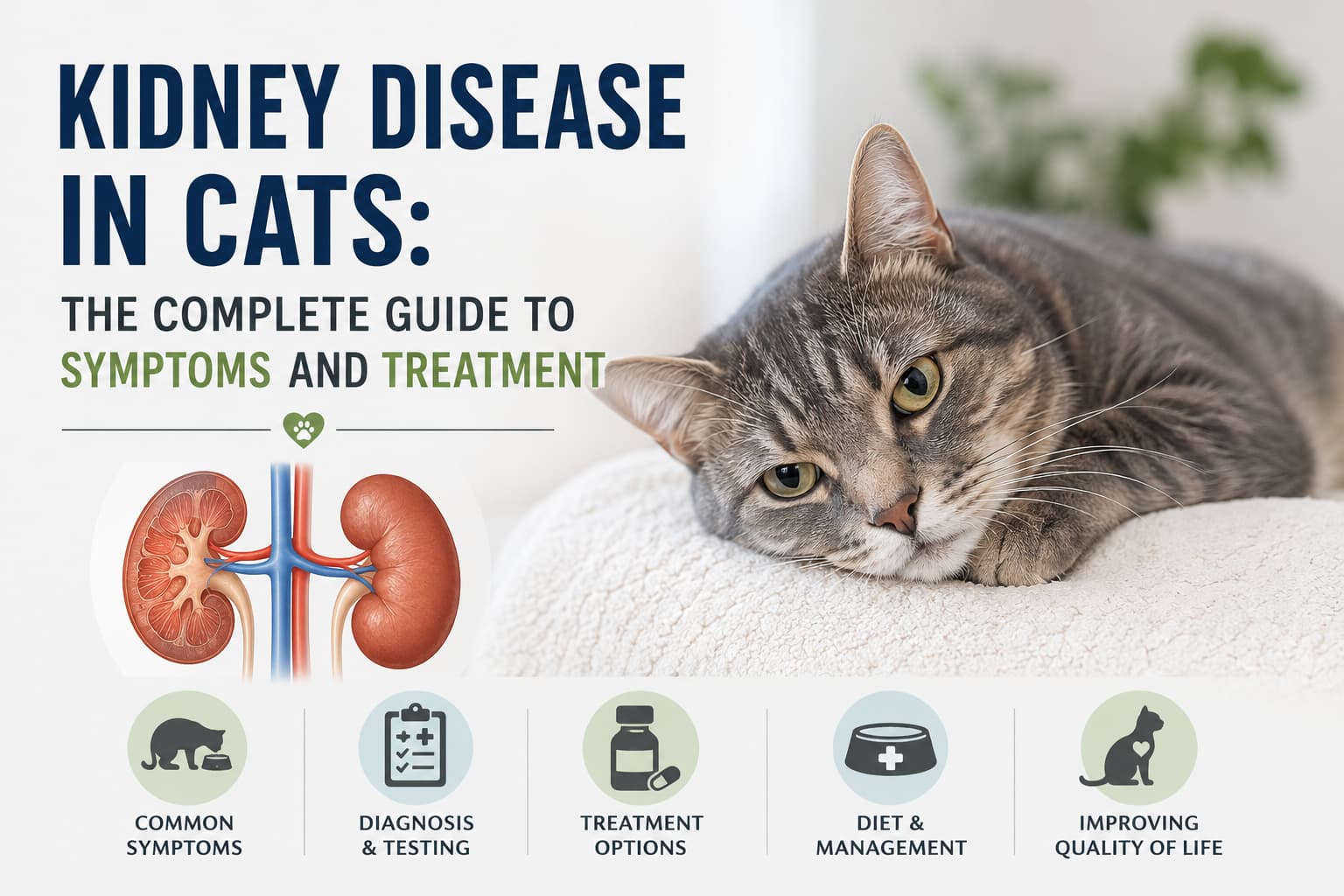

Frequently Asked Questions: Kidney Disease in Cats
How common is kidney disease in cats?
Kidney disease in cats is extremely common — it is estimated to affect around 30 to 40 percent of cats over the age of ten. Chronic kidney disease (CKD) is one of the leading causes of death in older cats, making it one of the most important conditions for cat owners to understand. Early detection through routine blood and urine testing is critical because kidney disease in cats is often silent in its early stages, with symptoms only appearing once significant kidney function has been lost.
What are the early signs of kidney disease in cats?
The earliest signs of kidney disease in cats are subtle and easily mistaken for normal ageing. These include increased thirst and urination, slight weight loss, reduced appetite, and occasional vomiting. As kidney disease in cats progresses, symptoms become more pronounced: significant weight loss, poor coat condition, bad breath with a chemical odour, mouth ulcers, and profound lethargy. Because early signs are easy to miss, cats over seven years old should have annual blood and urine panels to catch kidney disease in cats before it becomes advanced.
What do I feed a cat with kidney disease?
Diet is one of the most powerful tools for managing kidney disease in cats. Vets typically recommend a prescription renal diet that is reduced in phosphorus (which the damaged kidneys struggle to filter), moderately restricted in protein, and high in moisture. Wet food is strongly preferred over dry for cats with kidney disease, as hydration directly supports kidney function. Never restrict protein drastically without vet guidance — adequate protein is still essential, particularly in earlier stages of kidney disease in cats.
Can kidney disease in cats be treated?
Kidney disease in cats cannot be reversed or cured, but it can be managed effectively. Treatment focuses on slowing progression and maintaining quality of life. This includes a kidney-supportive diet, subcutaneous fluid therapy (often administered at home), phosphate binders, blood pressure medication if hypertension is present, and anti-nausea medications. With committed management, many cats with kidney disease in cats live comfortably for years after diagnosis. Regular monitoring through repeat blood tests allows treatment to be adjusted as the disease evolves.
Related: our guide on why is my cat lethargic? covers this in more depth.
| Medical Disclaimer : This article is written for informational purposes based on the research and personal experience of the author. It is not a substitute for professional veterinary advice, diagnosis, or treatment. Always consult your veterinarian with concerns about your pet’s health. |
This article is written for informational purposes and reflects the personal experience and research of the author. It does not replace professional veterinary or dog training advice. Always consult your veterinarian or a certified trainer for individual guidance.