

Published April 2026 | 7 min read
Few sounds in the world are as universally comforting as the purr of a cat. Whether your cat is curled up on your lap or pressed against your side, that low, rhythmic vibration feels like a statement of perfect contentment. But why do cats purr — and is that really what it means?
The science behind purring is far more surprising than most people expect. Cats don’t just purr when they’re happy. They purr when they’re injured, frightened, giving birth, and dying. The mechanism behind the sound is genuinely extraordinary. And emerging research suggests that purring may be one of the most remarkable biological tools in the animal kingdom — with potential healing properties that benefit both cats and the humans they live with.
Here’s everything you need to know.
For more on this, see our guide on why does my cat lick me?.
You might also find our guide on why do cats sleep so much? helpful.
How Do Cats Purr? The Mechanics
Before answering why do cats purr, it helps to understand how — because the mechanism is remarkable.
Purring begins in the brain. A neural oscillator sends rapid, repetitive signals to the muscles of the larynx — the voice box. These signals cause the glottis (the space between the vocal cords) to open and close rapidly as the cat breathes both in and out. This splitting of airflow produces the characteristic continuous vibrating sound we recognise as a purr.
The resulting frequency is between 25 and 150 Hertz (Hz) — a range your ears can hear but that you can also physically feel as a vibration when a cat is pressed against you. The purr happens continuously during both inhalation and exhalation, which is what gives it that uninterrupted, cycling quality.
Interestingly, big cats like lions and tigers cannot purr this way. They have a more flexible hyoid bone that allows them to roar — but prevents continuous purring. Domestic cats have a rigid hyoid apparatus that enables purring throughout their lives but prevents roaring. Cheetahs and pumas, being smaller wild cats, can also purr.
| 🔬 Science note According to the Journal of the Acoustical Society of America, every felid studied — including cheetahs, ocelots, pumas, and domestic cats — produced strong frequencies between 25 and 150 Hz. Domestic cats and servals produced dominant frequencies at exactly 25 Hz and 50 Hz — the two frequencies most effective for promoting bone growth. |
Why Do Cats Purr? The 7 Real Reasons
1. Happiness and Contentment — The Most Common Reason
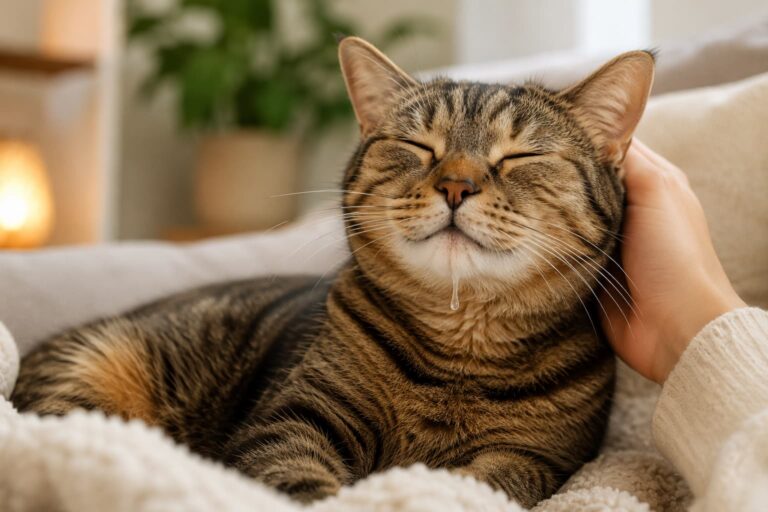
The classic answer to why do cats purr is the correct one most of the time. A cat purring while being stroked, while eating, or while curled up in a warm spot is almost certainly expressing contentment. Purring begins in kittens within days of birth as a way to communicate comfort and satiation to their mother while nursing — and for most cats this association with positive states continues throughout their lives.
If your cat purrs when you pet them, when they settle on your lap, or when you arrive home, they’re telling you they feel safe and happy. This is the purr most owners know best and it’s genuinely what it appears to be.
2. Communication — Especially the Solicitation Purr
Researchers have identified a specific type of purr called the solicitation purr — a clever variation your cat deploys specifically when they want something from you, typically food or attention.
The solicitation purr embeds a high-frequency cry within the normal purr — a frequency that sits close to the range of a human infant’s distress cry. Humans are neurologically primed to respond to infant cries, so this embedded sound makes the solicitation purr feel more urgent and harder to ignore.
Studies show people find the solicitation purr less pleasant than a regular purr but significantly more compelling — they respond to it faster and more reliably. Your cat has essentially evolved a biological hack that exploits your parental instincts. The next time your cat purrs insistently at 6am near their food bowl, this is exactly what’s happening.
3. Self-Soothing During Stress or Pain
This is where the answer to why do cats purr gets genuinely surprising. Cats frequently purr when they are frightened, in pain, giving birth, or severely injured. A cat at the vet, a cat in labour, a cat recovering from surgery — all of them may be purring. And they’re clearly not purring from happiness.
The leading explanation is that purring serves as a self-soothing mechanism — like a human humming quietly when nervous. The vibration of purring triggers the release of endorphins in cats, providing natural pain relief and anxiety reduction. It’s essentially self-administered calm.
This also explains why cats sometimes purr when they are close to death. It’s not a sign they’re comfortable — it’s their body’s way of self-regulating in extreme distress.
| 🐾 Tip for cat ownersIf your cat is purring but also showing signs of discomfort — hiding, not eating, unusual posture, or reluctance to move — don’t assume the purring means they’re fine. A purring cat can absolutely be a cat in pain. Trust the full picture, not just the sound. |
4. Bonding With You
Purring is deeply embedded in the mother-kitten bond. A mother cat purrs almost continuously while nursing her kittens, and the kittens purr back. The vibration helps them locate each other, maintains physical warmth, and reinforces the bond between them.
When your adult cat purrs in your presence — especially when physical contact is involved — they’re drawing on these same early associations. You’ve become the safe, warm, comforting presence that triggers their earliest purring memories. That’s a meaningful thing to be.
5. Healing — The Most Extraordinary Reason
This is the aspect of cat purring that surprises most people and is supported by genuine scientific research.
According to Scientific American, sound frequencies in the 25–150 Hz range have been shown to improve bone density and promote healing of bones, muscles, tendons, and wounds. The domestic cat purrs at precisely these frequencies — and researchers have proposed that this may not be a coincidence.
Cats spend up to 16 hours a day resting and sleeping. Unlike most animals, prolonged inactivity leads to muscle atrophy and reduced bone density. Researchers propose that purring during these extended rest periods may be a low-energy mechanism by which cats stimulate their own musculoskeletal systems — keeping bones dense and muscles healthy without requiring physical activity.
This would explain several curious facts about cats: they rarely develop bone cancer, they have remarkably low rates of joint problems compared to dogs, and they are famous for surviving falls and injuries that would be catastrophic for other animals.
The research even extends to humans. Studies suggest that cat owners have lower rates of cardiovascular disease, lower blood pressure, and reduced stress hormone levels — and some researchers believe the vibration of purring plays a role alongside the general companionship benefits of pet ownership.
| 🔬 The healing frequency in practice Research published in the Journal of the Acoustical Society of America recorded 44 felids and found all produced frequencies at 25 and 50 Hz — the precise frequencies most effective for promoting bone growth and fracture healing. Pulsed electromagnetic field devices that simulate these frequencies are now used in veterinary and human medicine for bone healing and pain relief. |
6. They’re Hungry (The Dinner Purr)
If you’ve ever been woken at an ungodly hour by a cat purring loudly and insistently in your face, you’ve experienced the dinner purr. This is closely related to the solicitation purr described above — cats have learned that purring near their owners prompts feeding, so they use it strategically at mealtimes.
Many cat owners notice their cat’s purring becomes noticeably louder or more urgent around feeding time. If you suspect your cat has learned to use purring as a dinner bell, you’re almost certainly right.
7. They Simply Feel Safe
One of the most beautiful answers to why do cats purr is the simplest: they purr because they feel safe. A cat who purrs when you pick them up, when they settle next to you, or when you quietly sit nearby is communicating that your presence makes them feel secure.
Given that cats are fundamentally prey animals who carry an evolutionary instinct to be on guard, a cat relaxed enough to purr freely is a cat that genuinely trusts you. That’s not a small thing.
Why Do Cats Purr So Loud?
Purring volume varies enormously between individual cats. Some cats produce a barely audible vibration you only notice when touching them. Others sound like a small motorboat. The volume of purring depends on individual anatomy — the size and tension of the laryngeal muscles, the structure of the vocal cords — and it’s not connected to how happy or relaxed the cat is.
Some of the most famously loud-purring breeds include Maine Coons, Ragdolls, and Birmans. If your cat purrs loudly, it simply means they have anatomy that produces more volume — nothing more significant than that.
Do Cats Purr When in Pain?
Yes — and this is important for owners to understand. Cats absolutely purr when in pain, frightened, or severely stressed. The self-soothing function of purring means it can be triggered by negative states just as much as positive ones.
Signs that a purring cat may actually be unwell or in pain include:
- Purring that is constant and doesn’t stop even when they move away from you
- Purring combined with hiding, loss of appetite, or unusual lethargy
- Purring when being handled in a specific area — this can indicate pain in that spot
- Purring during a vet visit — most cats don’t purr at the vet from happiness
- A sudden change in purring patterns — either starting to purr much more or much less
When in doubt, trust your knowledge of your individual cat’s baseline. Any meaningful departure from their normal purring pattern is worth paying attention to.
Which Cats Purr the Most?
While all domestic cats can purr, some breeds are famous for being particularly vocal and enthusiastic purr-ers:
- Maine Coon — one of the loudest purring breeds, known for chirping alongside their purring
- Ragdoll — extremely placid cats that purr readily and often
- Birman — gentle, affectionate cats with a distinctive soft purr
- Burmese — highly social cats who purr almost constantly when with their owners
- Persian — calm cats who purr deeply when comfortable
On the other end, some cats — particularly more independent or anxious cats — purr less frequently. A cat that doesn’t purr much isn’t necessarily unhappy; they may simply express contentment differently.
Frequently Asked Questions
| Q: Why does my cat purr when I pet them?A: Petting triggers purring because it’s pleasurable and creates a sense of safety and bonding. Your cat’s brain associates physical touch from a trusted person with comfort and wellbeing — the same association formed in kittenhood when their mother groomed them. Purring during petting is one of the clearest signals that your cat is happy and trusts you. |
| Q: Why does my kitten purr so much?A: Kittens are the most prolific purrers. Purring begins within days of birth as a way to communicate with their mother, and young cats purr readily in almost any positive situation — feeding, being held, exploring, playing. As cats mature they typically purr a little less reflexively, though many retain their kittenhood purring habits throughout their lives. |
| Q: Why does my cat purr when sleeping?A: Cats can purr during light sleep — this is completely normal. The neural mechanisms behind purring are relatively low-energy and can continue during drowsy or lightly sleeping states. It usually means your cat is deeply relaxed and comfortable in their sleep environment. |
| Q: Can cats purr and meow at the same time?A: Not simultaneously in the traditional sense. Meowing requires a different vocal mechanism that briefly interrupts the purring cycle. However, cats can alternate rapidly between purring and vocalising, which can sound like they’re doing both at once. The solicitation purr does embed a cry-like sound within the purr, but these are produced by different mechanisms working in concert. |
| Q: Is it true that a cat’s purr can heal humans?A: The science is genuinely promising but not yet conclusive. Cat purrs vibrate at 25–150 Hz, which overlaps with frequencies shown in clinical research to promote bone healing, reduce pain, and stimulate tissue repair. Cat owners statistically have lower rates of cardiovascular disease. Whether purring specifically causes these benefits or whether they result from general pet ownership stress reduction is still being studied. The evidence is interesting enough that it shouldn’t be dismissed — but it’s not proven enough to replace medical treatment. |
Final Thoughts
Why do cats purr? The answer is never just one thing. It’s contentment, communication, self-healing, bonding, hunger, and safety — often several of these simultaneously. The purr is one of the most versatile and extraordinary sounds in nature.
What we know for certain is this: when a cat chooses to purr in your presence, they’re telling you something meaningful. They feel safe enough to let their guard down. You’re part of their world. And that low, rumbling vibration — whatever its full scientific story turns out to be — is one of the most genuine expressions of trust in the animal kingdom.
You may also want to read our guide on why does my cat headbutt me?.

Frequently Asked Questions: Why Do Cats Purr?
Why do cats purr when you pet them?
Petting activates your cat’s pleasure response, and purring is one of the clearest signals of enjoyment and contentment. Understanding why do cats purr during affection comes down to association — cats learn from kittenhood that purring while being held or stroked is rewarding, since it encourages their mother (and later their owner) to continue. It’s a form of social bonding reinforced through positive experience.
Do cats purr when they’re in pain?
Yes — this surprises many owners. Why do cats purr when sick or injured? Research suggests that the vibration frequency of a cat’s purr (25–150 Hz) promotes bone density and tissue healing. Cats may purr as a self-soothing mechanism when stressed, anxious, or in pain, not just when happy. If your cat is purring while also hiding, refusing food, or showing signs of distress, a vet visit is warranted.
Why do cats purr at night?
Cats often purr at night when they’re settled beside or near their owner, seeking warmth and closeness. Why do cats purr in the small hours? It’s usually the same comfort-seeking behaviour — they feel safe and content in your presence. Some cats purr to communicate hunger when they’re up early or after waking, especially as part of a morning routine they’ve established with their owner.
Can all cats purr?
Not all cats can purr in the same way. Domestic cats and some small wild cats purr continuously during both inhale and exhale. Big cats like lions and tigers can only purr on the exhale because the anatomy of their larynx differs. Why do cats purr so readily compared to their wild relatives? Domestic cats have evolved much closer bonds with humans, and purring has become a key tool in maintaining that relationship across thousands of years of co-habitation.
Related: our guide on why do cats knead? covers this in more depth.
This post is part of our complete cat behaviour library. For the full guide covering all 18 cat behaviours in one place, visit our complete cat behaviour guide.
| ⚠️ Disclaimer This article is for informational purposes only and does not constitute veterinary advice. If you are concerned about changes in your cat’s purring behaviour or overall health, please consult your veterinarian. |
This article is written for informational purposes and reflects the personal experience and research of the author. It does not replace professional veterinary or dog training advice. Always consult your veterinarian or a certified trainer for individual guidance.