

Published April 2026 | 7 min read
If you’ve ever tried to bathe your cat, you already know the answer feels obvious — they hate it with every fibre of their being. But the question of why do cats hate water is actually more fascinating and nuanced than most people realise.
The short answer is that most cats don’t hate water itself — they hate what water does to them. There’s a crucial difference, and understanding it explains why your cat will happily paw at a dripping tap for twenty minutes but turn into a furry tornado the moment you try to give them a bath.
In this guide we break down the 6 real science-backed reasons why cats hate water, look at which breeds actually love it, and share practical tips for bathing a cat that hates getting wet — without losing a limb in the process.
Related: our guide on why do cats sleep so much? covers this in more depth.
Do All Cats Hate Water? The Truth Might Surprise You
Before diving into why do cats hate water, it’s worth clearing something up: not all cats do. According to veterinary behaviorist Wailani Sung of Joybound People & Pets, generalising that all cats hate water does animals a disservice. Cats are individuals — some genuinely love it.
Many cats are fascinated by running water. They’ll sit at the sink and meow until you turn on the tap, then bat at the stream with their paw. They’ll knock over their water bowl just to watch it spread across the floor. This fascination makes sense — running water looks and sounds like prey, triggering their hunting instinct.
The distinction is between water on their own terms (a dripping tap, a puddle to bat) and water imposed on them (a bath, a rain shower, an accidental fall into the tub). For most cats, it’s the loss of control that’s the real problem — not the water itself.
| 💡 Key insight Most cats don’t hate water — they hate being wet without choosing it. A cat that panics during a bath may happily play with a running tap five minutes later. The difference is control. |
Why Do Cats Hate Water? The 6 Real Reasons
1. Their Ancestors Evolved in the Desert
To understand why do cats hate water, you have to go back 10,000 years. The domestic cat descended from the African wildcat (Felis silvestris lybica), a species that evolved in the arid deserts and dry savannas of the Fertile Crescent — a region stretching from northern Egypt through the Middle East.
In that environment, large bodies of water were rare. The African wildcat had no evolutionary reason to become comfortable in water, unlike dogs whose wolf ancestors frequently crossed rivers and streams. Those desert origins are baked into your cat’s DNA. When they encounter water, their instincts flag it as unfamiliar and potentially dangerous — even though your bathroom is about as far from a desert as you can get.
| 🔬 Science note According to Scientific American, the African wildcat ancestor of domestic cats evolved in dry climates with little exposure to rivers or lakes — meaning water has always been an unfamiliar element for the feline lineage. Domestic cats have changed remarkably little from their wild ancestors despite 10,000 years of living with humans. |
2. Wet Fur Is Genuinely Uncomfortable and Dangerous
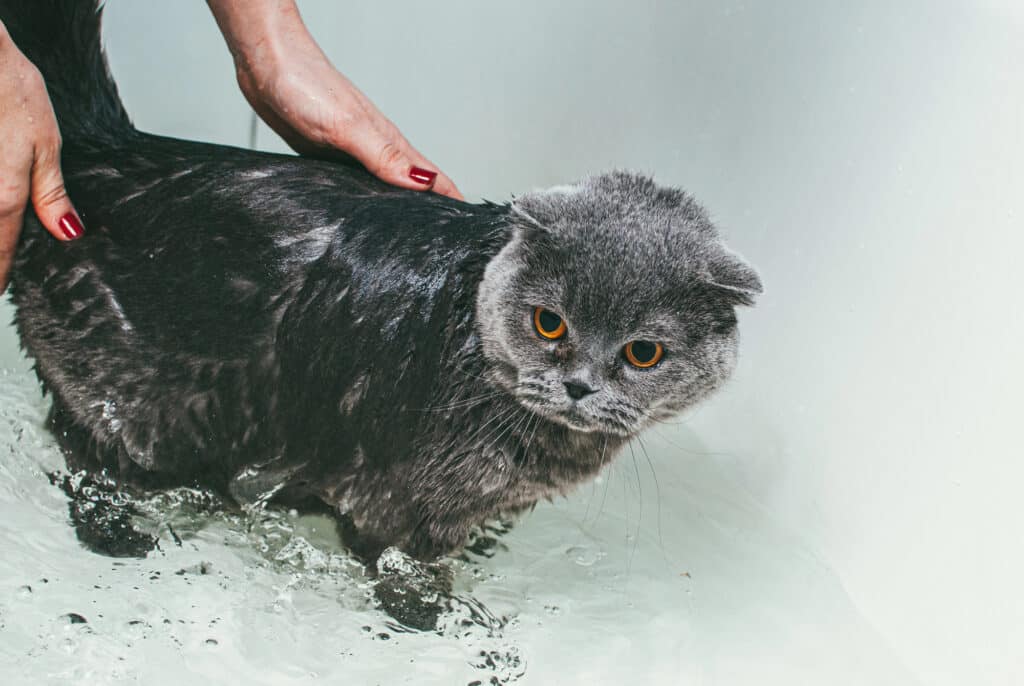
This is perhaps the most practical answer to why do cats hate water. A cat’s coat is extraordinarily well designed for staying dry — but once it gets wet, it becomes a serious problem.
Cat fur absorbs water deeply, becoming waterlogged. This does several unpleasant things simultaneously:
- The fur becomes significantly heavier, making movement awkward and draining energy
- Waterlogged fur loses its insulating properties, leaving the cat vulnerable to cold
- Reduced agility makes a cat feel vulnerable to predators — a powerful instinct even for indoor cats that have never seen a predator in their life
- Drying takes hours, leaving the cat in discomfort long after the bath is over
Jennifer Vonk, an animal cognition expert at Oakland University, describes it well: wet fur makes movement more cumbersome, which leaves cats feeling vulnerable. That vulnerability triggers stress and anxiety — which is why even a small splash can make your cat act as though their life is in danger.
3. Water Disrupts Their Sense Organs
Cats have whisker-like sensory hairs across their entire body called vibrissae that help them navigate and sense the world. According to veterinary behaviorist Wailani Sung, getting these hairs wet may disrupt how cats perceive their environment — essentially blurring their sensory picture of the world around them.
Additionally, cats have an extraordinarily sensitive sense of smell — far more powerful than ours. Tap water treated with chlorine or other chemicals smells strongly and unpleasantly to a cat. Shampoos and soaps add another layer of unfamiliar, overwhelming scent. From your cat’s perspective, a bath involves being assaulted by smell while their sensory hairs stop working properly. It’s genuinely disorienting.
This also explains why cats groom themselves intensely immediately after getting wet. They’re not just drying off — they’re restoring their natural scent and getting their sensory picture back to normal as quickly as possible.
4. It Strips Their Natural Scent
Cats are territorial animals who rely heavily on scent to communicate, feel safe, and identify themselves and their environment. Their natural scent is something they spend a significant portion of every day carefully maintaining through grooming.
Water — especially scented shampoo — washes that natural scent away completely. For a cat, this is genuinely distressing. Their home suddenly smells wrong. They smell wrong. Everything that creates a sense of safety and familiarity has been disrupted in one go. No wonder they want to escape.
This is also one reason veterinarians generally advise against bathing healthy cats. A cat’s natural scent plays an important social role — bathing a cat with a scented shampoo can temporarily confuse other cats in the household, sometimes triggering hissing or avoidance between cats that normally get along perfectly.
5. Loss of Control Triggers Their Survival Instinct
Cats are both predators and prey animals. They carry the evolutionary memory of being hunted, and one of their most powerful survival instincts is to maintain control of their environment and their escape routes at all times.
A bath violates this completely. Your cat is placed in a slippery confined space, held still, doused with water from above, and unable to escape. From their perspective, this ticks every box for a genuinely dangerous situation — even if intellectually (if cats had intellect in that sense) they know you’re not a predator.
Carlo Siracusa, a veterinary behaviorist at the University of Pennsylvania, puts it directly: “Cats in general are averse to new stimuli that they feel they cannot control.” A bath is perhaps the ultimate expression of being unable to control the situation.
| 🐾 Tip Never force a cat into water. This compounds fear and creates a lasting negative association. The goal is always to introduce water gradually and positively, giving the cat as much control as possible at each stage. |
6. Bad Past Experiences Create Lasting Fear
Cats are extremely good at forming and remembering negative associations. A single bad experience with water — accidentally falling into the bathtub, getting caught in rain, being forced into a bath as a kitten — can create a lasting aversion that persists for years.
According to PetMD veterinarian Brittany Klesznyski DVM, if a cat accidentally fell into the bathtub, they may have bad memories related to water and try to avoid it going forward. This isn’t stubbornness — it’s the cat’s memory doing exactly what it evolved to do: keep them away from things that previously caused distress.
This is also why early positive exposure matters so much. Kittens introduced gently and gradually to water before 12 weeks old are far more likely to tolerate or even enjoy water as adults. The window closes quickly, but the results are dramatic for cats that go through it.
If you want to dig deeper, check out our guide on why does my cat follow me everywhere?.
Cat Breeds That Love Water — A Surprising List
If you’re wondering why your neighbour’s cat happily jumps in the shower while yours treats a single water droplet as a personal attack — the answer might be breed. Some cats are genuinely wired to enjoy water:
| Breed | Water attitude | Why |
| Turkish Van | Loves it — nicknamed ‘the swimming cat’ | Evolved near Lake Van in Turkey; ancestors hunted fish |
| Maine Coon | Fascinated by water | Water-resistant coat; often plays in water bowls and sinks |
| Bengal | Enjoys water | Descended from Asian leopard cats that live near water |
| Norwegian Forest Cat | Tolerates it well | Dense water-resistant coat evolved in wet Nordic climates |
| Abyssinian | Curious about water | Playful breed that enjoys splashing and dripping taps |
| Most domestic cats | Strongly dislikes it | Desert-evolved ancestors; no positive water exposure history |
If you have one of these breeds and they seem to love water, lean into it. Provide a shallow water tray to play in, let them join you in the shower, or invest in a pet water fountain — these breeds often drink more when the water moves.
Why Does My Cat Like Running Water but Hate Baths?
This is one of the most common questions cat owners ask, and it perfectly illustrates why the framing of ‘cats hate water’ is too simple.
Running water — a tap, a fountain, a dripping faucet — appeals to cats for two reasons. First, it moves like prey, triggering their hunting instinct. Second, from an evolutionary standpoint, running water signals freshness and safety — still water in the wild is more likely to be contaminated. Cats are drawn to it instinctively.
The difference from a bath is control. At the tap, your cat chooses to engage with the water. They can stop any time. Only their paw gets wet. They’re in charge. In the bath, none of that is true — and that’s the real problem.
| 💧 Affiliate tip for readers If your cat loves running water, a cat water fountain encourages them to drink more — which is important for kidney health, especially in older cats. Look for ones with a quiet motor so the sound doesn’t put them off. |
How to Bathe a Cat That Hates Water — Without the Scratches
Sometimes bathing is unavoidable — your cat got into something, has a skin condition, or simply needs cleaning. Here’s how to make it as stress-free as possible for both of you:
Before the bath
- Trim their nails a day or two before — not on bath day as that adds stress
- Brush out tangles and mats first — wet fur makes them much worse
- Fill the sink or tub before bringing your cat in — the sound of running water is often scarier than the water itself
- Use warm water — cold water is more shocking and distressing
- Have everything ready before you start: shampoo, towels, the works
During the bath
- Place a non-slip mat in the sink or tub — losing footing massively increases panic
- Use a cup or gentle spray to wet the fur — never put their head underwater
- Talk calmly and quietly throughout — your tone of voice genuinely helps
- Keep it as short as possible — efficiency is kindness here
- Use a cat-specific shampoo only — human shampoos disrupt the pH of cat skin
After the bath
- Wrap immediately in a warm towel and gently pat dry — never rub
- Keep them in a warm room until fully dry — wet cats get cold quickly
- Give a high-value treat immediately after — you’re building a positive association for next time
- Let them groom themselves — this restores their scent and helps them calm down
| ✂️ Pro tip — consider waterless shampoo For cats that truly cannot tolerate water, waterless cat shampoo or grooming wipes are an excellent alternative. They clean effectively without any water involved, making them ideal for very anxious cats or spot-cleaning between proper baths. |
Should You Ever Bathe Your Cat?
Most vets say no for most cats. Healthy cats are meticulous self-groomers — their coarse tongues are remarkably effective at keeping their coats clean. Bathing a healthy cat is usually unnecessary and can cause more stress than it’s worth.
Situations where bathing may genuinely be necessary include:
- Your cat has gotten into something toxic, sticky, or difficult to self-groom away
- Your cat has a skin condition or fungal infection that requires medicated shampoo
- Your cat is elderly or obese and cannot reach certain areas to groom
- Your cat is being treated for fleas and requires a flea-treatment bath
- Your vet has specifically recommended bathing as part of a treatment plan
Outside of these situations, a simple wipe-down with a damp cloth or pet grooming wipes achieves most of what bathing does, without the drama.
Frequently Asked Questions
| Q: Why does my cat hate water but loves to watch it? Cats are fascinated by moving water because it resembles prey — the movement, sound, and unpredictability all trigger hunting instincts. Watching it from a safe distance is exciting. Being submerged in it removes all control and overwhelms their senses. It’s the difference between watching a thriller movie and being in one. |
| Q: Is it cruel to bathe a cat? For healthy cats that self-groom effectively, yes — bathing is usually unnecessary and causes real stress. For cats that genuinely need bathing (due to illness, contamination, or inability to self-groom), it’s fine if done gently and infrequently. The key is never forcing it and making the experience as brief and calm as possible. |
| Q: Why does my cat hate water but will sit next to my bath? Your cat is curious about what you’re doing — cats are extremely nosy about their owner’s activities. Sitting next to the bath is safe because they’re in control and not getting wet. Many cats will perch on the edge of a bath watching with great interest, then flee in horror if you splash them. Curiosity and aversion can coexist perfectly happily in a cat. |
| Q: Can I train my cat to like water? You can train kittens to tolerate or even enjoy water through gradual positive exposure from a young age — ideally before 12 weeks. For adult cats that already have a strong aversion, significant improvement is possible but requires patience, consistency, and always going at the cat’s pace. Never force it. Small steps over weeks and months are far more effective than intensive exposure. |
| Q: Why do cats hate water but love fish? Great question. Cats love fish because of the smell and taste — hunting instincts and protein reward — not because of any connection to water. In the wild, some big cats like tigers do fish in water, but the domestic cat’s desert ancestors rarely encountered fish. The love of fish as food and the dislike of water as a medium are completely unrelated in the cat’s mind. |
Final Thoughts
Why do cats hate water? The honest answer is a combination of evolution, biology, sensory disruption, and past experience. Their desert-born ancestors had no reason to become comfortable in water. Their fur becomes heavy and uncomfortable when wet. Their senses are overwhelmed. And they lose the control that cats need to feel safe.
But remember — it’s not all cats, and it’s not really water they hate. It’s the loss of control, the sensory overload, and the vulnerability that getting wet creates. The cat pawing at your tap five minutes after fleeing your bath isn’t confused — they’re perfectly rational. They just prefer water on their own terms.
Respect that, keep baths rare and gentle, invest in a good water fountain if they love running water, and you and your cat will navigate this age-old standoff just fine.
We also have a complete guide on why do cats purr?.
For more on this, see our guide on why does my cat bite me?.
This post is part of our complete cat behaviour library. For the full guide covering all 18 cat behaviours in one place, visit our complete cat behaviour guide.
| ⚠️ Disclaimer This article is for informational purposes only and does not constitute veterinary advice. If your cat requires bathing for medical reasons, please consult your veterinarian for specific guidance. |
This article is written for informational purposes and reflects the personal experience and research of the author. It does not replace professional veterinary or dog training advice. Always consult your veterinarian or a certified trainer for individual guidance.