

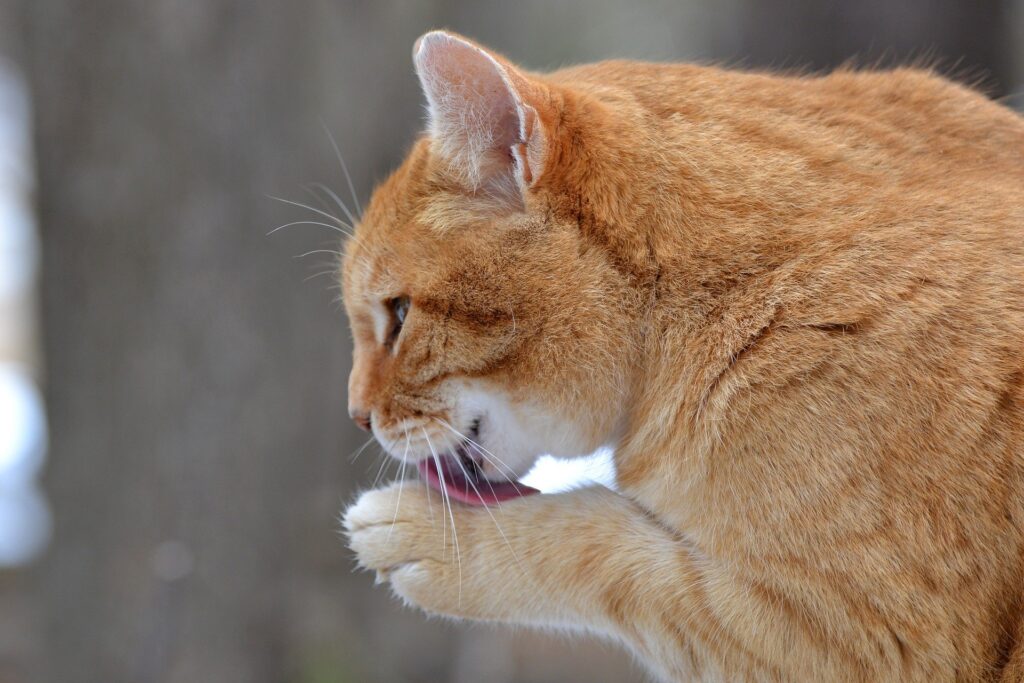
Cat overgrooming happens when your feline friend licks its fur excessively leading to redness of the skin, patchy fur, or sores. It can also lead to a sharp uptick in hairballs, since all that extra licking means more loose fur being swallowed.
Cats are known to be finicky about staying clean, spending almost as much as half of their waking hours removing loose fur, grime, and parasites from their coat.
Signs of overgrooming
- When your pet resorts to more than normal self-cleaning including licking, scratching, biting, and chewing, you may have a case of cat overgrooming on your hands.
- If you notice strips of fur missing, either fully bare or reduced to just stubbles, on the back, stomach, or inner side of legs, your cat may be overgrooming itself.
- Lots of hairballs strewn around corners or under the furniture is also a telltale sign of cat overgrooming.
Cats feel comfortable in the presence of their owners and seldom resort to overgrooming when they are around. The absence of the owner is also a trigger sometimes to start overgrooming as the cat may feel stressed or not so comfortable.
The main triggers of cat overgrooming include:
- Stress – Cats lick themselves excessively when they are stressed. The licking helps to release endorphins that comfort the cat and make it feel good. So when the cat is stressed, it starts grooming to calm down and overcome the stress. Behavioral over-grooming, otherwise known as “psychogenic alopecia,” is a form of stress-relief for many cats.
- Health-related reasons – Skin infections, parasites, allergies, and pain can also trigger overgrooming in cats — and research suggests these are far more common than the stress-only explanation implies.
Why it’s worth ruling out a medical cause first
“Psychogenic alopecia” is a useful label, but veterinary dermatologists caution against reaching for it too quickly. A review of cats referred to veterinary behaviorists for presumed psychogenic alopecia found that roughly 76% actually had an underlying medical cause for their itching, and only about 10% turned out to have psychogenic alopecia with no medical trigger at all (Clinician’s Brief). In practice, that means most “stress licking” is, at least in part, a response to an itch or pain the cat is trying to soothe. The most common medical causes include:
- Allergies – to fleas, food, or environmental allergens like pollen and dust mites. Roughly 15% of itchy cats turn out to be food allergic.
- Parasites – fleas (including flea-allergic reactions to a single bite), mites, and ringworm can all cause intense itching focused on specific areas.
- Pain – cats sometimes overgroom a specific spot because something underneath hurts, most commonly from a urinary tract problem (overgrooming around the belly or genital area) or arthritis in an older cat.
This is exactly why tip #1 below — seeing your vet before assuming it’s “just stress” — matters so much.

Cause of stress in cats
- Cats are easily stressed by changes in their environment or variations in the routines that they are accustomed to.
- Things that can stress out a cat can be as simple as the owner’s absence from the house, the addition of a new baby to the family, or another cat trespassing into its territory.
- The presence of other cats in the home can also be a source of stress. The cat may not show aggression and it may seem as if all is well but the underlying stress can manifest as overgrooming.
- You need to remember that cats are very sensitive to whatever is happening in their environment and if there are loud noises in the house, people arguing and shouting, it can stress out your cat and induce overgrooming.
- Even simple things such as a change in the feeding schedule, location of feeding, the bowl used for feeding, etc can cause stress and so it is important to keep things consistent.
Cats like consistency and stability and whenever introducing a change in your home or lifestyle, be alert to how your cat is responding.
Here are a few tips to control cat overgrooming:
1. Identify the root cause
The starting point for addressing excessive grooming is to identify the cause. It will be good to consult your veterinarian to see if the behavior is triggered by a medical issue or stress.
If the overgrooming is triggered by pain, an infection, or an allergy, your veterinarian will be able to prescribe an appropriate treatment plan. Your veterinarian will also be able to advise on steps that you can take to deter overgrooming induced by stress.
2. Provide a safe haven
You need to provide your cat with a safe area that it can call its own. The cat should be able to retreat and feel protected in this space when there are changes happening in its environment.
Cats like to take up a high vantage point from where they can observe whatever is happening in their environment. You can provide a few options including the top of a shelf, windowsills, boxes, etc. Having a safe haven can help to deter overgrooming, especially when the cat feels stressed by whatever is happening in its environment.
3. Provide opportunities for play
A little more attention from the owner is sometimes all that it takes to get cat overgrooming under control. Encourage play indoors by providing toys that can trigger chasing and pouncing. You can also consider taking your cat outside if he or she enjoys the experience.
You might also like
4. Establish a routine
Cats are happiest when there is a predictable routine and an environment where they feel comfortable.
Little things like changing the litter daily or feeding your cat at a fixed time every day can contribute to your cat’s wellbeing.
Changes to the environment such as the addition of another pet to the household or change in the routine should be rolled out gradually to avoid causing stress to your cat.
5. Keep your cat mentally stimulated
Keep your cat engaged and distracted from excessive grooming by providing a mentally stimulating environment that has perching areas, scratching posts, toys and so on.
6. Patience
Don’t lose your cool even if you happen to catch your cat overgrooming. Shouting or punishing the cat will only add to the stress and worsen the problematic behavior.
It may take a month or more to see a change in the overgrooming behavior after consulting your vet and taking corrective action. It will take longer for the patchy fur to be filled in again.
7. Address separation anxiety
If the stress is caused by the prolonged absence of a family member, the scent of an unwashed garment or a blanket belonging to the person can provide temporary relief to the cat till the person gets back.
8. Use pheromone products
Synthetic pheromone products such as Feliway can help to relieve stress by providing a calming effect. Feliway is a synthetic variant of the pheromone that cats deposit on surfaces or objects by rubbing their cheeks against them. Feliway can be sprayed or rubbed on surfaces to set your cat at ease. The evidence backs this up to a real degree: a placebo-controlled trial found cats exposed to Feliway spray had significantly lower stress scores than those given a placebo (Journal of Feline Medicine and Surgery), though it works best alongside the environmental changes above rather than as a standalone fix.
9. Location of food and water

If there are multiple cats in your home, make sure to put food and water in different locations to avoid stress and bullying by the dominant cat. Your feline friend will appreciate having its food and water at a respectable distance from other cats.
10. Choose a good location for the litter box
Make sure to place the litterbox in a place that the cat can easily access without fear. Placing the litter box next to a home appliance, especially a noisy washing machine or dryer is a bad idea and can be a cause of stress for your cat.
Conclusion
There you go, we have listed above our best 10 tips to handle cat overgrooming. Let us know if there is something different that you have tried to get your cat’s problematic grooming behavior under control.
Frequently Asked Questions
Should I take my cat to the vet for overgrooming?
Yes, especially the first time you notice it. Since the large majority of cats with presumed psychogenic alopecia actually turn out to have a medical cause like allergies, parasites, or pain, a vet visit to rule those out should always come before assuming it’s purely behavioral. See our Pet Health Guide for more on recognizing when a symptom needs professional attention.
Will the bald patches grow back?
Usually, yes, once the underlying cause (medical or stress-related) is addressed. Fur regrowth is typically slower than the licking that caused the hair loss, so expect it to take noticeably longer than the month or so it usually takes to see a behavior change.
Can overgrooming be a sign of something serious?
It can be a visible symptom of conditions ranging from minor (a flea bite) to more serious (chronic pain, hyperthyroidism, or a urinary tract problem). It’s rarely an emergency on its own, but persistent or worsening overgrooming is a good enough reason to get it checked out.
You may also find our posts on how to introduce a kitten to a cat? Tips for a safe start and how to tame a wild kitten? 7 tips every cat lover should know helpful.