

Table of Contents
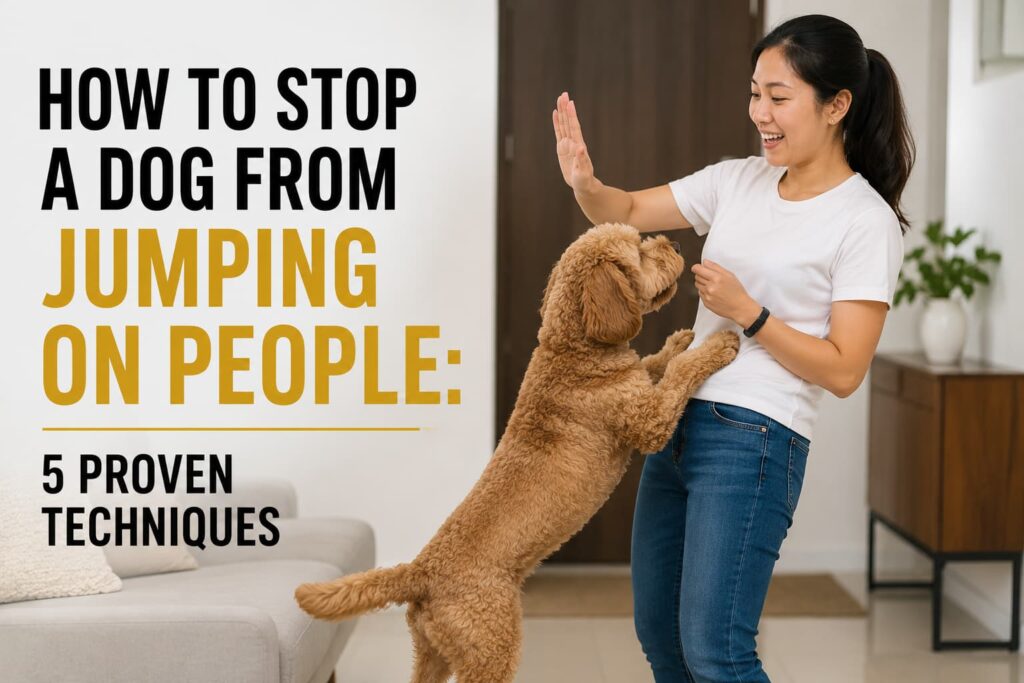
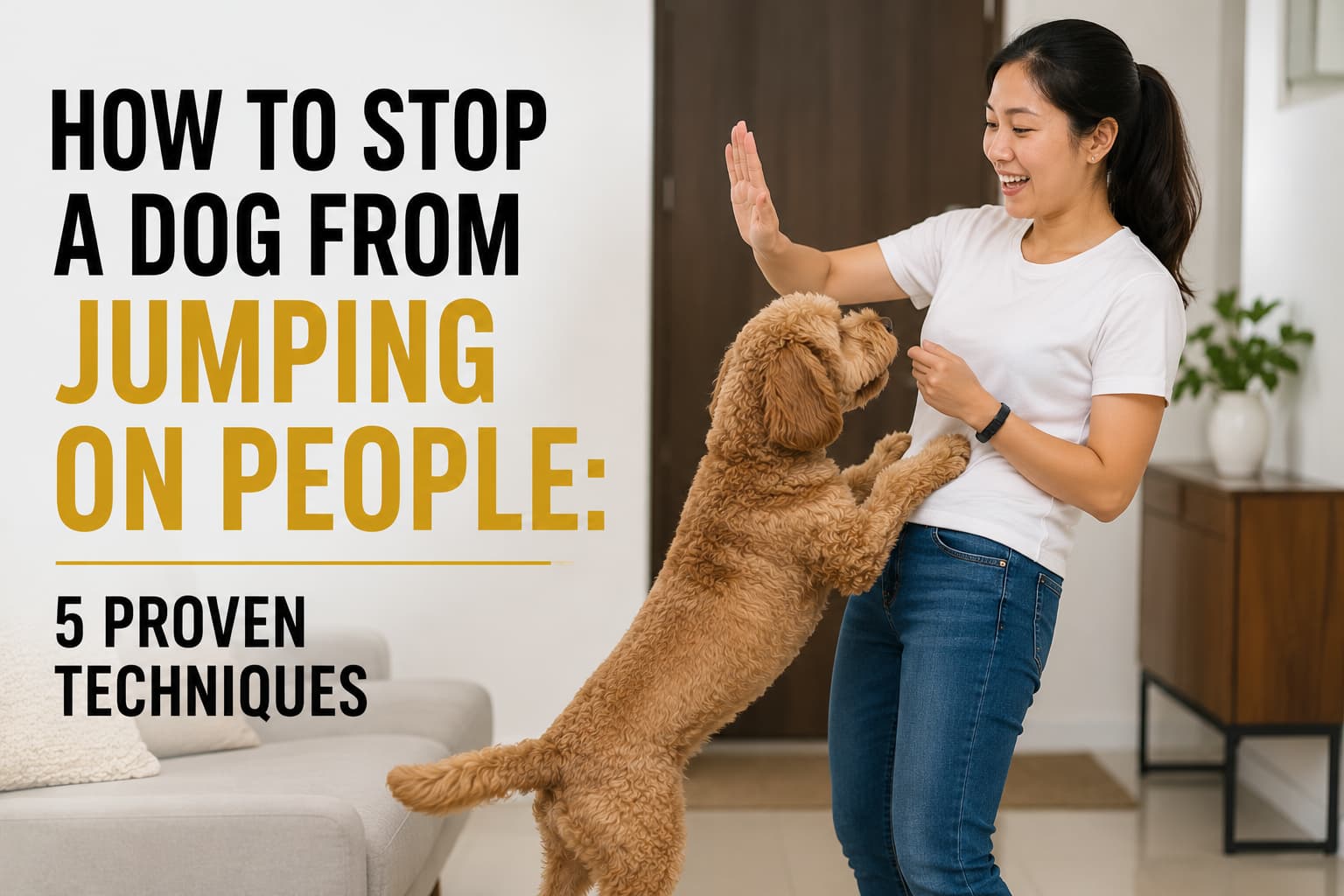
6 min read | If you want to know how to stop a dog from jumping on people, the first thing to understand is why every approach you have probably already tried has not worked. You push them off — still jumping. You say ‘no’ — still jumping. You tell your guests to ignore them — they give in within 30 seconds. I have been there.
Here is the thing nobody tells you clearly enough: jumping is an attention-seeking behaviour, and it works. Every time someone reacts to jumping — even negatively — the dog gets what they wanted. Eye contact is attention. Touching them to push them off is attention. Saying ‘off’ loudly is attention. The behaviour persists because it has never consistently failed to produce a result.
PetMD is correct that jumping is usually friendly, not aggressive — your dog is excited to see people and this is how they greet. That does not mean it is acceptable, especially for larger breeds. It does mean that punishment is the wrong approach, because you are punishing enthusiasm and trust rather than teaching an alternative. The five techniques below teach your dog what to do instead.
For more on this, see our guide on how to teach a dog to sit.
You might also find our guide on how to get your dog to listen helpful.
5 Techniques: How to Stop a Dog from Jumping on People
1. Complete withdrawal of all attention
This is the foundation. The moment your dog’s paws leave the floor and make contact with anyone, all attention stops:
- Turn your back immediately — no eye contact, no talking, no touching
- Cross your arms so there are no hands available
- If they come around to the front to jump again — turn away again
- The instant four paws are on the floor — turn back, acknowledge calmly
- If they jump again immediately — turn away again
The AKC guidance on this is worth emphasising: once your dog understands that four paws on the floor earns attention and jumping earns nothing, the behaviour changes. The process is not fast — expect 2 to 4 weeks of consistent application. But it is effective. The caveat is the word consistent. One family member breaking the rule teaches your dog that jumping sometimes works. And intermittent reinforcement makes a behaviour more persistent, not less.
2. Teach sit for greetings
The most reliable long-term solution for how to stop a dog from jumping on people is teaching an incompatible behaviour — a sit. A dog cannot jump and sit simultaneously. Best Friends Animal Society confirms that dogs can absolutely learn to sit for every greeting, even when genuinely excited.
- Train a reliable sit in low-distraction environments first
- Tether your dog’s leash to a door handle or furniture piece
- From several feet away, ask for a sit. When they sit, approach calmly
- If they stand up before you reach them — turn and walk back to your starting point
- If they hold the sit until you arrive — calmly greet and reward
- Repeat with family members, then friends, then strangers
Once this is reliable, your dog begins to offer a sit automatically when someone approaches — because that has consistently earned the greeting they wanted. It becomes their default greeting behaviour.
3. Brief your visitors — this is not optional
Half of how to stop a dog from jumping on people is training your dog. The other half is managing the humans who interact with your dog. This is often harder. Visitors who find jumping cute and respond with laughter and pets are not just failing to help — they are actively undoing your training.
Be direct with guests before your dog approaches them: ‘We are training our dog not to jump. Please ignore any jumping completely — no eye contact, no talking, no touching — until all four paws are on the floor. Then you can greet them.’ Give guests a treat to reward the dog for keeping four paws down. Make it easy for people to participate in your training.
4. Exercise before high-excitement situations
A tired dog is a calmer dog. The jumping at guest arrivals is partly arousal — your dog is excited and has energy to burn. A vigorous walk or play session before guests arrive reduces that arousal level significantly. It does not replace training, but it makes the other techniques much more effective and gives everyone a more pleasant experience.
5. Manage during the training period
Until the training is solid, prevent the behaviour from being practised:
- Leash your dog when guests arrive — gives you control during greetings
- Baby gate at the entrance — your dog can see and smell guests but cannot jump
- Separate room until they are calm — then introduce in a controlled way
- Keep a toy at the front door — redirect excitement onto an appropriate object at the moment of maximum arousal
What Consistently Makes This Worse
A few specific things to avoid, because they come up repeatedly and genuinely set progress back:
- Kneeing the dog in the chest — still physical contact, often registers as rough play
- Grabbing front paws and holding them — interaction, attention, often reinforcing
- Shouting ‘off’ or ‘no’ while touching the dog — the touch is still contact
- Allowing jumping from some people — the dog cannot distinguish the rules by person and learns that jumping sometimes works
The most common reason this training fails is inconsistency. Not technique — consistency. If the approach is applied by everyone your dog interacts with, results come reliably.
Frequently Asked Questions
| Q: My dog only jumps on some people — why?A: Your dog has learned that specific people reward the jumping. Different handlers produce different outcomes, and dogs adapt their behaviour accordingly. Get every person using the same response and the situation changes. There is no shortcut around the consistency requirement. |
| Q: How long does it take to stop a dog jumping?A: With complete consistency from everyone the dog interacts with, most dogs show significant improvement within 2 to 4 weeks. A sit-for-greetings that works reliably with visitors takes 4 to 8 weeks of regular practice. The timeline is almost entirely determined by how consistent the humans are, not by how trainable the dog is. |
| Q: My small dog jumps and nobody minds — do I still need to address it?A: Worth addressing even if no one complains now. Small dogs jumping can startle people, scratch skin, knock over children or elderly visitors, and the habit becomes harder to break as it becomes more established. More importantly, a small dog who jumps becomes a problem visitor in dog-friendly environments where not everyone appreciates it. |

Frequently Asked Questions: How to Stop a Dog from Jumping on People
Why does my dog jump on people in the first place?
Dogs jump on people to greet them — it’s how puppies greet their mother and each other face-to-face. The behaviour gets reinforced when owners or visitors respond with attention, even negative attention like pushing the dog away. Knowing how to stop a dog from jumping on people starts with understanding that any attention — including saying “no” or pushing — can inadvertently reward the behaviour.
What’s the fastest method to stop jumping?
Turn away completely the instant your dog jumps. No eye contact, no touch, no words — simply become boring. The moment all four paws hit the floor, reward immediately with calm praise and a treat. This approach — extinction of the jumping followed by reinforcement of the alternative — is the most evidence-based answer to how to stop a dog from jumping on people. Consistency across everyone the dog meets is essential.
How do I teach visitors to help with the training?
Brief your guests before they enter. Ask them to turn away and ignore your dog if it jumps, then reward when the dog is calm. Most people mean well but instinctively pet an excited dog — which undermines all your work. Knowing how to stop a dog from jumping on people is a whole-household effort: the training breaks down when even one person rewards the jumping. A simple sign on your door can prompt guests to follow the protocol.
How long does it take to train a dog to stop jumping?
With consistent training, most dogs show significant improvement within two to four weeks. However, the behaviour may resurface in high-excitement situations — when a favourite person arrives, or in a stimulating outdoor setting. The goal of how to stop a dog from jumping on people isn’t a single training event but a long-term habit reinforced through regular practice across different environments and with different people.
You may also want to read our guide on how to teach a dog to stay.
For the complete overview of dog training, see our complete dog training guide.
| ⚠️ Disclaimer This article – How to Stop a Dog from Jumping on People: 5 Proven Techniquesis – is written for informational purposes and reflects the personal experience and research of the author. It does not replace professional veterinary or dog training advice. For severe behavioural issues, please consult a certified professional dog trainer (CPDT-KSA) or veterinary behaviourist. |
This article is written for informational purposes and reflects the personal experience and research of the author. It does not replace professional veterinary or dog training advice. Always consult your veterinarian or a certified trainer for individual guidance.