


Table of Contents
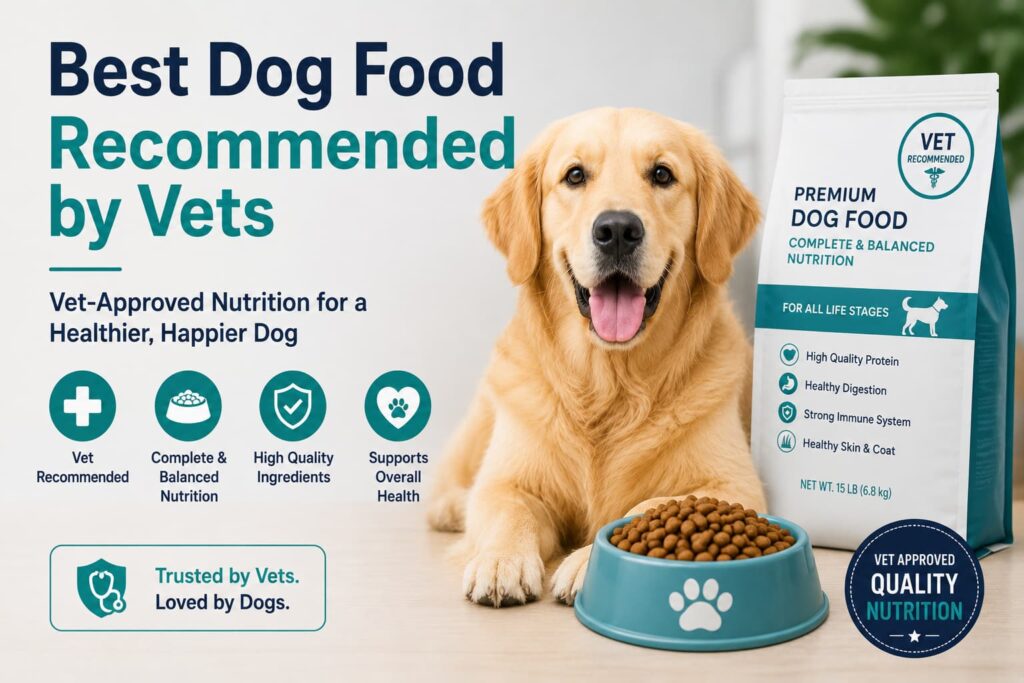
The question of best dog food recommended by vets is one I hear from dog owners constantly — and one where the internet makes the decision significantly harder than it needs to be. Every brand claims to be natural, premium, and nutritionally complete. Celebrity-endorsed raw diets sit next to grain-free formulas with alarming warnings attached. It is genuinely hard to know what to trust.
What I have learned from years of reading veterinary nutrition research and talking to vets: the brands that consistently come up in vet recommendations are not the most expensive brands or the most heavily marketed brands. They are the brands that do the science. That distinction matters enormously.
This guide explains why specific brands get recommended by vets, what the credential markers actually mean (AAFCO, WSAVA, feeding trials), how to read a dog food label to evaluate any product independently, and the top vet-recommended picks by life stage and need.
We also have a complete guide on best dog food for senior dogs with kidney disease.
For more on this, see our guide on why is my dog not eating?.
Why Vets Recommend the Brands They Do — The Real Reason
This is the section missing from every best dog food list online. Understanding the answer changes how you evaluate any dog food for the rest of your life.
When veterinarians recommend Hill’s Science Diet, Purina Pro Plan, and Royal Canin more often than other brands, it is not because of any financial relationship with these companies (the suggestion of this is often made online — it reflects a fundamental misunderstanding of how veterinary nutrition works). It is because these brands consistently meet specific criteria that indicate nutritional quality and safety:
1. AAFCO feeding trials — not just formulation analysis
AAFCO (Association of American Feed Control Officials) sets the nutritional standards that US dog food must meet. There are two ways a company can claim AAFCO compliance: formulation analysis (calculating on paper that the food meets requirements) and feeding trials (actually feeding the food to dogs and measuring health outcomes).
Feeding trials are more expensive and time-consuming. They are also more meaningful. A food that passes feeding trials has been proven to maintain health in dogs who ate it — not just calculated to contain the right numbers on paper. Purina Pro Plan, Hill’s Science Diet, and Royal Canin all conduct feeding trials. Many trendy brands do not.
2. Board-certified veterinary nutritionists on staff
Chewy veterinarian Veronica Higgs DVM notes that reading a pet food label can be very confusing — but the brands that consistently employ board-certified veterinary nutritionists (DACVN — Diplomates of the American College of Veterinary Nutrition) to formulate their diets are producing food with a level of nutritional expertise that goes well beyond the minimum required.
3. WSAVA guidelines compliance
The World Small Animal Veterinary Association (WSAVA) has published Global Nutrition Guidelines that provide a framework for evaluating pet food manufacturers. Freshfoodpet recommends ensuring the brand follows WSAVA guidelines, which check if the company actually tests their food.
The WSAVA recommends asking pet food manufacturers: Do you employ a full-time board-certified veterinary nutritionist? Do you conduct feeding trials? Is your food manufactured in-house or contracted out? Brands willing to answer these questions transparently are the ones worth trusting.
The Top Vet-Recommended Dog Food Brands in 2026
Hill’s Science Diet — the overall veterinary favourite
Chewy veterinarian Tara Hansen DVM describes it simply: for value and quality, this is an excellent choice for overall dog food. Hill’s employs hundreds of food scientists and veterinarians, conducts rigorous feeding trials, and has been in the veterinary nutrition field for decades. Their adult chicken and barley formula is the top overall pick from multiple veterinary expert panels reviewed in 2026.
Hill’s also produces Prescription Diet lines for specific health conditions — kidney disease, weight management, urinary health, gastrointestinal conditions — which are the products vets reach for when a dog has a specific medical need. These require veterinary prescription and are formulated to therapeutic standards beyond regular dog food.
Purina Pro Plan — the science-backed mainstream choice
PetMD veterinary experts’ overall pick for best dry dog food is Purina Pro Plan Complete Essentials. Purina is the largest pet food company in the world with the most extensive research infrastructure in pet nutrition. Pro Plan is the brand they direct their research investment toward — it contains live probiotics, is formulated by veterinary nutritionists, and undergoes rigorous feeding trials.
The salmon and rice formula is particularly popular for dogs with sensitive stomachs. The sport formula is used by many working dog handlers and competitive sport dog owners for its higher protein and fat content.
Royal Canin — breed and size specific precision
Royal Canin’s approach is distinctive: they produce diets tailored to specific breeds, sizes, and life stages with remarkable precision. A Great Dane puppy and a Chihuahua puppy have genuinely different nutritional requirements — calcium and phosphorus ratios for bone development, kibble size for jaw anatomy, caloric density for growth rates. Royal Canin’s breed-specific lines address these differences more precisely than any other mainstream brand.
It is more expensive than Hill’s or Purina, which is a legitimate consideration. For dogs without special needs, the mainstream Hill’s or Purina formulas provide equivalent quality at lower cost.
Fresh food brands — the premium tier
Healthline’s medical review describes Farmer’s Dog as high-quality fresh dog food with human-grade ingredients and recipes developed by vet nutritionists. Other fresh brands meeting similar standards include JustFoodForDogs and Freshpet. These are minimally processed, highly digestible, and formulated to AAFCO standards.
The legitimate downside is cost — fresh food is significantly more expensive than kibble, particularly for large breeds. For owners with the budget and preference, it is a nutritionally sound choice. For the majority of dog owners, a quality kibble from the brands above provides equivalent nutrition at a fraction of the price.
How to Read a Dog Food Label — Evaluate Any Product Yourself
These are the criteria Freshfoodpet and WSAVA guidelines recommend applying to any dog food you are evaluating:
Check the first three ingredients
The first ingredient listed is the most abundant by weight. Look for a named animal protein — chicken, beef, salmon, lamb — as the first ingredient. Avoid foods where the first ingredient is a grain or where the protein is described vaguely as ‘meat’ or ‘poultry’ without specifying the source.
Verify AAFCO compliance and look for feeding trials
Every dog food package must state how it meets AAFCO requirements. Look for ‘Animal feeding tests using AAFCO procedures’ — this indicates feeding trials were conducted. A statement that the product is formulated to meet AAFCO standards indicates calculation-based compliance only, which is less meaningful.
Look for an NASC or veterinary nutritionist statement
Brands that have a board-certified veterinary nutritionist on staff, or that are members of veterinary nutrition organisations, will typically mention this on their website or packaging. It is a positive signal.
Avoid red flag marketing language
Several phrases in dog food marketing are more about sales than nutrition: ‘grain-free’ has no proven health benefit and has been associated with an investigation into dilated cardiomyopathy. ‘Human-grade’ has a specific legal meaning but does not automatically indicate better nutrition. ‘Natural’ is a marketing term with no regulatory definition. ‘Premium’ means nothing nutritionally.
Vet-Recommended Picks by Life Stage and Need
Best for adult dogs — general
Hill’s Science Diet Adult Chicken and Barley, Purina Pro Plan Complete Essentials Adult, or Royal Canin Size specific line for your dog’s weight. These three cover the vast majority of healthy adult dogs with no special health needs.
Best for puppies
Purina Pro Plan Development Puppy, Hill’s Science Diet Puppy, and Royal Canin Puppy are the most frequently recommended by vets for sound nutritional reasons. Petautumn notes these are among the most frequently recommended by vets. For large breeds specifically, choose a large breed puppy formula — the calcium and phosphorus ratios are critical for preventing developmental bone problems.
Best for sensitive stomachs
Hill’s Science Diet Sensitive Stomach and Skin is the Healthline vet recommendation for digestive sensitivities. Purina Pro Plan Sensitive Skin and Stomach is the alternative. Both use highly digestible protein sources and avoid common dietary triggers.
Best for dogs with specific health conditions
For any diagnosed medical condition — kidney disease, heart disease, weight management, gastrointestinal disease, urinary health — a prescription therapeutic diet from Hill’s, Purina, or Royal Canin is almost always the starting point recommended by vets. These require a veterinary prescription because they are formulated to therapeutic specifications rather than general nutrition standards.
Frequently Asked Questions
| Q: Why do vets recommend Hill’s, Purina, and Royal Canin over boutique brands?A: Because these brands consistently meet the evidence-based criteria that indicate nutritional quality and safety: feeding trials conducted, board-certified veterinary nutritionists employed, WSAVA guidelines followed, and decades of longitudinal feeding data. Many boutique and premium brands produce nutritionally adequate food, but the evidence base for the mainstream vet-recommended brands is simply more robust. |
| Q: Is grain-free dog food healthier?A: No — and there is an active concern in the opposite direction. The FDA investigated a potential link between grain-free diets and dilated cardiomyopathy (DCM) in dogs, particularly diets high in peas, lentils, and legumes as substitutes for grains. The investigation is ongoing and causality has not been proven, but most veterinary nutritionists recommend against grain-free diets unless your dog has a specifically diagnosed grain allergy — which is far rarer than marketing suggests. |
| Q: Should I rotate dog food regularly?A: Not unless your dog has digestive issues that benefit from dietary variety. Consistent feeding with a nutritionally complete food produces predictable, stable digestive health. Frequent rotation can cause digestive upset in dogs with sensitive systems. If you want to provide variety, feeding the same brand with different protein sources is more appropriate than switching between entirely different formulas. |
| Q: How much should I feed my dog?A: Use the feeding guidelines on the packaging as a starting point, then adjust based on your dog’s body condition score. You should be able to feel (but not prominently see) your dog’s ribs. Overweight is significantly more common than underweight in pet dogs and carries serious long-term health consequences. Your vet can assess body condition at annual check-ups and recommend adjustments. |


Frequently Asked Questions: Best Dog Food Recommended by Vets
What makes a dog food vet-recommended?
The best dog food recommended by vets typically meets AAFCO (Association of American Feed Control Officials) nutritional standards, is backed by feeding trials, and is formulated by veterinary nutritionists. Vets look for foods with a named protein source listed first, appropriate life-stage labelling, and a proven track record of safety. Brands that invest in clinical research — such as Royal Canin, Hill’s Science Diet, and Purina Pro Plan — consistently appear on vet-recommended lists.
Should I choose wet or dry food when following vet recommendations?
Both wet and dry formats can feature in the best dog food recommended by vets — the right choice depends on your dog’s individual needs. Dry kibble supports dental health and is more calorie-dense, making portion control easier. Wet food has a higher moisture content, which benefits dogs prone to urinary issues or those that don’t drink enough water. Many vets recommend a combination of both for variety and nutritional balance.
How do I transition my dog to a new vet-recommended food?
When switching to the best dog food recommended by vets, transition gradually over seven to ten days to avoid digestive upset. Start by mixing 25% of the new food with 75% of the old, increasing the new food’s proportion every two to three days. If your dog experiences loose stools or refuses to eat during the transition, slow the process down and consult your vet if symptoms persist.
Is grain-free dog food a good option?
Most vets do not recommend grain-free diets for the general dog population. The best dog food recommended by vets for most healthy dogs includes wholesome grains like rice, oats, or barley, which provide easily digestible carbohydrates and fibre. Grain-free diets have been associated with an increased risk of dilated cardiomyopathy (DCM) in some breeds, and should only be chosen when a genuine grain allergy has been diagnosed by a veterinarian.
You might also find our guide on dog diarrhea helpful.
| Medical Disclaimer : This article is written for informational purposes based on the personal experience and research of the author. It is not a substitute for professional veterinary advice, diagnosis, or treatment. Always consult your veterinarian before making decisions about your dog’s health. |
This article is written for informational purposes and reflects the personal experience and research of the author. It does not replace professional veterinary or dog training advice. Always consult your veterinarian or a certified trainer for individual guidance.