
7 min read |
Table of Contents
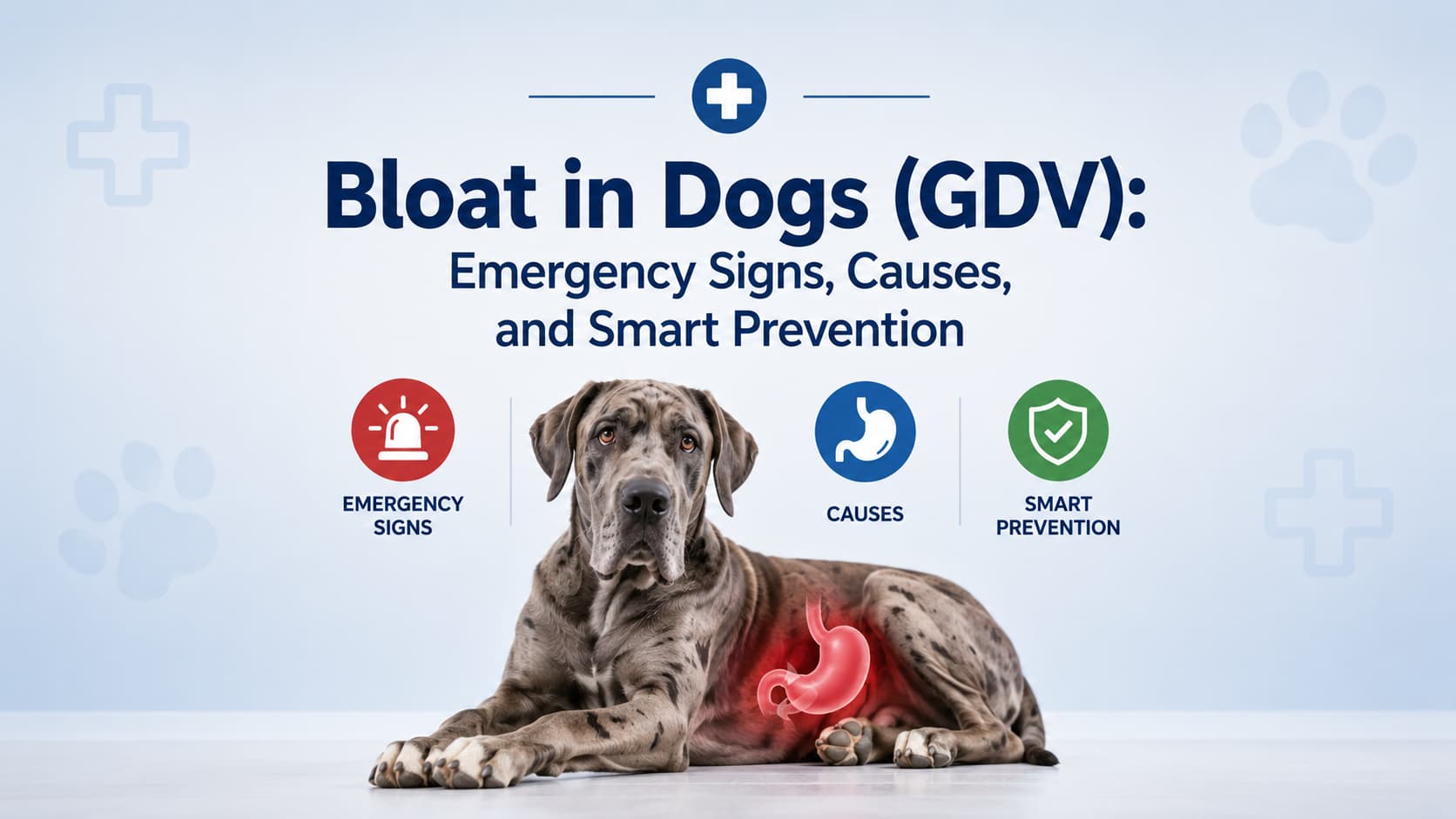
Bloat in dogs, also called GDV (gastric dilatation-volvulus), is one of the most rapidly life-threatening emergencies in veterinary medicine. ARCH Veterinary’s 2026 emergency guide is unambiguous: without emergency surgery, a dog with GDV can die within 1 to 6 hours. It is never safe to wait and see with suspected bloat.
I want to be direct about something before the details: if your dog is retching without producing vomit right now, with a visibly swollen abdomen, stop reading and go to the emergency vet immediately. Call them on the way. This is the one condition in this entire guide where reading further is less important than acting immediately.
For everyone else: understanding GDV before it happens is how owners recognise it in the critical first minutes. The AAHA’s GDV guide confirms that early intervention dramatically improves survival chances. The difference between acting in the first hour and acting in the third hour is measurable in survival statistics.
We also have a complete guide on signs a dog is in pain.
For more on this, see our guide on why is my dog lethargic?.
What Happens During Bloat and GDV
PetMD explains the two distinct stages. Simple bloat (gastric dilatation without volvulus) involves the stomach filling with gas but not twisting. This is serious but may be manageable without surgery. GDV is the more dangerous progression: the gas-filled stomach twists on itself, cutting off its blood supply and trapping the contents.
ARCH Veterinary describes the mechanism: the trapped gas causes the abdomen to distend rapidly, and toxins from dying stomach tissue enter the bloodstream. The twisting also compresses major blood vessels, reducing blood flow to the heart. Shock, organ failure, and cardiac arrhythmias follow rapidly. Without emergency surgery to untwist the stomach and remove the dead tissue, death is inevitable.
The Warning Signs — Know These Before You Need Them
AAHA’s GDV guidance confirms that early signs can be subtle and easily mistaken for less serious problems. The progression from subtle to life-threatening happens within hours:
Early signs
- Unproductive retching — trying to vomit but nothing comes up. ARCH Veterinary identifies this as the number one warning sign of GDV.
- Restlessness and inability to settle — pacing, lying down and immediately getting up, obvious discomfort
- Excessive drooling
- Looking at or biting at the abdomen
- Behavioural changes — seeking attention or appearing frightened
Advanced signs — immediate emergency
- Visibly distended abdomen — particularly noticeable on the left side behind the ribcage. Sometimes described as appearing like a basketball under the ribs.
- Pale or white gums — indicating shock from internal blood flow compromise
- Rapid heart rate
- Weakness or collapse
- Laboured breathing
GSVS Emergency hospital is clear: these symptoms mean your dog needs emergency veterinary care within minutes, not hours. Call the clinic before leaving so they can prepare for your arrival.
This post is part of our complete pet health library — visit our pet health guide for the full collection.
| 🚨 The number one sign Unproductive retching — attempting to vomit repeatedly without bringing anything up — is the most reliable early warning sign of GDV. A dog that retches without result alongside any other symptom on this list needs to be in an emergency vet facility immediately. |
Which Dogs Are Most at Risk
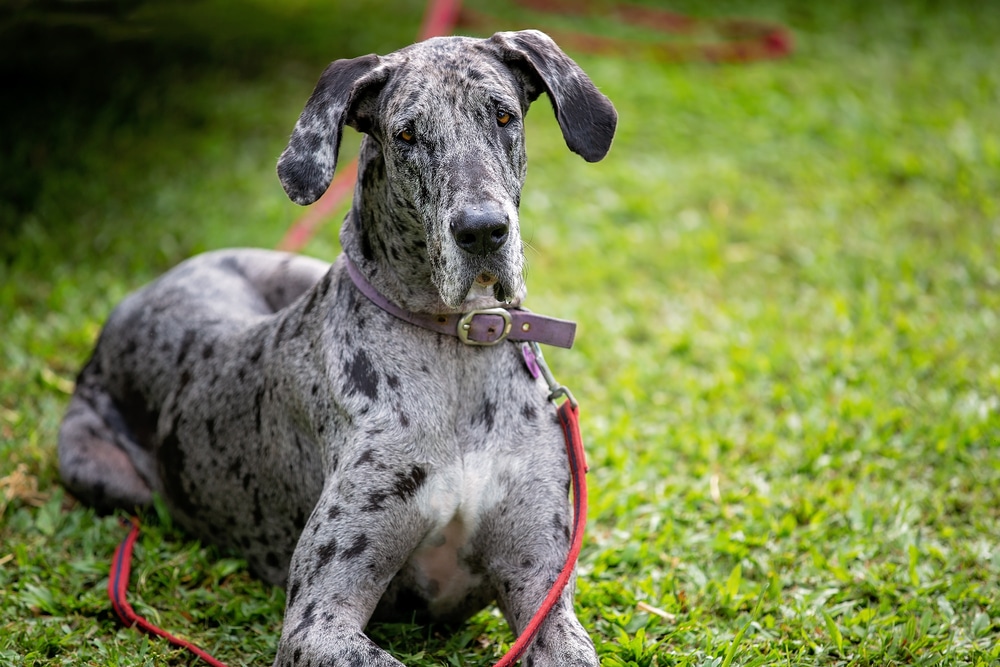
BluePearl Veterinary Hospital provides the most striking breed statistics: about 50% of all Great Danes will bloat during their lifetime. About 1 in 5 Irish Wolfhounds will bloat. These are not rare events in high-risk breeds — they are near-certainties.
The primary risk factor is chest conformation: deep-chested, narrow-waisted breeds are disproportionately affected. High-risk breeds include:
- Great danes — highest single-breed risk. Prophylactic gastropexy is recommended for most owners.
- Irish Wolfhounds, Scottish Deerhounds— very high risk, large and deep-chested
- Standard Poodles, Dobermans, Weimaraners, German Shepherds
- Bloodhounds, Saint Bernards, Labrador and Golden Retrievers— lower than the above but still meaningful risk
Age increases risk. Dogs over seven are at higher risk than younger dogs. A family history of GDV increases risk significantly.
Prevention — What Actually Reduces Risk
Preventive gastropexy — the most effective intervention
Gastropexy is a surgical procedure that permanently tacks the stomach to the abdominal wall, preventing it from rotating. For high-risk breeds, prophylactic gastropexy is the single most effective preventive measure available — it does not prevent bloat (simple dilatation can still occur) but it prevents the fatal volvulus (twisting).
The procedure is commonly performed at the time of spay or neuter — adding approximately 30 minutes to the surgery with minimal additional risk. For Great Danes, Irish Wolfhounds, and other very high-risk breeds, most veterinary cardiologists and surgeons recommend discussing gastropexy with every owner. BluePearl notes that even after gastropexy, a small percentage of stomachs can still twist (less than 5%), but this is uncommon.
Feeding management
- Feed two or three smaller meals daily rather than one large meal
- Use a slow feeder bowl to reduce gulping and air swallowing
- Allow 30 to 60 minutes of rest after eating before vigorous exercise
- Avoid stress during feeding in multi-dog households
The raised bowl myth — important correction
For years, raised food bowls were recommended for deep-chested breeds to reduce bloat risk. Current evidence does not support this, and some research suggests raised bowls may actually increase GDV risk in large breeds. PetMD explicitly notes: no specific foods cause bloat, but large amounts of food and exercising after a large meal are more significant concerns. Do not use a raised bowl on the assumption it prevents bloat.
Treatment — What Happens at the Vet
PetMD outlines the treatment pathway. If bloat is confirmed without stomach twisting (simple dilatation), IV fluids, medications, and walking may resolve it without surgery. If GDV is confirmed — stomach twisted — emergency surgery is required to untwist the stomach, assess tissue viability, remove any dead tissue, and perform a gastropexy to prevent recurrence.
AESC Parker’s retrospective analysis of 736 GDV cases confirms a clear correlation between treatment delay and mortality. The surgery itself carries risk, and cardiac arrhythmias are a common complication requiring monitoring. With prompt treatment, survival rates for GDV surgery are generally 70 to 90%.
Frequently Asked Questions
| Q: How quickly does bloat progress?A: Rapidly. The GSVS emergency guide notes that bloat can progress from initial symptoms to life-threatening shock in just a few hours. There is no safe monitoring window for suspected GDV. If the warning signs are present, the journey to the emergency vet should begin immediately — not after observing for an hour to see if it improves. |
| Q: My dog has bloated before — will it happen again?A: Simple bloat without GDV may recur, particularly if the underlying cause (eating too fast, eating too much at once) is not addressed. GDV that has been surgically treated without gastropexy can recur. If your dog has had GDV, discuss prophylactic gastropexy with your surgeon — it is strongly recommended for dogs who have survived an episode. |
| Q: Can small dogs get bloat?A: GDV is rare in small breeds but not impossible. Deep-chested small breeds like Dachshunds and Miniature Poodles have some risk. The condition is overwhelmingly more common in large and giant deep-chested breeds. |

Frequently Asked Questions About Bloat in Dogs
What exactly is bloat in dogs? Bloat in dogs — medically known as Gastric Dilatation-Volvulus (GDV) — is a life-threatening condition in which the stomach fills with gas and twists on itself, cutting off blood supply to vital organs. The twisting, called volvulus, is what makes bloat in dogs so dangerous: it traps gas inside, causes the stomach to expand rapidly, and can cause the spleen to twist with it. Without emergency surgery, most dogs with GDV will die within hours. Even with prompt treatment, mortality rates remain significant — which is why recognising the signs of bloat in dogs early is so critical.
Which dog breeds are most prone to bloat in dogs? Deep-chested, large and giant breeds face the highest risk of bloat in dogs. Great Danes have the highest lifetime risk — studies estimate nearly a 40% chance of developing GDV. Other high-risk breeds include Standard Poodles, German Shepherds, Weimaraners, Saint Bernards, Gordon Setters, and Basset Hounds. The deep, narrow chest creates the anatomical conditions that allow the stomach to rotate. Age also plays a role — the risk of bloat in dogs increases significantly in dogs over 7 years old, and intact males appear more susceptible than females.
How can bloat in dogs be prevented? While there is no guaranteed way to prevent bloat in dogs, several management strategies significantly reduce risk. Feed large breeds two or three smaller meals per day rather than one large meal. Avoid vigorous exercise for at least an hour before and after eating. Use a slow-feeder bowl to reduce rapid eating and air ingestion. Elevated food bowls were once recommended but are now considered a risk factor rather than a protection against bloat in dogs. For very high-risk breeds, vets may recommend a prophylactic gastropexy — a surgical procedure that tacks the stomach to the abdominal wall to prevent rotation.
What should I do if I suspect bloat in dogs? If you suspect bloat in dogs, treat it as a veterinary emergency and go to an animal hospital immediately — do not wait to see if symptoms improve. Time is critical. Do not attempt to relieve the gas at home. Call ahead so the vet can prepare for your arrival. The sooner bloat in dogs is treated, the better the outcome. Emergency surgery to decompress the stomach and correct the volvulus is the only curative treatment, and a gastropexy is typically performed at the same time to prevent recurrence. Every minute matters with GDV.
You might also find our guide on why is my dog vomiting? helpful.
| Medical Disclaimer This article is written for informational purposes based on the research and personal experience of the author. It is not a substitute for professional veterinary advice, diagnosis, or treatment. Always consult your veterinarian with concerns about your pet’s health. |
This article is written for informational purposes and reflects the personal experience and research of the author. It does not replace professional veterinary or dog training advice. Always consult your veterinarian or a certified trainer for individual guidance.