

Published May 2026 | 20 min read | Covers 18 cat behaviors
You live with a cat. You love them. And you frequently have absolutely no idea what they are doing or why.
Cats are one of the most popular pets on the planet — more than 60 million live in American homes alone, and similar numbers exist across Europe, Asia, and Australia. Yet research shows that cat owners misread their cat’s behaviour and emotional signals nearly a third of the time. We consistently underestimate what cats are trying to communicate, and we consistently overestimate how much cats actually understand our attempts to communicate back.
This guide changes that. Written for beginner cat owners and experienced cat lovers alike, it covers 18 of the most common cat behaviours — why cats do them, what they mean, and what (if anything) you should do about them. Every section links to a deeper dive so you can explore any behaviour in as much detail as you want.
Understanding your cat’s behaviour is not just interesting — it genuinely improves their welfare and your relationship. A cat that is understood is a cat that can be supported. And a supported cat is a happier, healthier companion.
| 📚 How to use this guide This is the anchor post for our complete cat behaviour library. Each section below gives you the essential explanation of a behaviour, and every section links to a full in-depth post covering that topic completely. Use this as your starting point and follow the links for the full story on any behaviour that applies to your cat. |
First: Understanding What Makes Cats Tick
Before decoding individual behaviours, it helps to understand three fundamental things about cats that explain almost everything they do.
1. Cats are both predators and prey
This sounds contradictory but it’s the key to understanding feline behaviour. Cats hunt smaller animals — but they’re also hunted by larger ones. This dual nature means cats simultaneously carry the instincts of a hunter (stalk, pounce, chase, bite) and the instincts of prey (hide weakness, control escape routes, monitor territory, avoid vulnerability).
Every confusing cat behaviour becomes more logical through this lens. Why do cats hide when ill? Because showing weakness invites predators. Why do they need to control their environment so intensely? Because a prey animal that loses situational awareness doesn’t survive. Why do they react so dramatically to losing control? Same reason.
2. Cats are not small dogs — or small humans
According to veterinary behaviour expert Carlo Siracusa of Penn’s School of Veterinary Medicine, one of the biggest mistakes cat owners make is treating cats as low-maintenance dogs — expecting them to respond to social cues the same way dogs do. Cats are a different species with a different evolutionary history, different social structures, and a fundamentally different relationship with their environment.
Dogs evolved alongside humans over tens of thousands of years and are wired for pack social dynamics. Cats domesticated themselves much more recently and remain far closer to their wild ancestors in both behaviour and psychology. This isn’t a flaw — it’s simply what cats are.
3. Meowing is a language invented for humans
Adult cats almost never meow at each other. They use body language, scent, and vocalisations like chirps, yowls, and hisses for inter-cat communication. Meowing — as we know it — is something cats developed specifically to communicate with people. When your cat meows at you, they’re using a communication system they evolved just for this relationship. That’s remarkable.
Cat Body Language: Reading the Signals
Before diving into specific behaviours, knowing how to read basic cat body language gives you the context to interpret everything else correctly.
The tail tells you everything
- Tail straight up — confident, happy greeting
- Tail up with a hook at the top — friendly and approachable
- Tail low or tucked — fear or submission
- Tail puffed up — frightened or agitated
- Tail thrashing or thumping — irritated, overstimulated — stop what you’re doing
- Tail slowly swishing — focused, alert, possibly about to pounce
The ears are the mood barometer
- Ears forward and relaxed — curious and content
- Ears sideways (‘airplane ears’) — irritated or anxious
- Ears flat back against head — frightened or aggressive — do not approach
The eyes say it all
According to Wikipedia’s review of cat behaviour research, when a familiar human slow-blinks toward a cat, the cat tends to approach them more frequently than if the human uses a neutral expression. The slow blink is the most powerful positive signal in the cat’s emotional vocabulary — and you can do it back.
- Slow blink — trust, affection, relaxation — blink slowly back
- Soft half-closed eyes — completely relaxed and content
- Dilated pupils in normal light — excitement, fear, or overstimulation
- Hard, unblinking stare — challenge or high alert
- Constricted pupils in low light — potentially agitated
| 💡 The slow blink technique Try this right now: look at your cat softly, then slowly close and open your eyes. Wait. Many cats will blink back. This is direct communication in their emotional language — the equivalent of saying ‘I love you and I feel safe with you.’ It works. |
18 Cat Behaviours Explained
1. Sleeping 12–20 hours a day
The single most common question new cat owners ask. Your cat isn’t lazy or depressed — they’re operating exactly as their biology designed them. Cats are explosive hunters who need enormous energy reserves for short, intense bursts of activity. Sleep is how they store that energy.
How much cats sleep varies with age: kittens and senior cats sleep up to 20 hours, adults average 12–16 hours. The concern is never the baseline — it’s a sudden change from your individual cat’s normal pattern.
| → Full guide: Why do cats sleep so much? The complete guide https://dogsandcatshq.com/why-do-house-cats-sleep-so-much-4466 |
2. Hating water
Most domestic cats descended from African wildcats that evolved in arid desert environments — they had no evolutionary reason to become comfortable around water. Wet fur also becomes heavy and uncomfortable, stripping insulating properties and reducing agility. Add in the loss of control and the overwhelming of scent receptors and you have a recipe for a very unhappy cat.
Interestingly, some breeds — Turkish Van, Maine Coon, Bengal — genuinely love water. And most cats will happily bat at a dripping tap. The issue isn’t water itself; it’s water on someone else’s terms.
| → Full guide: Why do cats hate water? Science-backed reasons explained https://dogsandcatshq.com/why-do-cats-hate-water-4506-4506 |
3. Licking you
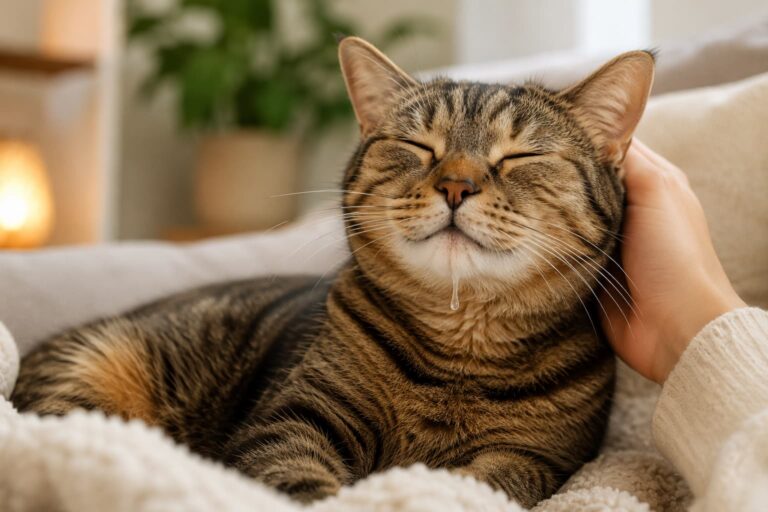
When your cat licks you they’re performing allogrooming — social grooming reserved for members of their inner circle. It’s also scent marking (depositing their scent on you), comfort seeking, and attention getting. You’re not being cleaned. You’re being cherished.
The lick-then-bite sequence is a natural part of cat social grooming — a light nip follows a grooming session, just as it would between bonded cats. If the bite is gentle and your cat continues purring, it’s affection, not aggression.
| → Full guide: Why does my cat lick me? 8 surprising reasons https://dogsandcatshq.com/why-does-my-cat-lick-me-3159-3159 |
4. Purring
Purring is far more complex than most people realise. Yes, cats purr when content — but they also purr when frightened, in pain, giving birth, and dying. The purr is a self-soothing mechanism that triggers endorphin release, and the frequency (25–150 Hz) overlaps with ranges shown to promote bone healing and tissue repair.
There’s also the solicitation purr — a special variation cats use when they want something, embedding a high-frequency cry within the purr that humans find neurologically compelling. Your cat has essentially evolved a biological tool that hijacks your parental instincts. Clever.
| → Full guide: Why do cats purr? The surprising science behind the sound https://dogsandcatshq.com/why-do-cats-purr-4512-4512 |
5. Biting
Cat biting is almost never random or spite-driven. The eight types of biting each have a distinct cause: overstimulation (the most common), play aggression, love bites, fear, pain, redirected aggression, attention-seeking, and poor early socialisation. Identifying which type your cat is doing determines exactly how to respond.
The most important rule: never punish a bite. It creates fear without solving the cause and damages the relationship. Always find the type, address the cause, and redirect to a toy.
| → Full guide: Why does my cat bite me? 8 real reasons and how to stop it https://dogsandcatshq.com/why-does-my-cat-bite-me-4516-4516 |
6. Meowing constantly
Meowing is a communication system cats developed specifically for humans. Nine distinct reasons drive excessive meowing: hunger, attention seeking, greeting, boredom, wanting access, stress, heat cycles, pain or illness, and cognitive dysfunction in senior cats.
The distinction that matters most: meowing that’s been present for a while versus meowing that has suddenly increased. Sudden increases in an otherwise quiet cat — especially an older one — are always worth a vet conversation.
| → Full guide: Why does my cat meow so much? 9 real reasons explained https://dogsandcatshq.com/why-does-my-cat-meow-so-much-4521 |
7. Following you everywhere (including the bathroom)
The shadowing cat is not clingy or pathological — they’re bonded. Research confirms cats form secure attachments to their owners similar in structure to the bonds infants form with caregivers. Following is proximity maintenance — staying near their safe person.
The bathroom specifically attracts cats for several reasons: closed doors represent unknown territory, you’re a captive audience who can’t leave, and the space is full of concentrated versions of your personal scent.
| → Full guide: Why does my cat follow me everywhere? (Including the bathroom) https://dogsandcatshq.com/why-does-my-cat-follow-me-everywhere-4524-4524 |
8. Staring at you
The meaning of a cat stare depends entirely on the context and body language surrounding it. A soft gaze with slow blinking is pure affection. A focused stare tracking movement is the predator brain at work. A tense, hard stare with dilated pupils is a warning. And the hunger stare — timed perfectly before mealtimes — is strategic communication.
Always read the whole body, not just the eyes. The tail, ears, and posture give you the context the stare alone can’t provide.
| → Full guide: Why does my cat stare at me? 7 reasons behind that unblinking gaze https://dogsandcatshq.com/why-does-my-cat-stare-at-me-4527-4527 |
9. Headbutting you
Head bunting — pressing the forehead against you — is one of the most meaningful things a cat can do. Cats have scent glands on their forehead, cheeks, and chin. Bunting deposits their pheromones on you, marking you as part of their social group and creating the shared colony scent that signals safety to all members.
Critical distinction: headbutting (a deliberate, social press against you) is completely different from head pressing (sustained pressing against walls or hard surfaces, often with apparent confusion). The second is a neurological emergency requiring immediate veterinary attention.
| → Full guide: Why does my cat headbutt me? The science of feline bunting https://dogsandcatshq.com/why-does-my-cat-headbutt-me-4530-4530 |
10. Kneading
Kneading — rhythmically pressing paws into a soft surface — begins in kittenhood as a nursing behaviour that stimulates milk flow. Cats that knead as adults are accessing the same comfort associated with their earliest sense of safety and nourishment. It’s a deeply positive behaviour: a kneading cat is a cat that feels completely at home.
| → Full guide: Why do cats knead? Top 12 reasons https://dogsandcatshq.com/why-do-cats-knead-2920 |
11. Eating grass
Grass eating is completely normal — 71% of cats eat plants, and only 25% vomit afterward. The behaviour appears to have evolutionary roots: indigestible grass stimulates gut contractions that help expel intestinal parasites (historically common in wild cats) and move hairballs through the digestive system. Grass juice also contains folic acid.
If your cat is drawn to grass, the safest option is an indoor cat grass kit — wheatgrass or oat grass grown pesticide-free. Outdoor grass may have been treated with herbicides or pesticides that are toxic to cats.
| → Full guide: Why do cats eat grass? The surprising science explained https://dogsandcatshq.com/why-do-cats-eat-grass-4535 |
12. Spraying urine
Spraying is not the same as urinating outside the litter box. Spraying involves standing upright, backing against a vertical surface, and releasing a small amount of strongly-scented urine — a territorial communication message. Urinating outside the litter box involves squatting on horizontal surfaces and is usually a litter box problem.
Spaying or neutering eliminates spraying in about 90% of cats. For the remainder, stress, multi-cat conflict, and inadequate resources are the primary drivers — all addressable with targeted interventions.
| → Full guide: Why do cats spray? Causes, prevention, and how to stop it https://dogsandcatshq.com/why-do-cats-spray-4538 |
13. Getting the zoomies
Frenetic Random Activity Periods (FRAPs) are sudden bursts of high-energy running, jumping, and erratic movement. They serve as an energy release valve — a way for cats to discharge the stored hunting energy that accumulates during their long daily sleep. According to PetMD, zoomies may trigger endorphin release, making them a genuinely pleasurable experience for the cat.
The post-poop zoomies deserve special mention: the vagus nerve, stimulated by a large bowel movement, can produce a brief euphoric sensation — and evolutionary instinct may drive cats to sprint away from their defecation site to avoid attracting predators.
| → Full guide: Why do cats get the zoomies? Science behind FRAPs explained https://dogsandcatshq.com/why-do-cats-get-the-zoomies-4542 |
14. Knocking things off surfaces
The internet’s favourite cat behaviour has a straightforward explanation: paw-testing objects for movement mimics the way wild cats test prey for signs of life. Moving objects are fascinating. Falling objects produce sound and unpredictable movement. And if knocking things over also produces an immediate reaction from a human — it becomes a reliable attention-getting tool.
The counter-intuitive response is no reaction. If the performance has no audience it becomes far less appealing.
| → Full guide: Why do cats knock things over? 5 real reasons (not spite) https://dogsandcatshq.com/why-do-cats-knock-things-over-4545 |
15. Bringing you dead animals
Cats that bring prey home are doing something genuinely generous by their own standards. Mother cats bring prey to their kittens — first dead, then injured, then alive — to feed them and teach them to hunt. Your cat has decided you are part of their family group and is providing for you accordingly. They may also be trying to teach you, who they have observed to be a hopelessly ineffective hunter.
The appropriate response is brief warm acknowledgment followed by discreet disposal. Never punish this behaviour — from the cat’s perspective, it’s one of the most caring things they can do.
| → Full guide: Why does my cat bring me dead animals? 4 reasons explained https://dogsandcatshq.com/why-does-my-cat-bring-me-dead-animals-4547 |
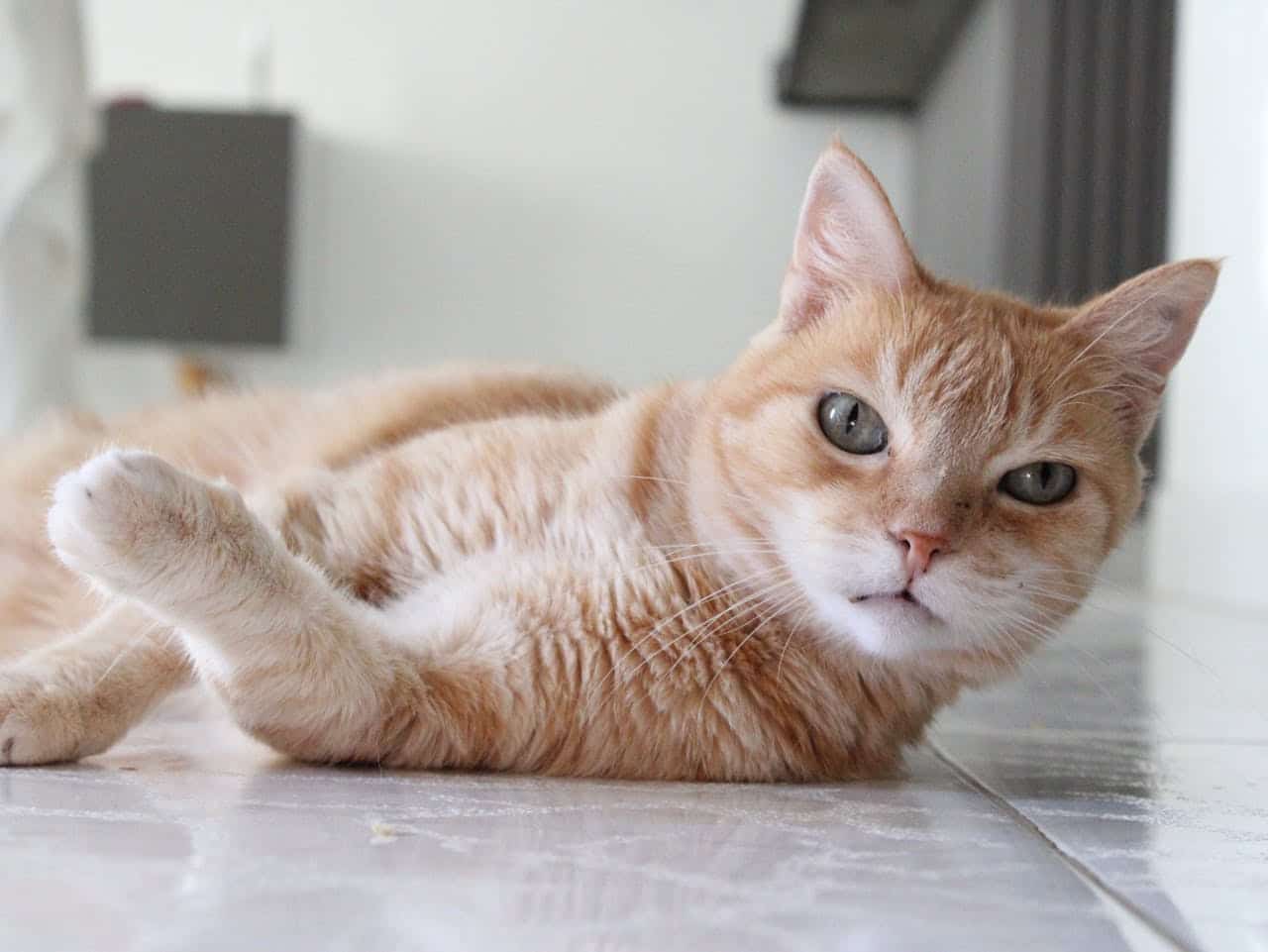
16. Rolling on the ground
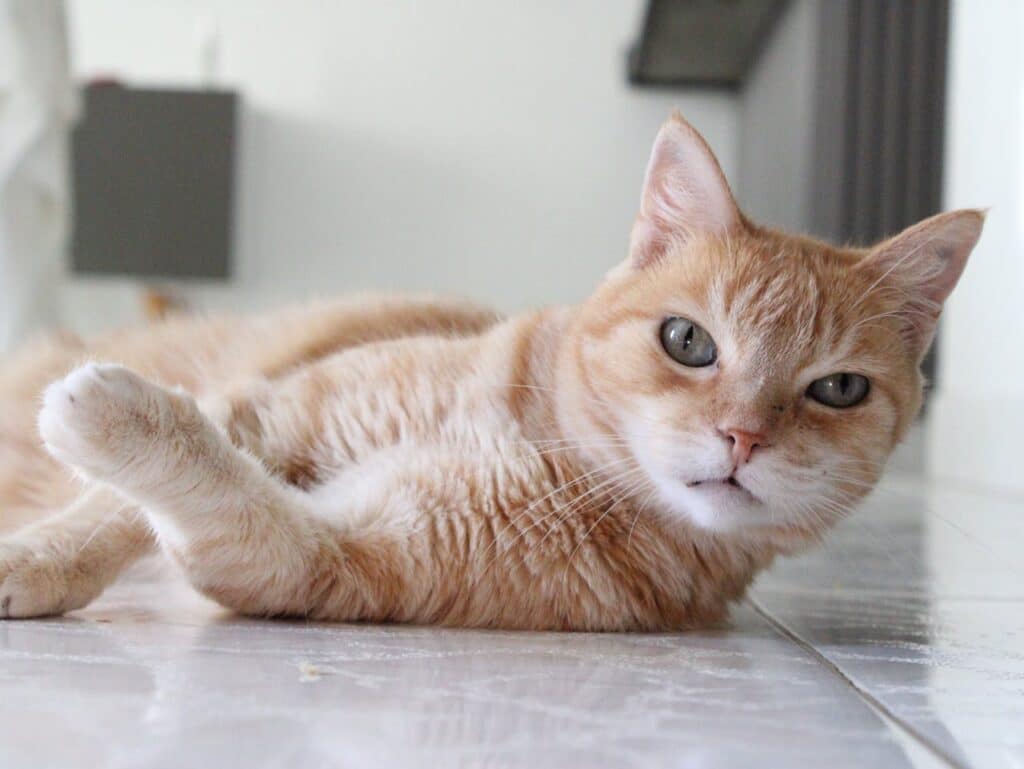
Rolling has several distinct causes depending on context: a catnip or silver vine response (the most dramatic version), a greeting and trust display when you arrive, scent marking a surface, a full-body stretch, reaching an itch, or in unspayed females, heat behaviour.
The classic mistake is interpreting a belly-up roll as an invitation to touch the stomach. An exposed belly signals trust and relaxation — not ‘please rub here.’ Most cats find prolonged belly contact overstimulating and will bite to stop it. Brief, gentle contact with a relaxed cat is usually fine.
| → Full guide: Why do cats roll on the ground? 6 reasons explained https://dogsandcatshq.com/why-do-cats-roll-on-the-ground-4551 |
17. Hiding
Occasional hiding is completely normal — cats need private spaces to decompress, sleep safely, and feel in control of their territory. The concern arises when hiding is new, prolonged, or accompanied by other changes: not eating, not using the litter box, unusual lethargy, or visible discomfort.
Cats instinctively hide illness and pain — it’s a survival mechanism that makes them look fine right up until they’re seriously unwell. A cat that is hiding AND showing any other behavioural change deserves a vet assessment.
| → Full guide: Why is my cat hiding? 7 reasons and when to worry https://dogsandcatshq.com/why-is-my-cat-hiding-4549 |
18. Eating non-food items (pica)
Pica — the compulsive eating of non-nutritive materials — ranges from mild (occasional fabric chewing) to medically serious (consuming string, rubber, or plastic in quantity). Common targets include wool and fabric (especially in Oriental breeds), plastic bags, hair, rubber bands, and cardboard.
String, thread, ribbon, and tinsel deserve special mention as emergency hazards: they can become anchored at one end and cause potentially fatal intestinal injury. If you see string hanging from your cat’s mouth or rear end — do not pull it. Go to an emergency vet immediately.
| → Full guide: Why does my cat eat non-food items? Pica in cats explained |
What Normal Cat Behaviour Looks Like — A Quick Reference
| ✅ Signs your cat is happy and thrivingSlow blinking at you. Greeting you with tail up. Purring when stroked. Kneading on soft surfaces. Headbutting and rubbing against you. Sleeping in open, relaxed positions. Eating consistently. Using the litter box normally. Playing enthusiastically. Grooming regularly but not excessively. |
| ⚠️ Signs something may be wrong — consult your vetSudden change in any normal behaviour. Not eating or drinking for over 24 hours. Hiding combined with other changes. Straining in the litter box. Excessive or compulsive grooming. Sudden increase in vocalisation. Confusion or disorientation. Unexplained weight loss. Changes in litter box habits. |
How to Build a Better Relationship With Your Cat
Understanding behaviour is the foundation, but the relationship is built on consistent daily actions. Here’s what the science and the experience of millions of cat owners points toward:
Respect their need for control
The single most important thing you can do for a cat’s wellbeing is ensure they always have choices and escape routes. Never trap a cat. Never force interaction. Always let them determine when contact begins and ends. A cat that feels in control is a calm, bonded cat.
Learn their individual language
The behaviour patterns described in this guide are general. Your cat is an individual. Some cats are vocal and some are silent. Some are physically affectionate and some show love through proximity without contact. Some slow-blink readily and some express trust in completely different ways. Spend time observing your specific cat’s baseline and the deviations from it tell you everything you need to know.
Provide what their biology needs
- Hunting outlet — at least two dedicated play sessions daily using wand toys that mimic prey
- Vertical space — cats need to climb and observe from elevation. A cat tree changes the quality of an indoor cat’s life dramatically
- Hiding spots — multiple enclosed, private spaces where your cat can retreat and not be disturbed
- Clean litter — one box per cat plus one extra. Scooped daily. Unscented litter. In a quiet, accessible location
- Fresh water — ideally a cat fountain since many cats are drawn to running water and drink more from it
- Routine — cats thrive on predictability. Consistent feeding times, consistent play times, consistent human presence
Never punish — redirect instead
Punishment — shouting, spraying water, physical correction — does not teach cats what you want them to do instead. It teaches them that you are unpredictable and potentially dangerous. Every unwanted behaviour has a cause and an appropriate alternative. Find the cause, provide the alternative.
Know when to call the vet
Cats are extraordinarily good at hiding illness. By the time a cat appears obviously unwell to a human observer, they have often been managing symptoms for days or weeks. Trust changes in behaviour as much as physical symptoms. Your vet would rather see a cat that turns out to be fine than miss an early intervention window.
Frequently Asked Questions
| Q: How do I know if my cat is happy?A: Happy cats slow-blink, greet you with tail up, seek contact on their own terms, eat and drink normally, groom regularly, use the litter box consistently, and play with enthusiasm. A content cat at rest typically has soft eyes, a loosely curled or still tail, and a relaxed body posture. The most reliable indicator is knowing your individual cat’s normal — happiness looks different in different cats. |
| Q: Why does my cat suddenly act strange?A: A sudden change in behaviour is almost always meaningful. Check for environmental changes first — new people, pets, furniture, or disruptions to routine. If nothing has changed externally, a vet visit to rule out medical causes is the right step. Sudden behavioural shifts in older cats particularly deserve prompt attention as they can signal the onset of conditions like hyperthyroidism, kidney disease, or cognitive dysfunction. |
| Q: Do cats have feelings?A: Yes. Cats experience emotions — research using brain imaging and behavioural studies confirms that cats have the neurological structures associated with fear, pleasure, stress, anxiety, and attachment. They experience positive emotional states (contentment, excitement, affection) and negative ones (fear, pain, grief, frustration). They also form genuine social bonds — with other cats and with their human owners. |
| Q: Can I train my cat?A: Absolutely. Cats learn through association and positive reinforcement very effectively. Clicker training works well with cats for teaching behaviours like sitting, coming when called, and entering a carrier. The key differences from dog training are shorter sessions (cats lose interest faster), higher-value rewards (finding what your individual cat loves is essential), and accepting that cats choose when to engage — you cannot compel participation. |
| Q: Why does my cat ignore me?A: Cats are selective about when they engage and on what terms — this is not rejection, it’s simply their nature. Unlike dogs, who are generally happy to respond to human-initiated interaction at any time, cats prefer to set the agenda. A cat that ignores you may simply be resting, overstimulated, or not in the mood. The same cat may seek you out ten minutes later. Their interest in you hasn’t changed — only their momentary availability. |
| Q: How do I introduce a new cat to my existing cat?A: Slowly. The most common mistake is introducing cats too quickly and letting conflict establish a negative baseline that’s hard to reverse. The proven approach: separate rooms for the first week, swap bedding to exchange scents, introduce scent before visual contact, then supervised visual contact through a barrier, then brief supervised meetings. The whole process typically takes 2–4 weeks minimum. Rushing it almost always makes things worse. |
The Complete Cat Behaviour Library — All Posts
This guide is the anchor for our complete cat behaviour library. Every behaviour listed below has its own comprehensive guide — click any link to go deeper on that specific topic:
Final Thoughts
Cats are not mysterious. They are not aloof. They are not untrainable or unknowable. They are a species with a different evolutionary history, a different social structure, and a different communication style — one that rewards observation, patience, and the willingness to learn a new language.
The behaviours in this guide — the purring, the headbutting, the zoomies, the dead mouse at 6am — are all your cat’s attempts to communicate, to bond, to maintain their world, and to navigate life with you in it. Every behaviour makes sense once you understand the lens through which cats see the world.
You don’t need to become a feline behaviourist. You just need to learn your specific cat — their baseline, their preferences, their individual ways of expressing what they feel. The research gives you the framework. Your cat fills in the details.


Frequently Asked Questions: Cat Behavior
How do I know if my cat’s behavior is normal?
Normal cat behavior varies considerably between individuals, but key baselines include: regular eating and drinking, using the litter box consistently, grooming daily, and alternating between active and restful periods. When cat behavior deviates suddenly — for example a previously sociable cat becoming withdrawn, or a neat cat stopping grooming — that change is often more meaningful than any single behaviour viewed in isolation.
Can cat behavior change as cats age?
Yes, significantly. Senior cats often show changes in cat behavior that can include sleeping more, becoming less tolerant of handling, or vocalising more — sometimes due to cognitive decline or conditions like hyperthyroidism. Conversely, kittens display exploratory, high-energy cat behavior that settles considerably by around 2–3 years of age. Tracking changes at different life stages helps owners distinguish normal development from signs that need veterinary attention.
Why does my cat’s behavior change after a vet visit?
Stress is the primary driver. The smells, sounds, and handling involved in a vet visit are profoundly unsettling for most cats. Post-vet cat behavior changes — hiding, aggression, or refusing food — typically resolve within 24–48 hours. If other cats in the household react negatively to a returning cat, it’s because the vet-scented cat smells “wrong.” Separating them briefly and using a Feliway diffuser can ease the reintegration.
Is destructive cat behavior a sign of something serious?
It depends on context. Scratching furniture is normal cat behavior — cats scratch to mark territory and maintain claw health. But destructive cat behavior that’s sudden, escalating, or accompanies other changes (weight loss, increased vocalisation, litter box avoidance) can indicate anxiety, boredom, or medical issues. Providing appropriate outlets, environmental enrichment, and ruling out health causes are the recommended first steps.
Start with the slow blink. Everything else follows from there.
MSD Veterinary Manual -> https://www.msdvetmanual.com/cat-owners/behavior-of-cats/introduction-to-behavior-of-cats
| ⚠️ Disclaimer This guide is for informational purposes only and does not constitute veterinary advice. If you are concerned about changes in your cat’s behaviour or health, please consult your veterinarian. |
This article is written for informational purposes and reflects the personal experience and research of the author. It does not replace professional veterinary or dog training advice. Always consult your veterinarian or a certified trainer for individual guidance.