

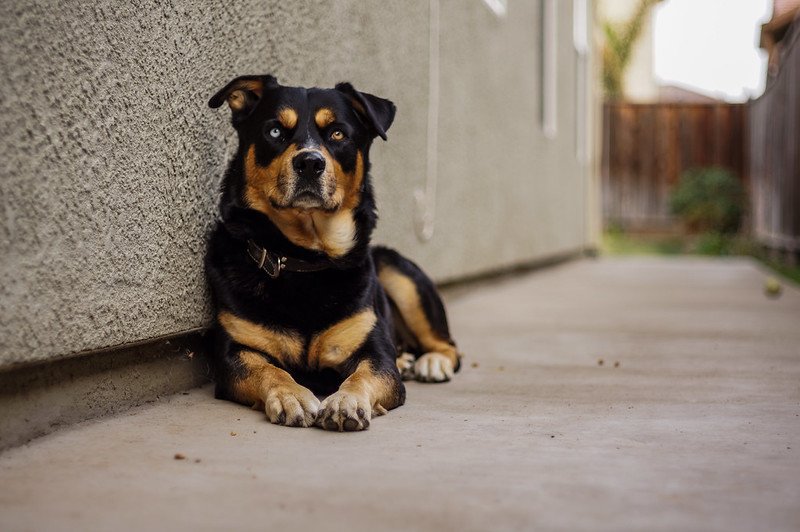
The Rottsky is a relatively new breed of designer dog, intentionally bred by crossing a Rottweiler with a Siberian-Husky.
Though the large and muscular Rottweiler and the sled pulling Siberian-Husky are different in their physical features and personality, the Rottsky with qualities of both parents has turned out to be a good-looking dog with a fascinating character.
Rottsky at a Glance
| Trait | Typical Range |
|---|---|
| Height | 20-27 inches |
| Weight | 55-135 lbs (varies by parent traits) |
| Lifespan | 9-14 years |
| Puppy Price | $600-$2,000+ |
| Exercise Needs | ~2 hours/day |
| Shedding | Heavy (brush 3x/week, daily in spring/fall) |
| Good With Kids | Yes, with early socialization |
| Experience Level | Not recommended for first-time owners |
The Rottsky can make a great pet but before you bring one home here are 14 facts that you should know:
1. They make excellent family dogs
Rottskies are excellent guard dogs, loving, protective, and loyal to their owners.
They get along well with children if socialized and trained early. However, they tend to get anxious around unfamiliar people.
2. Puppies are expensive
Though people like and admire Rottskies, they have recognition only from a few clubs and registries.
As a relatively new designer breed, the Rottsky tends to be expensive, with puppy prices typically starting around $600 and reaching $2,000 or more depending on the lineage, breeder, and location. Budget an additional $1,500 to $2,000 for first-year costs such as vaccinations, spaying or neutering, food, and supplies.
When buying a puppy, insist on seeing the parents so that you can be sure that there are no hereditary health issues.
If the parents are healthy, the chances of the offspring being in good health are also high.
If you don’t want to spend a lot of money, you can explore the adoption route, but be careful when adopting an adult dog as it may come with behavioral issues, as explained earlier.
3. Not for first-time dog owners
According to dog behavior experts, there are no bad dogs, but the fault lies with wrong or inadequate training.
Early training and socialization can help any dog to develop into a well-mannered pet.
That said, training is not the only factor. The American Veterinary Society of Animal Behavior notes that the critical socialization window, roughly 3 to 14 weeks of age, shapes a great deal of a dog’s adult temperament, alongside genetics from each parent breed (AVSAB). A Rottsky puppy that misses this window, or inherits a more reactive temperament from either parent, may need more structured, professional guidance regardless of how consistent the training is.
A Rottsky is a breed that needs a lot of early and consistent training to become well-adjusted and well mannered.
It will do well with an owner who already has experience with dogs, the knowledge and patience to give the Rottsky the required care and attention.
The Rottsky is not the right fit for a first-time dog owner, who may find the independence and stubbornness of the breed too much to handle.
Siberian Huskies and Rottweilers are both difficult breeds to own, and a puppy of these two breeds is going to be challenging.
You might also like:
4. Cannot be left alone
The Rottsky does not like to be left alone for long hours, which may be the case if members of the family must go out during the day.
They need attention and can develop separation anxiety if left alone at home.
5. Not suitable for apartment living
The Rottsky is not suitable for life in an apartment; they are an active breed that requires space to run around and release pent up energy.
They will do well in a house with a backyard.
If the Rottsky does not have space to stay active and release stored-up energy, they may start exhibiting destructive behavior such as chewing things and digging.
6. Needs training
The Rottsky is one breed that needs training early, or they can end up with behavioral problems.
You will need to spend time training the puppy and introducing it to new sounds, experiences, people, and other pets to ensure that it grows up to be well mannered.
If you neglect the area of socialization and training, you will end up with a powerful and dangerous dog that is hard to control.
Though an intelligent breed, it is not easy to train the Rottsky as it tends to be independent and stubborn.
It will require patient and consistent training to develop the right behavior traits in the dog.
Because the Husky side of the Rottsky can bring some classic Husky independence and vocal stubbornness into the mix, our guide to training a Husky has techniques that translate well, alongside standard Rottweiler obedience work.
Check out this article on strategies for training a stubborn dog.
7. Mixed color eyes
Rottskies have heterochromia, a genetic condition, where the color of one eye is different from the other. It is a unique and endearing trait;
This trait is typically inherited from the Siberian Husky side, where odd-colored or particolored eyes are common due to how pigment is distributed in the iris. Heterochromia is purely cosmetic in most dogs and does not affect vision or eye health.
A Rottsky with blue and brown eyes, and a dark coat is striking in appearance and stands out.
8. High need for exercise
As large and active dogs, Rottskies have a high need for exercise to work off excess energy.
They are also intelligent and need mental stimulation in the form of interactive games and toys to be happy and healthy.
The Rottsky’s need for physical activity cannot be satisfied with a casual walk around the block.
Nearly two hours of exercise (long walks and runs) is required every day, split up into two slots of one hour each in the morning and evening.
As this breed is more susceptible to heat exhaustion, you need to keep an eye on the Rottsky if exercising outdoors in hot weather.
9. High prey drive
The Rottsky has a high prey drive, just like its parents – the Rottweiler and Siberian Husky.
This high prey drive of the Rottsky can be a challenge in a home with other pets such as cats, hamsters, etc. or even in a neighborhood with small pets.
The Rottsky may get along with other dogs with early socialization but not with cats.
Also, be careful when picking a puppy as you may end up with one that is very stubborn and hard to handle.
Look for a puppy that is friendly and shows interest in you or the people around but be wary of those that seem withdrawn or timid.
A rescued adult Rottsky might come with behavioral problems, especially if it was not trained as a puppy or subjected to abuse and neglect.
You may not be able to handle the behavioral issues, and the dog will require professional help.
10. Shedding
The Rottweiler and the Siberian Husky are known to be heavy shedders and their offspring the Rottsky also sheds.
Regular grooming, including thrice a week brushing, is required to manage shedding and during spring and autumn, daily brushing is necessary to handle the heavy shedding.
If you are the kind who does not like a lot of dog hair everywhere, then the Rottsky is not the right pet for you.
There is no need for frequent bathing as it can dry up the skin of natural oils necessary for a healthy coat.
The undercoat of the Rottsky should be dry as otherwise, it can lead to mildew and mold.
11. Needs more calories per day
As a large and active dog, the Rottsky requires more calories per day, which translates into a large amount of food.
Be prepared to spend more on dog food than you would for a smaller dog breed.
High protein dry dog food from whole food clusters is ideal for keeping the Rottsky healthy and happy.
12. Health problems
If you buy a puppy from a reputed breeder after making sure that the parents are healthy, your dog will most likely be healthy as well.
Rottskies, like their parents, are generally healthy dogs.
However, common health problems can include osteochondritis dissecans (a disease of the cartilage affecting the joints), cataracts, bloat, hip and elbow dysplasia, and progressive retinal atrophy.
Bloat, also known as gastric dilatation-volvulus (GDV), deserves special attention. Deep-chested large breeds like the Rottweiler are especially prone to it, which means a Rottsky inherits that risk. GDV happens when the stomach fills with gas and twists on itself, cutting off blood flow; it is a true emergency that can kill a dog within hours without immediate surgery. Feeding two or three smaller meals instead of one large one, avoiding vigorous exercise right after eating, and using a slow-feed bowl can all help lower the risk. See our guide to bloat in dogs for the warning signs to watch for and what to do if you suspect it.
People consider hybrid dogs to be healthier than purebred dogs because of the larger gene pool though there are different opinions on this among experts.
The likelihood of Rottskies developing health issues is almost the same as any other dog, and it should not hold you back from getting this dog if you are okay with everything else that comes with the ownership of this amazing dog breed.
Like with any other dog breed, you need to ensure that the Rottsky gets adequate exercise, a healthy diet, and regular visits to the veterinarian.
13. Size
The average height of the Rottsky, depending on sex, varies between 20-27 inches. Weight varies more widely than height because it depends on which parent breed a puppy favors: the AKC standard puts Rottweilers at 80-135 lbs and Siberian Huskies at 35-60 lbs, so a Rottsky can reasonably fall anywhere between roughly 55-135 lbs.
14. Lifespan
The Rottsky has a lifespan ranging between 9 to 14 years.
Frequently Asked Questions
Is a Rottsky a good family dog?
Yes, with early socialization and consistent training. Rottskies tend to be loving and protective of their family, but their size and high prey drive mean young children should always be supervised around them, especially with smaller pets in the house.
How much exercise does a Rottsky need?
Plan on roughly two hours of physical activity a day, split into a couple of sessions, plus mental stimulation like puzzle toys or training games. An under-exercised Rottsky is much more likely to develop destructive habits such as digging or chewing.
Are Rottskies recognized by major kennel clubs?
As a designer/hybrid breed, the Rottsky is not recognized by the AKC. It has recognition from a few hybrid and designer-dog registries, which is part of why pricing and quality can vary so much between breeders.
What health issues should I watch for in a Rottsky?
Keep an eye out for hip and elbow dysplasia, eye conditions like cataracts and progressive retinal atrophy, and bloat (GDV), which is a life-threatening emergency in deep-chested breeds. Buying from a breeder who screens parent dogs, and learning the signs of bloat in advance, both help.
Conclusion
Now that you know the critical facts about the Rottsky, you are in an excellent position to decide whether you want to make this unique breed your companion.
Remember that owning a pet is a long-term responsibility that you should not take lightly.
You must research and study everything about the breed so that there are no surprises or regrets along the way.
Once you have done your homework and decided, then you should go ahead and get yourself a Rottsky, which is at the end of the day, a fantastic dog with a fascinating personality.
You may also find our post on puppies helpful.