

Updated May 2026 | 8 min read
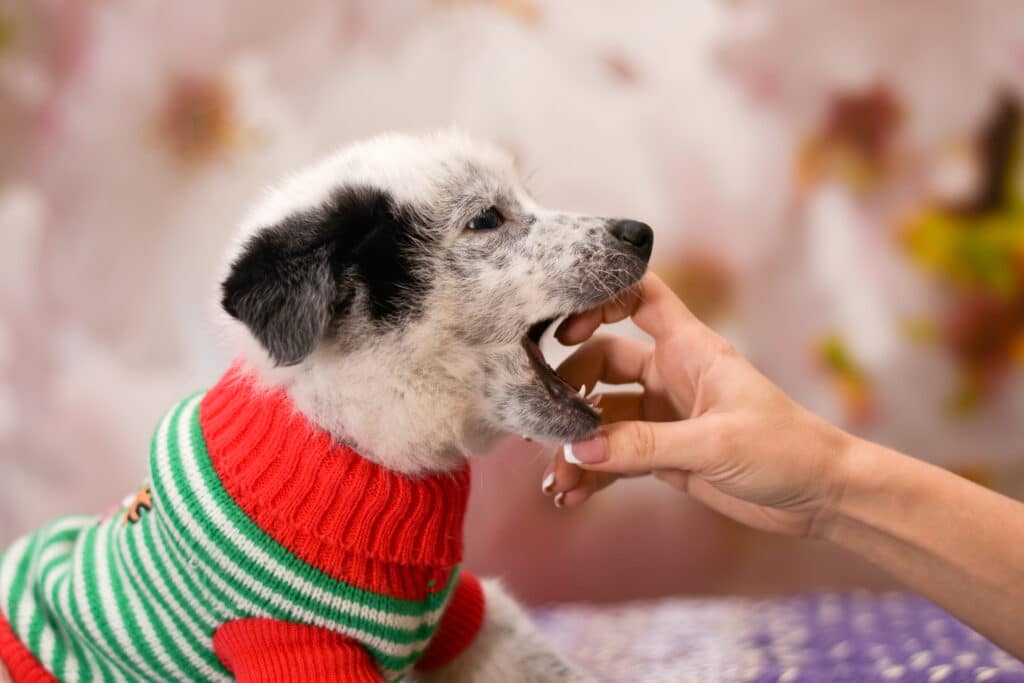
If you’re wondering how to stop a puppy from biting, you’re not alone — those needle-sharp puppy teeth feel like a personal attack, but puppy biting is completely normal. Almost every new puppy owner goes through it, and almost all of them wonder the same thing: when does it stop, and what can I do right now to make it hurt less?
Table of Contents
The good news is that puppy biting is very manageable with the right approach. The techniques in this guide are recommended by the American Kennel Club, the ASPCA, and leading veterinary behaviourists. What they all agree on: positive methods that teach bite inhibition work. Punishment-based methods don’t — and often make things worse.
You might also find our guide on how to potty train a puppy helpful.
You may also want to read our guide on how to teach a dog the leave it command.
Why Puppies Bite — Understanding the Behaviour
Before fixing the problem, it helps to understand puppy nipping. According to PetMD, puppy biting is a normal part of development, especially during teething between 12 and 16 weeks. Puppies bite to explore the world, play, and learn bite inhibition — the ability to control the force of their bite.
In the litter, puppies learn bite inhibition naturally. According to the ASPCA, when a puppy bites a littermate too hard, the victim yelps and stops playing. The biting puppy learns that hard bites end the fun — so they soften their bite to keep the game going. When we bring puppies home, we take over this teaching role.
Dr Ian Dunbar, who pioneered bite inhibition training, makes a critical point: a dog taught never to bite but without bite inhibition is far more dangerous than one allowed to mouth gently as a puppy. The goal is not zero mouthing but teaching gentle mouthing first, then gradually eliminating it. That is why knowing how to stop a puppy from biting the right way — through bite inhibition, not suppression — is one of the most important things you can do in your puppy’s first few months.
For the complete overview of everything covered in this guide, visit our complete dog training guide.
You may also find our post on how to Stop a Dog from Biting helpful.
| 💡 The two goals of biting training Goal 1: Teach your puppy to use their mouth gently — bite inhibition. Goal 2: Teach your puppy that human skin is completely off-limits. You work on Goal 1 first, then Goal 2. Skipping to Goal 2 without Goal 1 produces a dog that never mouthed gently but has no understanding of bite pressure — which is genuinely more dangerous. |
The Puppy Biting Timeline — What’s Normal by Age
- 3–8 weeks: Exploratory mouthing. All normal. Mother and littermates teach early bite inhibition.
- 8–16 weeks: Teething begins. Biting intensifies. This is when most people bring their puppy home — the most important window for bite inhibition training.
- 4–6 months: Adult teeth coming in. Biting often peaks, then begins to reduce.
- 6–8 months: Significant reduction in most puppies with consistent training.
- 8–10 months: According to Chewy, most puppies begin to outgrow biting and mouthing around this age with proper training.
Method 1: The Yelp and Redirect (Bite Inhibition Training)
This is the most widely recommended method by certified trainers and veterinary behaviourists. It mimics the natural littermate feedback that teaches bite pressure.
- Allow your puppy to mouth your hand during play
- When they bite harder than you’d like, immediately make a high-pitched yelp — a genuine, startled sound — and let your hand go limp
- Your puppy should startle and pause. The moment they release, praise calmly and redirect to an appropriate chew toy
- If they continue to bite after the yelp, end the play session for 10–20 seconds by standing up, folding your arms, and removing all attention
- When the brief pause is over, re-engage. Repeat every time pressure crosses your threshold
According to the AKC, repeat the yelp a maximum of three times in a 15-minute play session. If biting continues, end the session entirely. Consistency is the key to how to stop a puppy from biting for good — every person your puppy interacts with needs to use the same response.
| ⚠️ When yelping doesn’t work For some puppies — particularly high-energy or easily excited breeds — a yelp actually increases excitement and biting. According to ASPCA guidance, if yelping has no effect after a week of consistent use, switch to silent withdrawal: remove attention completely without any sound. |
Method 2: Redirection to Toys (Most Practical Day-to-Day)
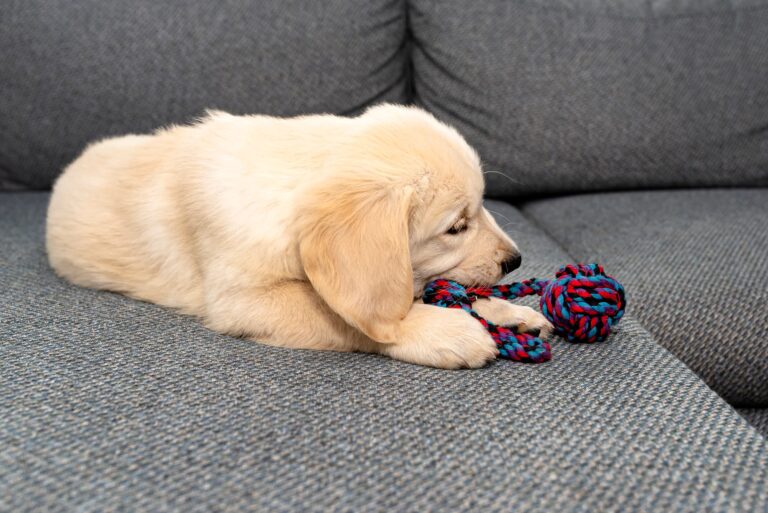
According to the AKC, keeping a chew toy within reach at all times is one of the most practical and effective strategies. The moment biting starts, immediately redirect to the toy.
- Keep a chew toy in your pocket or nearby at all times during play
- The moment your puppy’s teeth make contact with skin, immediately offer the toy
- When they take the toy, praise enthusiastically
- If they ignore the toy and go back to your skin, end play for 10–20 seconds
This method teaches your puppy that teeth on skin ends the fun, while teeth on a toy keeps it going. It’s simple, effective, and teachable to children and visitors who interact with your puppy.
Method 3: Time-Outs (For Persistent Biters)
According to the ASPCA, time-outs are very effective for curbing mouthing in puppies that don’t respond immediately to yelping. When your puppy delivers a hard bite, calmly say ‘too bad’ or ‘oops’, stand up, and leave the room or put your puppy briefly in a calm space — not as punishment, but as a clear consequence. Used consistently alongside redirection and praise, time-outs are one of the most reliable methods for how to stop a puppy from biting without damaging your bond.
Key rules for effective time-outs when working on how to stop a puppy from biting: keep them short — 10 to 30 seconds. Be completely calm — no drama or anger. Return and re-engage immediately after. Never use the crate as a time-out space — the crate must always remain associated with positive things.
Method 4: Tug-of-War with Rules (For Toy-Motivated Puppies)
Contrary to old advice, tug-of-war is actually one of the most effective tools for how to stop a puppy from biting through bite inhibition — when played with specific rules. A University of Southampton/Bristol study by researchers Rooney and Bradshaw found that dogs scored higher for “obedient attentiveness” toward their owner after playing tug-of-war, regardless of whether the dog or the human won — debunking the old myth that letting a dog win makes it more dominant or harder to control.
- Use a dedicated tug toy only — never hands or clothing
- Stop immediately if teeth touch skin — game over the moment it happens
- You control when the game starts and ends — ask for a sit before starting each round
- ‘Drop it’ ends the game — teach this separately and use it to conclude each session
What Causes Sudden Biting — The Overtired Puppy
This one is underrated. According to the AKC, sometimes a biting puppy is really just an overtired puppy. Puppies need 18–20 hours of sleep daily according to behavioural research. When they become overtired, they lose impulse control — biting becomes uncontrollable and redirection stops working.
If your puppy’s biting suddenly becomes frenzied and they seem unable to stop or redirect, they need a nap. Gently put them in their crate with a chew toy and let them sleep. The biting will usually resolve completely with rest.
| 🐾 The exercise rule A widely used veterinary guideline recommends limiting structured puppy exercise to about 5 minutes per month of age, twice daily. A 3-month-old puppy needs roughly 15 minutes of structured exercise twice a day — not more. Over-exercised puppies become overtired and bite more, not less. |
What NOT to Do
- Never use physical punishment — scruffing, alpha rolls, holding the mouth shut, tapping the nose. According to PetMD, these methods increase fear and can trigger aggression. They consistently produce worse outcomes than positive methods.
- Never yell — an excited reaction can increase arousal and worsen biting
- Never pull your hand away quickly — fast movement triggers prey instinct and escalates biting
- Never punish biting after the fact — if you find teeth marks but didn’t catch the bite happening, there’s nothing to correct. Your puppy cannot connect the punishment to the earlier behaviour
How to stop a puppy from biting? The Role of Socialisation
Puppy classes are one of the most powerful tools for bite inhibition. According to PetMD, puppies in classes learn to read other dogs’ body language, experience natural bite inhibition feedback from peers, and develop bite control faster than puppies trained in isolation. The AKC’s S.T.A.R. Puppy program or any well-run local class provides this invaluable peer interaction.
Interaction with vaccinated, well-socialised adult dogs also helps enormously. Adult dogs are skilled at canine communication and will often provide immediate, appropriate corrections when puppy play becomes too rough — corrections that humans simply cannot replicate with the same precision.
When to Get Professional Help
Biting that causes broken skin regularly, biting accompanied by growling or stiffening, biting from fear rather than play, or biting that shows no improvement after 4–6 weeks of consistent training — these all warrant a consultation with a certified professional dog trainer (CPDT) or veterinary behaviourist. Learning how to stop a puppy from biting early makes a significant difference. Waiting until the puppy is larger makes the issue much harder and riskier to address.
Frequently Asked Questions
| Q: When do puppies stop biting?A: According to Chewy, most puppies begin to outgrow biting around 8 to 10 months old, coinciding with the completion of teething and increased maturity. With consistent training, most owners see significant improvement by 5 to 6 months. Without training, biting can persist into adulthood. |
| Q: My puppy bites my ankles when I walk. How do I stop it?A: This is classic prey drive — moving feet and legs look like prey. One of the most practical answers to how to stop a puppy from biting ankles is simply to stop moving the moment they grab you. Standing still removes the stimulus. Then redirect to a toy. Carrying a toy with you when moving around the house and letting them chase the toy instead of your feet is a highly effective management strategy. |
| Q: Why does my puppy bite me but not other people?A: They’re most comfortable with you — which counterintuitively means they’re more likely to play-bite with you. They also know their behaviour with you has no consequence. Be consistent with your yelp-and-redirect response and ensure visitors respond the same way. |
| Q: Is it normal for puppy biting to get worse before it gets better?A: Yes — biting often increases during the 12–16 week teething phase before it begins to reduce. Puppies whose biting suddenly intensifies at this age are usually just in peak teething discomfort. Frozen toys and chew items specifically designed for teething puppies can provide significant relief. |
Related: our guide on how to teach a dog to drop it covers this in more depth.
| ⚠️ Disclaimer This article – how to stop a puppy from biting – is for informational purposes only and does not constitute professional veterinary or training advice. Every dog is different. If your puppy’s behaviour is severe or causing harm, consult a certified professional dog trainer or veterinary behaviourist. |
This article is written for informational purposes and reflects the personal experience and research of the author. It does not replace professional veterinary or dog training advice. Always consult your veterinarian or a certified trainer for individual guidance.