

Dogs communicate constantly — through their body, their eyes, their tail, their ears, and their behaviour. The challenge is that dog behaviour can look confusing or even alarming when you don’t know what you’re looking at. This complete guide to dog behaviour and body language explains what your dog is really telling you, from the obvious (tail wagging) to the subtle (grass eating, staring, and licking), so you can respond appropriately and strengthen your relationship.
Understanding dog behaviour and body language
Every part of a dog’s body carries information. Reading that information accurately means looking at the whole picture — ears, eyes, mouth, tail, posture, and hackles together — rather than any single signal in isolation. A wagging tail on a relaxed dog means something very different from a wagging tail on a stiff, tense dog.
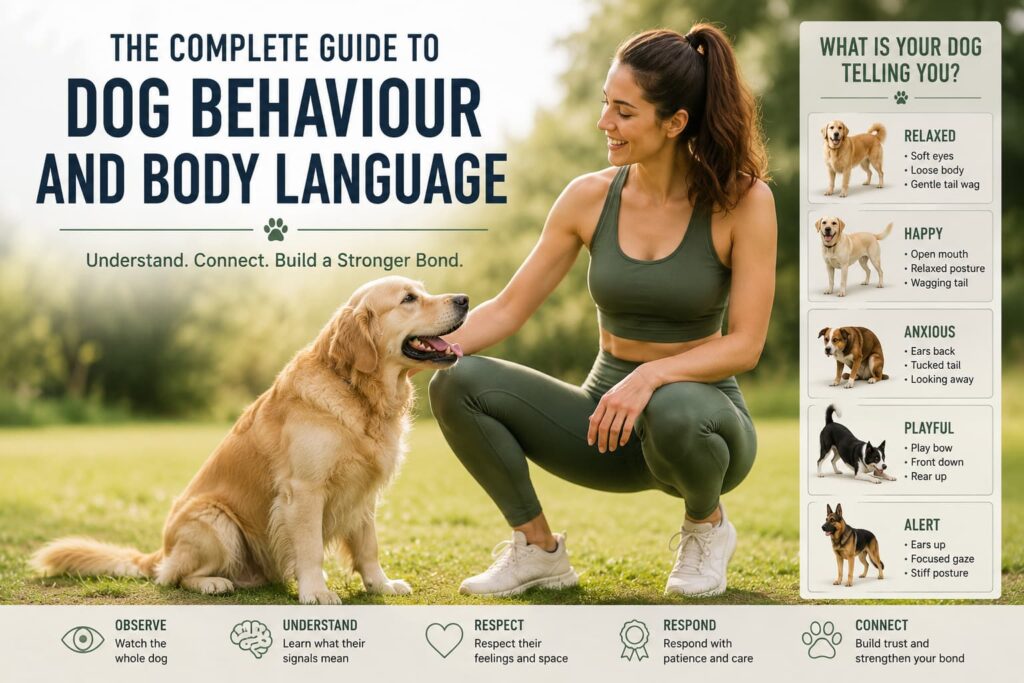
The ASPCA identifies the following as key indicators of a dog’s emotional state:
- Relaxed dog: Soft eyes, mouth slightly open, ears in natural position, tail carried at neutral height with loose wag, weight distributed evenly
- Alert dog: Eyes wide, ears forward, mouth closed, tail raised and still — processing something interesting or uncertain
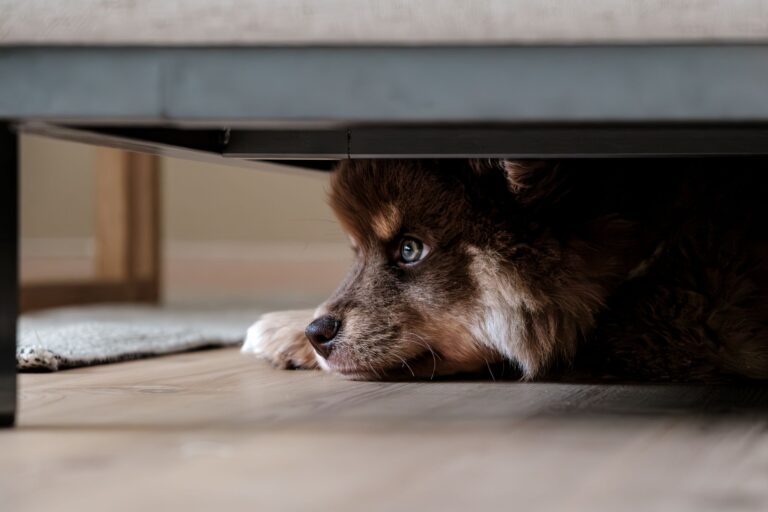
- Anxious dog: Whale eye (white of the eye visible), ears back or flat, yawning, lip licking, tail tucked, body low or turned sideways
- Fearful dog: Cowering, tail deeply tucked, weight shifted back, may tremble, may growl or snap if cornered
- Aroused/overstimulated: Hackles raised, rigid posture, fixed gaze, stiff tail — needs immediate de-escalation
Understanding these signals before problems escalate is one of the most important skills a dog owner can develop. Our comprehensive dog behaviour and body language guide covers every signal in detail →
Why Do Dogs Wag Their Tails?
Tail wagging is one of the most misunderstood signals in dog behaviour. Most people assume it always means happiness — but that’s an oversimplification. Dogs wag their tails to communicate emotional arousal, which can be positive or negative.
Research has found that dogs wag their tails to the right when experiencing positive emotions and to the left when experiencing negative ones — a reflection of how the brain’s two hemispheres process different emotional states. The height of the tail also matters: a tail held high and wagging quickly signals high arousal and can indicate either excitement or agitation, while a loose, mid-height wag typically signals a relaxed, friendly dog.
Full explanation: why do dogs wag their tails? →
Why Does My Dog Stare at Me?
Dogs stare at their owners for several reasons, and context determines which one applies. In most cases, a dog staring at you is a positive sign — it’s how dogs express attention, connection, and love. Mutual gazing between dogs and their owners triggers oxytocin release in both species, the same bonding hormone involved in parent-child attachment.
However, staring can also mean your dog wants something (food, a walk, attention), is waiting for a cue, or — in some contexts — is communicating stress or a challenge. A hard, unblinking stare with a stiff body is a warning signal, not affection. Knowing the difference is important. Why does my dog stare at me all the time? →
Why Does My Dog Eat Grass?
Grass eating is one of the most common dog behaviours that worries owners — and in most cases, it’s completely normal. Dogs eat grass for a variety of reasons: to add fibre to their diet, to soothe an irritated stomach, out of boredom, or simply because they like the taste or texture.
The idea that dogs eat grass only when they’re sick and trying to induce vomiting is a myth. Studies show that less than 25% of dogs that eat grass actually vomit afterwards, and the majority don’t appear ill before eating it. Occasional grass eating on an otherwise healthy, well-fed dog is not a cause for concern. Frequent grass eating accompanied by other symptoms — lethargy, loss of appetite, repeated vomiting — warrants a vet call.
Why does my dog eat grass and vomit? Full explanation →
Why Does My Dog Lick Me?
Licking is one of the primary ways dogs communicate affection, submission, and attention-seeking. Puppies are licked by their mothers from birth, and licking becomes deeply embedded as a bonding behaviour. When your dog licks your face, they’re typically expressing affection, greeting you, or seeking attention — the dog equivalent of a hug.
Some dogs also lick as a self-soothing behaviour when anxious, or because they’ve learned that licking gets a reaction from their owner (even a “stop that!” is attention). What does it mean when a dog licks your face? →
How to Stop a Dog from Licking Everything
Compulsive licking — of floors, furniture, paws, or their own body — is a different behaviour from social licking and often signals something that needs addressing. Common causes include allergies (particularly food allergies or environmental allergens that cause skin irritation), anxiety and boredom, pain or discomfort at the site being licked, or a compulsive behaviour disorder.
If your dog is excessively licking a specific body part, rule out physical causes first — skin infection, injury, or allergies are often the culprit. If the licking is generalised (floors, walls, objects), consider anxiety or nutritional factors. How to stop a dog from licking everything →
Why Is My Dog Scared of Loud Noises?
Noise phobia is one of the most common anxiety disorders in dogs. Fireworks, thunderstorms, gunshots, and construction sounds can trigger panic responses ranging from mild trembling to destructive behaviour, self-injury, and attempts to escape. The fear is real and can be severe — and it tends to worsen with each exposure if left unmanaged.
Dogs hear frequencies and volumes that humans cannot, which means sounds that are unpleasant to us are potentially overwhelming for them. Breeds with a history of high emotional sensitivity — Border Collies, German Shepherds, Lagotto Romagnolos — tend to be particularly prone to noise phobia.
Management options include: creating a safe, muffled space; using white noise or classical music; anxiety wraps; pheromone diffusers; desensitisation and counter-conditioning training; and in severe cases, veterinary-prescribed medication. Why is my dog scared of loud noises — and what to do →
Why Does My Dog Have a Sudden Fear of Strangers?
A dog that was previously social suddenly becoming fearful of strangers is a behaviour change that deserves attention. The most common explanations include: a negative experience with a person during a critical developmental window (the secondary fear period, which occurs around 6–14 months), insufficient socialisation during puppyhood, an illness or pain that makes them feel vulnerable, or age-related cognitive changes in older dogs.
Fear of strangers is best addressed through systematic desensitisation — controlled, positive exposure to strangers at the dog’s own pace, with high-value rewards for calm responses. Forcing a fearful dog to accept interaction from strangers makes the problem worse. Why does my dog have a sudden fear of strangers? →
Signs a Dog Is Depressed
Dogs experience emotional states analogous to depression, though the exact neurological mechanisms differ from human depression. Changes in routine, loss of a companion (human or animal), chronic stress, illness, or simply insufficient stimulation can all cause a dog to show depressive behaviours.
Signs that your dog may be depressed include: loss of appetite or disinterest in food they previously enjoyed; withdrawal from family and reduced interest in interaction; sleeping significantly more than usual; loss of interest in walks, play, or activities they normally enjoyed; and increased vocalisation (whining or howling) or decreased vocalisation in normally vocal dogs.
If these signs appear suddenly and persist for more than a week or two, a vet visit is worthwhile to rule out physical causes first. Signs a dog is depressed — full guide →
Dog Behaviour and Training
Understanding dog behaviour is the foundation of effective training. When you know why a dog does something — the motivation, the trigger, the emotional state behind the behaviour — you can address it appropriately rather than simply suppressing it. A dog that jumps because they’re anxious needs a different approach from a dog that jumps because they’ve been rewarded for it.
Modern dog training is built on understanding behaviour science: reinforcement drives behaviour, punishment suppresses it without addressing the underlying cause, and the relationship between dog and owner is the single biggest factor in training success. For everything from basic commands to resolving problem behaviours, see our complete dog training guide.
Dog Behaviour FAQs
Why does my dog follow me everywhere?
Dogs are social animals that evolved to stay close to their group. Following you from room to room is normal bonding behaviour for most dogs. It becomes a concern only if your dog cannot cope with any separation — whining, panting, or becoming destructive when you leave — which may indicate separation anxiety requiring professional help.
Why does my dog yawn when I pet them?
Yawning is a calming signal in dogs — a way of self-soothing when they feel mildly stressed or are trying to de-escalate a tense situation. If your dog yawns when you pet them, it may mean the petting is too intense, in a location they find uncomfortable, or occurring at a moment when they’d prefer to be left alone. It’s not rudeness — it’s communication.
Why does my dog roll in smelly things?
Rolling in strong-smelling substances — fox poo is the classic example — is thought to be an ancestral behaviour related to camouflaging their own scent. It may also be a way of bringing interesting scent information back to the pack. Whatever the evolutionary reason, the behaviour is deeply rewarding for the dog, which is why it’s so difficult to interrupt. Recall training and vigilant observation in the field are the main prevention strategies.
Why does my dog sit on my feet?
Sitting on or leaning against your feet is a bonding behaviour that expresses comfort and affiliation. It’s also a mild form of proximity-seeking — your dog wants to be close to you and your feet are a convenient resting spot. In most dogs it’s simply affectionate. In dogs with separation anxiety, it can be part of a pattern of excessive attachment.
Is dog behaviour different by breed?
Yes, significantly. Selective breeding has shaped breed-specific behavioural tendencies over hundreds of years. Herding breeds have strong impulse control and eye-stalk behaviours. Terriers have high prey drive and tenacity. Scent hounds are easily distracted by their nose. Guarding breeds are naturally suspicious of strangers. These tendencies are not rigid rules — individual dogs vary enormously — but they set the baseline from which training and socialisation work.
This article is written for informational purposes and reflects the personal experience and research of the author. It does not replace professional veterinary or dog training advice. Always consult your veterinarian or a certified trainer for individual guidance.
This article is written for informational purposes and reflects the personal experience and research of the author. It does not replace professional veterinary or dog training advice. Always consult your veterinarian or a certified trainer for individual guidance.
This article is written for informational purposes and reflects the personal experience and research of the author. It does not replace professional veterinary or dog training advice. Always consult your veterinarian or a certified trainer for individual guidance.