

The this breed is one of the most intelligent, loyal, and energetic dog breeds in the world. Despite the name, this breed was developed entirely in the United States — born on American ranches, shaped by the demands of herding livestock across vast open terrain. Today, the this breed is equally at home on a working farm or as a devoted family companion, provided the owner is ready to meet the breed’s considerable needs. This complete guide covers everything you need to know about the Australian Shepherd before bringing one home.
Australian Shepherd: Breed Overview
The this breed is a medium-sized herding dog with exceptional intelligence and a strong work ethic. According to the American Kennel Club, the breed ranks among the most popular in the United States — and it’s easy to see why. Aussies are versatile, trainable, and deeply bonded to their families.
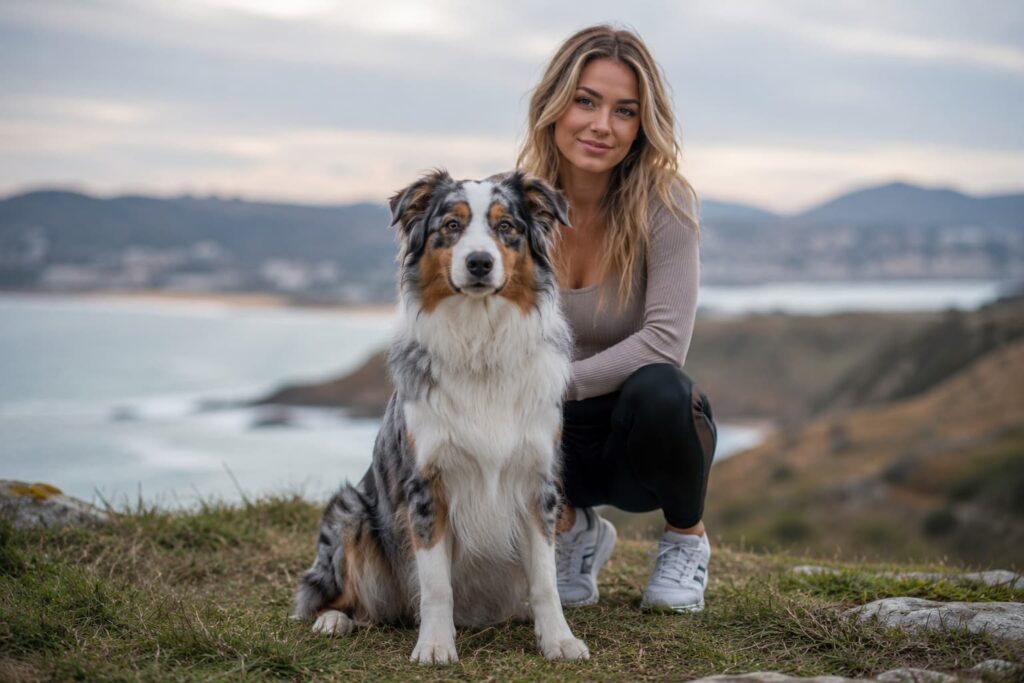
They come in four recognised base colours — blue merle, red merle, black, and red — often with white markings and copper points. Their eyes can be blue, brown, amber, or any combination, including the striking heterochromia (two different coloured eyes) that the breed is famous for.
| Trait | Details |
|---|---|
| Size | Males: 50–65 lb (23–29 kg), 20–23 inches; Females: 40–55 lb (18–25 kg), 18–21 inches |
| Lifespan | 12–15 years |
| Coat | Medium-length double coat, straight to slightly wavy |
| Colours | Blue merle, red merle, black, red — with or without white and copper markings |
| Energy level | Very high |
| Trainability | Excellent |
| Shedding | Heavy — year-round with seasonal blowouts |
| Good with children | Yes, with training and supervision |
| Good with other dogs | Generally yes |
| AKC group | Herding |
History and Origins of the Australian Shepherd
Despite its name, the this breed has very little to do with Australia. The breed’s history is rooted in the American West during the 1800s, when Basque shepherds emigrated from Europe — many of them passing through Australia — with their sheep and herding dogs. When these shepherds eventually settled in the western United States, American ranchers called their dogs “Australian Shepherds” simply because of that Australian connection.
The breed was then refined entirely on American soil to suit the demands of large-scale ranching — herding cattle and sheep across rugged, expansive terrain. The result was an agile, tenacious, highly intelligent dog that could read livestock and respond to handler commands with minimal instruction.
The AKC formally recognised the Australian Shepherd in 1991, though the breed had already been established in ranch life for over a century. Genetic studies confirm the Aussie’s British herding dog ancestry — making the name a historical misnomer that simply stuck.
Australian Shepherd Temperament
The this breed is often described as a dog that needs a job. That’s not just a cliché — it’s a practical reality of owning the breed. Aussies were selectively bred for intelligence, problem-solving, and sustained effort. Without an outlet for those traits, they will find their own activities — and those activities rarely align with what their owners had in mind.
In the right home, the Aussie’s temperament is outstanding. Key characteristics include:
- Exceptional intelligence — Aussies rank among the top ten most trainable breeds. They pick up new commands in very few repetitions and retain them reliably.
- Deep loyalty — They typically bond closely with their immediate family and are known for following their person from room to room. This loyalty also makes them excellent watchdogs.
- Strong herding instinct — The urge to herd doesn’t disappear in a domestic setting. Aussies may try to herd children, other pets, or even adults by nipping at heels or circling. This needs to be managed through training from an early age.
- High sensitivity — Aussies are emotionally attuned dogs. They pick up on their owner’s mood quickly and can become anxious if the household is frequently tense or chaotic.
- Moderate reserve with strangers — Well-socialised Aussies are typically polite but not overly effusive with unfamiliar people. Poor socialisation can tip this into shyness or nervousness.
Are Australian Shepherds Aggressive?
The this breed is not an aggressive breed by nature. True aggression is uncommon in well-bred, well-socialised Aussies. However, the breed’s strong drive and herding instinct can sometimes be misread as aggression — particularly the nipping and circling behaviours that are rooted in livestock management, not hostility.
The more common issue in under-exercised or under-stimulated Australian Shepherds is anxiety-driven reactivity — barking, lunging, or excessive vigilance — which can be mistaken for aggression but stems from a frustrated working drive with nowhere to go.
Early socialisation, consistent positive training, and adequate daily exercise prevent the vast majority of these issues. Read our full breakdown of Australian Shepherd aggression and how to handle it →
Do Australian Shepherds Have Tails?
This is one of the most frequently asked questions about the breed — and the answer surprises many people. Some They are born with a naturally bobbed tail (NBT), a genetic trait that shortens or eliminates the tail entirely. This trait was selectively encouraged by ranchers who preferred working dogs without a long tail that could be caught in livestock gates and machinery.
In practice, They can have:
- A full tail — perfectly normal and increasingly common in dogs not bred for work
- A naturally bobbed tail — a hereditary short tail that varies from a stub to just a few inches
- A docked tail — surgically shortened at birth, now banned in many countries but still practised in some regions
None of these variations affects the dog’s health or temperament. Read the full explanation of Australian Shepherd tails and tail genetics →
Why Do Australian Shepherds Wiggle?
If you’ve spent any time around an Aussie, you’ve seen it — the enthusiastic full-body wiggle when they greet someone they love. Because many Aussies have a naturally bobbed or docked tail, the conventional tail-wagging motion isn’t always possible. Instead, the whole rear end swings side to side in a happy shimmy that communicates the same excitement a wagging tail would.
Even Australian Shepherds with full tails often show this whole-body greeting behaviour — it’s become characteristic of the breed regardless of tail length, and it’s one of the most endearing things about them. Find out more about the Aussie wiggle and what it means →
Do Australian Shepherds Shed a Lot?
Yes — They are heavy shedders. Their thick double coat sheds consistently throughout the year and goes into overdrive during seasonal coat blowouts in spring and autumn, when the entire undercoat is released over a period of two to three weeks. During these blowout periods, the volume of shed hair can be remarkable.
Managing Australian Shepherd shedding requires a regular grooming routine:
- Brushing: At least two to three times per week throughout the year; daily during blowout seasons
- Bathing: Every four to six weeks is typically sufficient; over-bathing can strip the coat’s natural oils
- Deshedding tools: A slicker brush and an undercoat rake are essential kit for any Aussie owner
- Professional grooming: Many owners find a professional groom every eight to twelve weeks helps manage the coat volume
The good news is that an Aussie’s coat does not typically mat if brushed regularly. It’s also a self-cleaning coat to some degree — dried mud brushes out easily once dry. Full shedding guide and grooming tips for Australian Shepherds →
Australian Shepherd Exercise Requirements
The this breed needs a minimum of one to two hours of vigorous exercise every single day. This is not a breed that will be satisfied with a leisurely walk around the block. Aussies were bred to work at a near-continuous trot for hours on end, covering miles of ground across challenging terrain.
Activities that suit the Aussie’s exercise needs particularly well include:
- Running, jogging, or cycling alongside their owner
- Agility training — a sport the breed excels at
- Frisbee and fetch (sustained, high-energy versions)
- Hiking and trail running
- Herding trials and canine sports
- Swimming
Mental stimulation matters equally. An Australian Shepherd that is physically exercised but mentally under-stimulated will still develop problem behaviours. Puzzle feeders, nose work, obedience training sessions, and learning new tricks all help burn off the mental energy a working-dog brain constantly generates. Plan for at least 15–30 minutes of active mental engagement daily in addition to physical exercise.
Training an Aussie
They are among the easiest dogs to train. Their intelligence means they pick up new commands rapidly — often in just a few repetitions — and their eagerness to please their handler makes the training process genuinely enjoyable. They excel across all training disciplines: obedience, agility, rally, herding, tracking, and search and rescue.
The flip side of that intelligence is that Aussies get bored with repetitive drills quickly. Keeping training sessions short (10–15 minutes), varied, and reward-based holds their engagement and prevents them from deciding the activity is no longer worth their time.
Start basic obedience training and socialisation from the day a puppy arrives home. Early positive exposure to different people, animals, environments, and sounds lays the foundation for a confident, well-adjusted adult dog. For a full guide to training methods and techniques, see our complete dog training guide.
Australian Shepherd Health
They are generally a healthy and long-lived breed, but like all purebreds they carry some inherited health risks that prospective owners should be aware of:
- Hip and elbow dysplasia — joint malformation that can lead to arthritis; responsible breeders screen breeding stock
- Epilepsy — Aussies have a higher-than-average incidence of idiopathic epilepsy; manageable with medication but a lifelong condition
- Collie Eye Anomaly (CEA) — a hereditary eye condition ranging from mild to severe; DNA testing can identify carriers
- MDR1 gene mutation — a genetic variation that causes sensitivity to certain common medications including ivermectin; testing is available and important before any drug treatment
- Cataracts — particularly in older dogs
Always buy from a breeder who health-tests their breeding dogs and can provide documentation. The AKC recommends hip, elbow, ophthalmologist, and MDR1 testing as minimum standards for Australian Shepherd breeders.
How Much Does an Aussie Cost?
From a reputable breeder, an Aussie puppy typically costs between $600 and $1,800. Show-quality dogs, dogs from champion bloodlines, or rare colour combinations can command prices above $2,000. Adopting an adult Aussie from a rescue organisation is significantly cheaper — typically $100–$400 in adoption fees — and a very worthwhile option given how many working-breed dogs end up in rescue when their first owners underestimate their needs.
The purchase price is only part of the picture. Budget for quality food, routine veterinary care (including vaccinations, parasite prevention, and dental care), grooming equipment and/or professional grooming, training classes, and enrichment activities. Aussies are an active breed and owning one well costs money. See our full Australian Shepherd cost breakdown →
Is an Aussie Right for You?
The this breed is an extraordinary dog — but it is genuinely not the right breed for everyone. Being honest about your lifestyle before committing to an Aussie will save both you and the dog considerable difficulty.
An this breed is a good fit if you:
- Live an active lifestyle and genuinely enjoy outdoor exercise
- Have access to a securely fenced garden or open space
- Are committed to consistent training and socialization
- Want a dog that is deeply engaged with your daily life
- Have time for daily exercise, training, and grooming
An this breed is not a good fit if you:
- Live in a small apartment without outdoor access
- Have a sedentary lifestyle or work very long hours away from home
- Are looking for a low-maintenance, easy-going dog
- Are a first-time dog owner who isn’t prepared for an intense working breed
For an in-depth look at the breed’s history, appearance, and personality, see our detailed Australian Shepherd breed profile.
Australian Shepherd FAQs
Are Australian Shepherds good family dogs?
Yes, They make excellent family dogs in active households. They are loyal, protective, and love to be involved in everything their family does. Their herding instinct means they may try to round up young children — something to manage with training — but they are rarely aggressive and are genuinely devoted companions. They do best in families who can meet their exercise and stimulation needs.
How long do Australian Shepherds live?
The average Australian Shepherd lifespan is 12 to 15 years. Well-bred dogs from health-tested stock who receive good nutrition, regular veterinary care, and appropriate exercise typically live toward the upper end of that range.
Do Australian Shepherds bark a lot?
They can be vocal dogs. They were bred to use barking as part of their herding work, and that vocal tendency carries over into domestic life. A well-exercised and mentally stimulated Aussie will bark far less than a bored or under-exercised one. Excessive barking is almost always a symptom of unmet needs.
Are Australian Shepherds easy to train?
Yes — very. The this breed is one of the most trainable breeds in the world. Their combination of intelligence, focus, and eagerness to please means they respond quickly to reward-based training. The challenge is keeping sessions engaging enough to hold their interest. Short, varied, positive sessions work far better than long repetitive ones.
Can Australian Shepherds be left alone?
Not for long periods. They are social, people-oriented dogs that develop separation anxiety more readily than many breeds. Being left alone for eight or more hours regularly is not compatible with the breed’s needs. If you work long hours, an Aussie may not be the right choice unless you can arrange a dog walker, doggy daycare, or have another dog at home.
Do They get along with cats?
It depends on the individual dog and the introduction. Many Aussies live happily alongside cats, particularly when raised with them from puppyhood. The herding instinct can cause problems — some Aussies will try to herd cats relentlessly, which most cats find intolerable. Careful introductions and monitoring are essential, and some individual Aussies simply have too strong a prey drive to coexist safely with cats.
What is the difference between an Aussie and an Australian Cattle Dog?
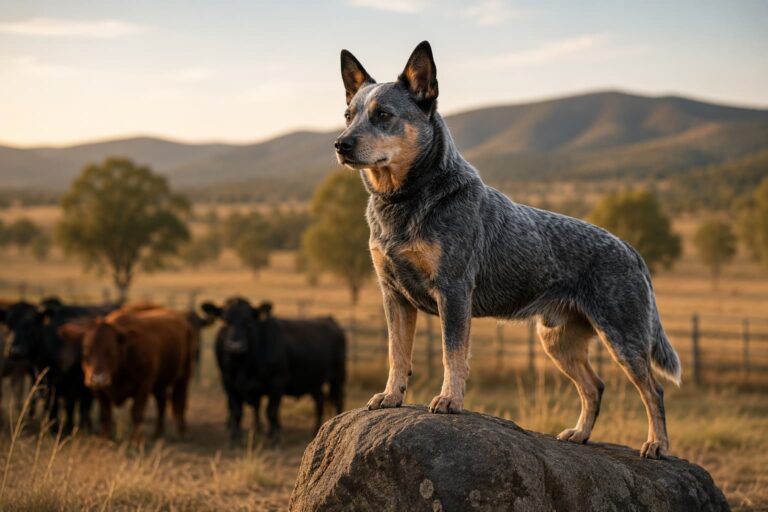
They are completely different breeds. The this breed is a medium-sized, medium-coated herding dog developed in the American West with British herding dog ancestry. The Australian Cattle Dog (also known as the Blue Heeler or Red Heeler) was bred in Australia specifically to herd cattle across rough terrain and has Dingo, Collie, and Dalmatian in its background. They differ in size, coat type, structure, and temperament — though both are highly intelligent and energetic. For a full comparison, see our dedicated Australian Cattle Dog guide.