Rescue Dog Scared of Men: What to Do and Why It Happens
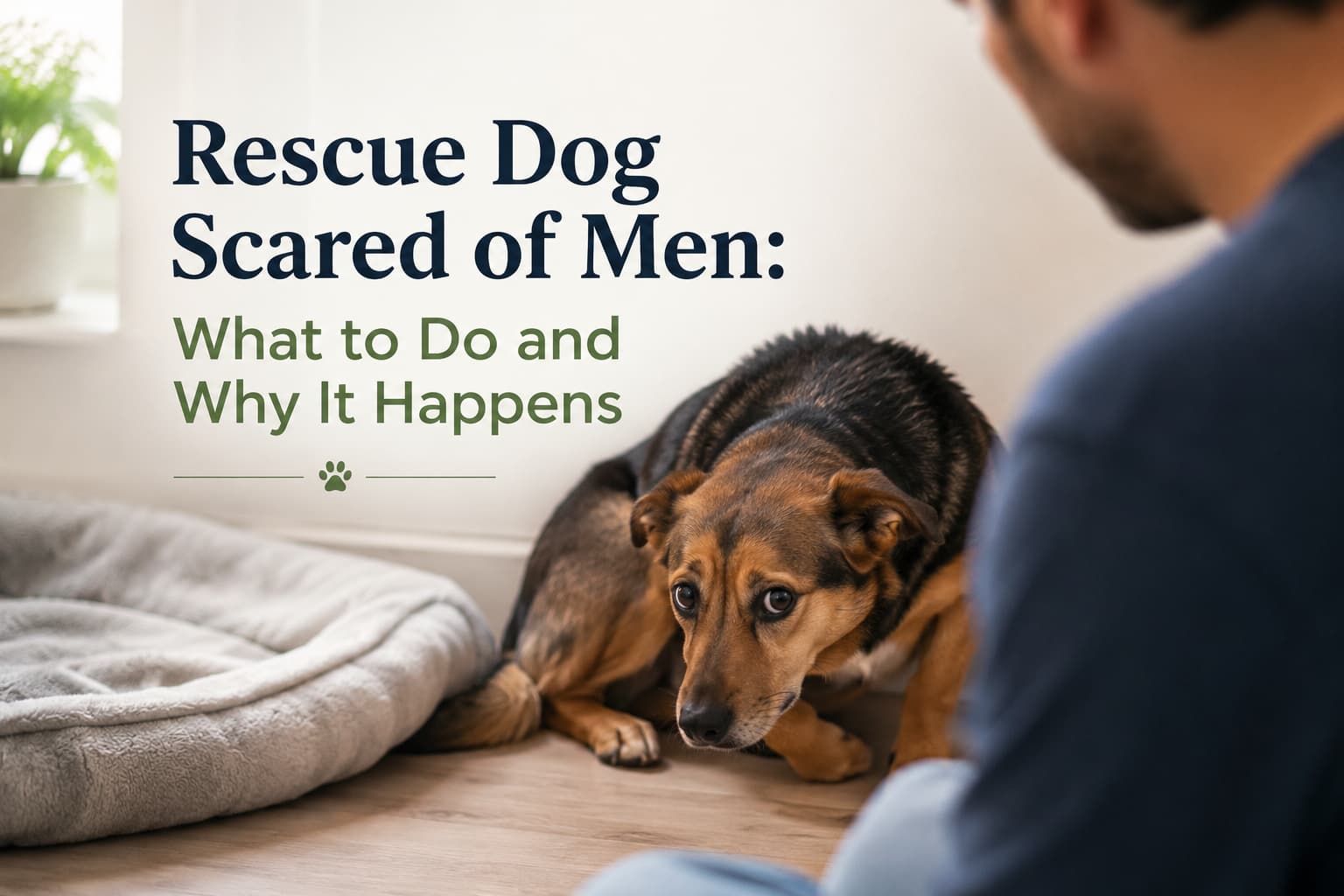
Table of Contents
A rescue dog scared of men is one of the most common — and most misunderstood — situations that comes up in newly adopted dogs. It is also one of the situations most likely to create genuine heartbreak in a household, particularly when the person the dog fears is trying their hardest to build a relationship and getting nowhere.
I have seen this play out in my own extended family — a rescue dog who adored my sister-in-law within days and visibly tensed every time her husband walked into the room. It was not personal, and it was not really about him specifically. Understanding that distinction is the first step to actually helping, rather than taking it as a verdict on the relationship.
A rescue dog scared of men is remarkably common, and it affects families across every demographic. It is not a reflection of anything the man in question has done. Once you understand why it happens, the path to building trust becomes much clearer — and considerably less discouraging. Our guides on building confidence in a dog that startles easily and reading fear-based aggression warning signs pair well with the approach below.
Why So Many Rescue Dogs Fear Men Specifically
There is rarely one single cause behind a rescue dog scared of men, and it is important not to assume abuse as the default explanation. According to the American Kennel Club, several genuine, non-traumatic factors can contribute independently of any mistreatment at all:
- Physical size and presence — men are typically larger and taller, and for a small or medium dog, looking up at a much bigger figure can feel inherently more threatening.
- Voice pitch — deeper, louder male voices carry differently and can be startling to a dog with limited prior exposure to them.
- Movement style — longer strides and more direct, abrupt movement patterns can read as predatory to a sensitive dog, even when there is no threatening intent at all.
- Limited early socialisation — if a dog’s critical socialisation window (roughly 3 to 14 weeks of age) involved mostly female caregivers, an unfamiliarity gap with men specifically can develop.
- Scent differences — male hormones and common male-associated scents, such as aftershave or different workplace smells, are detectable to a dog’s far more sensitive nose and can register as unfamiliar.
- Past experience — some dogs genuinely have had a negative experience with a man, but this is one possible explanation among several, not the default assumption.
Reading the Severity — A Practical Guide
Recognising where your rescue dog scared of men sits on the fear spectrum changes how you should respond. Pushing a dog past mild discomfort into moderate or severe territory can set back progress significantly.
| Severity | What It Looks Like | What to Do |
|---|---|---|
| Mild | Stiffening, leaning away, lip licking, yawning, sudden intense sniffing, avoiding eye contact | Note the trigger. No intervention needed beyond giving space. This is the easiest stage to work with. |
| Moderate | Lowered body, tail tucked, ears flattened, whale eye (whites showing), raised hackles, trembling | Increase distance immediately. Do not force closer. Begin counterconditioning at this distance only. |
| Severe | Growling, barking, lunging, snapping, frozen and unable to move, hiding with refusal to emerge | Stop the interaction entirely. Create more distance. Consult a certified trainer or veterinary behaviorist before continuing exposure work. |
How to Help a Rescue Dog Scared of Men Build Trust
Let the man become the source of good things
The single most effective shift is making male presence predictably positive rather than neutral or threatening. This starts indirectly — a man quietly dropping high-value treats near the dog without making eye contact, without approaching, without any expectation of interaction. Over repeated sessions, the dog begins to associate that specific person’s presence with something genuinely good, independent of any direct interaction at all. The team at Fear Free Happy Homes recommends exactly this kind of low-pressure, no-expectations approach for building trust.
Adjust body language deliberately
Small physical changes make a real difference to how a rescue dog scared of men perceives a man’s presence. Turning side-on rather than facing the dog directly, sitting or kneeling rather than standing over them, moving slowly and in curves rather than straight lines, and avoiding direct eye contact all remove the cues a fearful dog reads as threatening.
Use distance correctly
Counterconditioning only works when the dog notices the trigger without being overwhelmed by it. If your dog cannot take treats, will not look away from the man, or shows any moderate-to-severe signs from the table above, you are too close. Back up until the dog can relax, then work from there.
Coordinate with every household member
Consistency between everyone in the house matters enormously when you are helping a rescue dog scared of men. Decide together how the man will approach, how loudly people will speak, and how everyone will respond if the dog shows fear. Mixed approaches — one person pushing interaction while another holds back — confuse the dog and slow progress.
Be patient with the human side of this too
It is genuinely difficult to be the person a dog is afraid of, especially when you are trying hard to connect. Initial improvement often appears within a few weeks, but real, durable progress with a rescue dog scared of men typically takes three to six months of consistent, low-pressure work. Setbacks do not erase the progress already made — they are a normal part of the process, not evidence that it is not working.
Tools That Can Help Along the Way
A few tools tend to make life easier for a rescue dog scared of men, though none of them replace the step-by-step work above. A calming pheromone diffuser such as Adaptil can take the edge off background stress during sessions. Small, high-value training treats reserved only for these sessions help build a strong positive association faster. For dogs whose fear is severe or not improving, a certified professional trainer can tailor the process, and in some cases a veterinarian may discuss an anti-anxiety supplement or medication as a supporting tool alongside training rather than a replacement for it.
When to Bring in Professional Help
If progress stalls completely over several weeks despite consistent effort, if the fear response escalates rather than easing, or if there is any safety concern for the dog or anyone in the household, a certified professional dog trainer or veterinary behaviourist experienced with fear-based behaviour is the right next step.
Hill’s Pet notes that in some cases of more severe fear, a vet may also discuss anti-anxiety medication as a tool to support behaviour modification — not as a replacement for it. Our complete dog training guide is a useful next stop if you want to go deeper on counterconditioning technique.
Frequently Asked Questions
Will my dog ever completely get over their fear of men?
Many dogs make remarkable progress, and a rescue dog scared of men can build genuinely comfortable relationships with the men in their household. Some retain certain sensitivities even after significant improvement — complete comfort with every man in every situation is a high standard that not every formerly fearful dog will reach, and that is alright. Meaningful improvement is a realistic and achievable goal even when complete resolution is not.
Should male visitors avoid our home while we work on this?
During the early stages, limiting exposure to unfamiliar men helps prevent setbacks and gives your dog time to build a foundation with the men already in the household. As progress continues, carefully planned introductions to new men who understand the right approach can actually help the dog generalise their growing comfort more broadly.
Is this fear definitely caused by past abuse?
Not necessarily for a rescue dog scared of men, and it is worth resisting that assumption. While past negative experiences with men are one possible cause, physical size, voice pitch, movement patterns, limited early socialisation, and scent differences can all contribute independently of any mistreatment at all. Most rescue dogs come with unknown histories, and assuming the worst is rarely helpful or accurate.
How quickly should I expect to see any improvement?
Most households notice small signs of progress within two to four weeks of consistent, low-pressure work — a shorter recovery time after a startle, or a willingness to take treats from a slightly closer distance. Full, durable comfort with a rescue dog scared of men usually takes three to six months, and sometimes longer for dogs with a more severe starting point.
What if my dog is relaxed with men outside the home but scared of my husband specifically?
This is common and usually comes down to proximity and expectation rather than anything your husband is doing wrong. A man living in the home is expected to interact more, stand closer, and share space more often than a stranger passed on a walk, which can actually make the relationship feel higher-pressure to the dog. The same trust-building steps above apply, just with extra patience, since a rescue dog scared of men in the household needs consistent low-pressure exposure rather than fewer opportunities to adjust.
| Training Disclaimer: This article reflects the personal experience and research of the author and is for informational purposes only. It does not replace guidance from a certified professional dog trainer or veterinary behaviorist, particularly for dogs showing signs of fear-based aggression. |

Michael Burrows is a contributor and editor at Dogs and Cats HQ. He specializes in researching pet behavior, training, health, and nutrition topics. His articles are based on veterinary sources, animal welfare organizations, and practical pet ownership experience shared by the Dogs and Cats HQ editorial team.