

Table of Contents
7 Min Read |
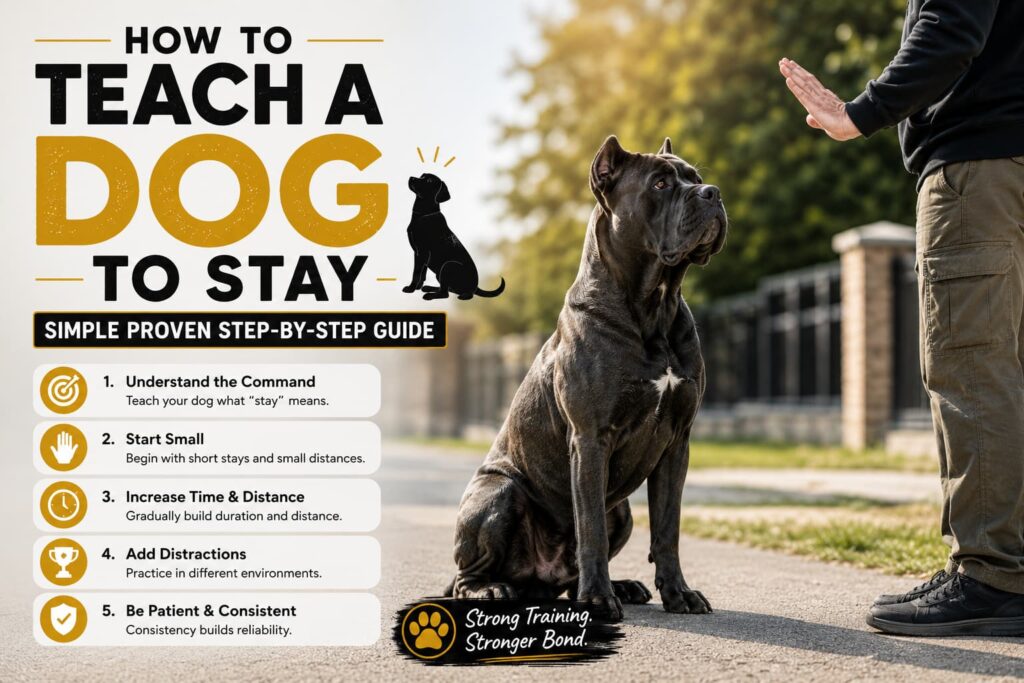
Knowing how to teach a dog to stay properly — not just a shaky two-second stay in the living room but a genuine, reliable hold-position-until-I-release-you stay — is one of the most practically useful things you can teach any dog. It keeps them safe at open doors, prevents jumping before greetings, creates calm during mealtimes, and gives you a reliable emergency brake in situations that would otherwise spiral.
In my experience, learning how to teach a dog to stay is also where owners most commonly make one specific mistake: they add duration, distance, and distractions all at once. That produces a dog who sort of stays in easy situations and not at all in harder ones. The 3D framework — building Duration first, then Distance, then Distraction — fixes this completely.
You also need a working sit or down first. Stay is built on top of a position your dog already knows. If sit is unreliable, work on that first.
Related: our guide on how to teach a dog to sit covers this in more depth.
If you want to dig deeper, check out our guide on how to teach a dog to lie down.
The Release Word — Decide This Before Anything Else
Your release word tells your dog that the stay is finished and they are free to move. Without a clear release word, your dog guesses when the stay ends — and they usually guess wrong, which makes the stay unreliable. Common choices: ‘OK’, ‘free’, ‘release’, ‘break’. Pick one and never change it.
The release word is not optional. It is what makes the stay command meaningful, because your dog learns to hold the position specifically until they hear that word — not until they feel like getting up.
The 3D Framework: How to Teach a Dog to Stay
Duration first. Distance second. Distraction third. Never combine more than one D at a time until the previous one is solid. Adding all three at once is the most common and most damaging mistake in stay training. It produces a dog that is confused about the rules rather than one who understands them deeply.
D1 — Duration: how long can they hold the stay?
This is where every stay starts. You are standing right next to your dog throughout this entire stage. Zero distance.
- Ask for sit or down
- Wait 1 second. Mark with ‘yes!’ and reward — while they are still in the position
- Say your release word and step back to end the repetition
- Ask again. Wait 2 seconds. Mark and reward
- Build to 5 seconds, 10 seconds, 30 seconds, 1 minute, 3 minutes, 5 minutes
Two things matter more than anything here: the reward comes while they are still in position (not after they have moved), and the release word is used every single time before they are allowed to move. These two habits build a stay that holds because the dog is waiting for a specific signal, not because they feel like staying.
D2 — Distance: how far can you move away?
Only attempt distance once your dog can hold a stay for at least 30 seconds with you standing right beside them. Most training failures in how to teach a dog to stay come from adding distance too early.
- Ask for a 5-second stay
- Take one small step back — return to your dog immediately, mark and reward
- Take two steps back — return, mark and reward
- Gradually increase to 3, 5, 10 steps
- Begin walking around your dog in a circle
- Move out of their line of sight briefly
Return to your dog to reward — do not call them to you during this stage. Recall is a separate skill. Returning to reward in position teaches your dog that staying put is what earns the reward.
D3 — Distraction: does the stay hold when things happen?
This is where how to teach a dog to stay becomes useful in real life. A stay that only holds in a quiet room is not reliable enough for the situations where you actually need it. Proof the stay in progressively more challenging conditions:
- Another person walking through the room
- A toy rolling across the floor nearby
- Another pet in the room
- The doorbell ringing
- The garden
- A quiet street
- A park with moderate activity
At each new level of distraction, go back to shorter duration and shorter distance. A new environment essentially resets the training — build back up from shorter stays in each new context. It is not starting over, it is proofing.
Real-World Applications Worth Practising
Once you know how to teach a dog to stay in a controlled setting, these are the real-world scenarios worth practising specifically — because this is where the command earns its keep.
Stay at the front door
Ask for a sit-stay before opening the door. Begin reaching for the handle. If your dog breaks — ask again before continuing. Gradually progress to opening the door, then stepping out and returning. This is one of the most safety-critical stays you can train, particularly for dogs who dart at every exit.
Stay during greetings
Ask for a sit-stay when guests approach. If the stay breaks — guests stop moving and turn away until the stay resumes. This pairs naturally with the jumping training: a dog in a sit-stay is a dog who cannot jump.
Stay during mealtimes
Ask your dog to stay while you prepare and place their food bowl. Use the release word to allow them to eat. This builds impulse control around food and eliminates the frantic pushing and rushing that makes small kitchens genuinely dangerous with large dogs.
Common Mistakes When Learning How to Teach a Dog to Stay — and Their Fixes
- Saying ‘stay’ repeatedly — once is the rule. If they break, reset without drama and reward a shorter duration. Repeating the command teaches your dog it is optional.
- Advancing all three Ds simultaneously — work on duration alone first, then add distance, then add distraction. Patience here produces reliability later.
- Calling your dog out of the stay — always return to reward. Recall is a separate command with a separate cue.
- Punishing breaks — dogs break stays because the training moved too fast, not out of defiance. Reset to a shorter duration and rebuild. There is no punishment for an imperfect stay.
Frequently Asked Questions
| Q: How long does it take to teach a dog to stay?A: How long it takes to teach a dog to stay depends entirely on how consistently you work the 3D framework. A reliable 10 to 30-second stay with you standing next to your dog… A stay that holds for 5 minutes under moderate distraction takes weeks of consistent practice. A genuinely bombproof stay in any environment takes months of proofing. The investment is absolutely worth it. |
| Q: Should I use a separate ‘stay’ cue or just build duration into sit?A: Both approaches work. Some trainers argue that sit should inherently mean sit-until-released without a separate stay command. Others prefer an explicit stay cue. Pick one approach, apply it consistently, and never mix them. What matters is that your dog reliably holds the position until the release word — however you get there. |
| Q: My dog stays perfectly at home but breaks immediately at the park — is this normal?A: Completely normal. Every new environment with new distractions is essentially a fresh training challenge. Go back to 3-second stays at the park, reward heavily, and build duration back up in the new context. The more environments you proof in, the more reliable the stay becomes across the board. |
We also have a complete guide on how to teach a dog to come when called.
For more on this, see our guide on how to get your dog to listen.
For the complete overview of dog training, see our complete dog training guide.
AKC -> https://www.akc.org/expert-advice/training/stay-put-teaching-your-dog-to-stay/
Purina -> https://www.purina.com/articles/dog/training
PetMD -> https://www.petmd.com/dog/training
| ⚠️ Disclaimer This article -How to Teach a Dog to Stay: Simple Proven Step-by-Step Guide – reflects the personal experience and research of the author. It does not replace professional veterinary or dog training advice. For severe behavioural issues, please consult a certified professional dog trainer (CPDT-KSA) or veterinary behaviourist. |
This article is written for informational purposes and reflects the personal experience and research of the author. It does not replace professional veterinary or dog training advice. Always consult your veterinarian or a certified trainer for individual guidance.