

8 min read |
Table of Contents
Knowing how to help a dog with separation anxiety is one of the most emotionally demanding challenges in dog ownership. You leave for work and return to destruction, a neighbour complaint about barking, and a dog so visibly relieved to see you that the guilt is almost physical. I have spoken to dozens of dog owners in this situation. The thing they nearly all have in common: they tried to fix it with the wrong approach, often for months, before understanding what was actually happening.
Separation anxiety is not bad behaviour. It is not spite, defiance, or a training failure. The ASPCA describes it as a genuine anxiety condition — the equivalent of a panic attack — occurring when a dog with a strong attachment to their person is left alone. The destruction, the barking, the accidents — these are symptoms of distress, not choices.
That distinction matters enormously, because it means punishment is not just unhelpful — it actively makes things worse by increasing the anxiety that is causing the problem in the first place.
For more on this, see our guide on how to stop a dog from chewing.
You might also find our guide on how to stop a dog from barking helpful.
Is This Actually Separation Anxiety? Signs to Look For
The diagnostic feature of separation anxiety is that the problematic behaviours occur specifically during your absence. A dog that chews throughout the day regardless of whether you are present has a different problem from a dog that chews only when you leave.
The ASPCA lists these signs as characteristic of separation anxiety:
- Howling, barking, or whining that begins when you prepare to leave or shortly after you depart
- Destructive behaviour — chewing, scratching, digging — focused on exit points like doors and windows
- House soiling when the dog is otherwise reliably house trained
- Pacing in a fixed pattern
- Attempting to escape — which can lead to self-injury
- Excessive drooling or panting when alone
- Refusing to eat when left alone despite normally being food-motivated
| 💡 A useful diagnostic tool Set up a phone or tablet to record what your dog does in the first 30 minutes after you leave. A dog with true separation anxiety will show distress within minutes — pacing, vocalising, scratching at the door. A bored dog typically settles for a while before eventually finding something to chew. The distinction changes your entire approach. |
What Consistently Fails — Avoid These
Worth covering before the solutions, because anyone researching how to help a dog with separation anxiety will likely have already tried at least one of these — and found it made things worse:
- Punishment — punishing anxiety symptoms increases the anxiety. The destruction is not defiance, it is panic.
- Getting another dog — sometimes helpful, but the anxiety is typically person-specific. A second dog does not replace the attachment to you.
- Dramatic goodbyes and hellos — these increase the emotional significance of departures and returns, heightening the anxiety around both.
- Flooding — forcing the dog to endure long absences to get used to it. Research published in PMC (National Institutes of Health) confirms this approach sensitises the dog and increases distress rather than reducing it.
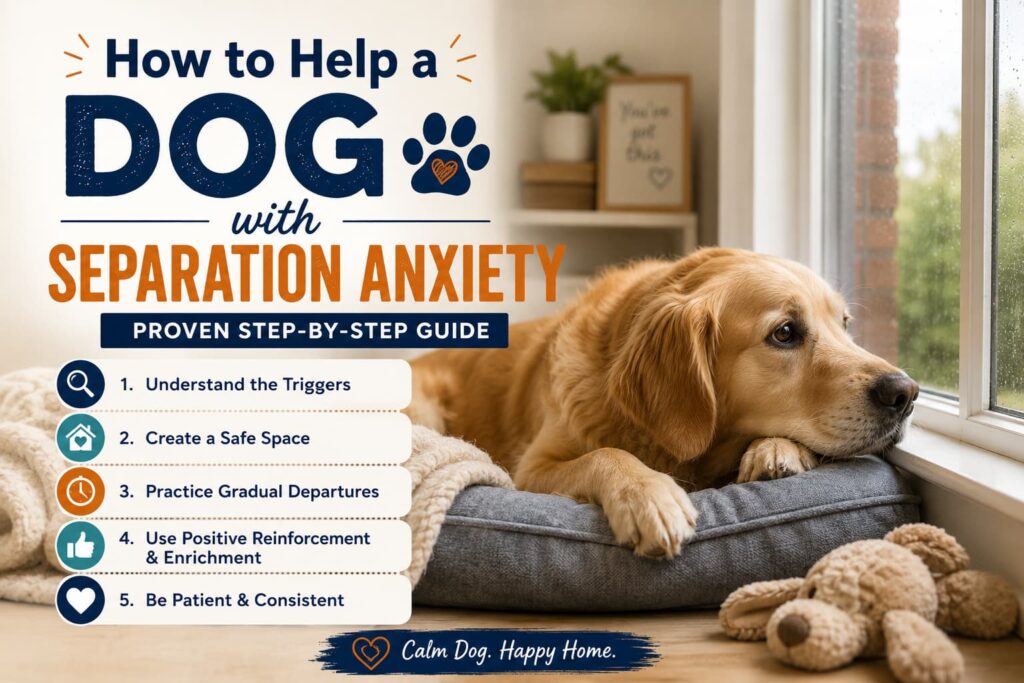
The Proven Approach: How to Help a Dog with Separation Anxiety Using Graduated Training
The evidence-based treatment for separation anxiety is systematic desensitisation — gradually building your dog’s tolerance for being alone by starting with absences so brief they do not trigger anxiety, then increasing duration very slowly. A PMC study on canine separation anxiety found that because problem behaviours begin within minutes of departure, the initial separation period must be short enough to ensure the dog’s absence is not associated with anxiety — sometimes starting at just seconds.
The PDSA describes this in practical terms: gradually get your dog used to being alone (desensitisation), then get them to associate it with positive things (counterconditioning). These two techniques used together produce the most reliable results.
Stage 1 — Desensitise departure cues
Many dogs begin showing anxiety before you leave — when you pick up your keys, put on your coat, pick up your bag. They have learned to predict your departure and the anxiety begins with these cues, not with the actual absence.
- List your pre-departure routine — every action you take before leaving
- Perform individual cues randomly throughout the day without leaving — pick up keys, put them down, sit back down
- Repeat until your dog stops reacting to each individual cue
- Gradually combine cues without departing, until your dog remains calm through your full pre-departure routine
Stage 2 — Build tolerance from seconds upward
Today’s Veterinary Practice guidance is clear: depending on the dog’s tolerance, the first actual departure may last from a few seconds to a few minutes — and should increase gradually and randomly, not in rigid increments.
- Leave for 10 to 30 seconds. Return before any distress signs begin.
- Re-enter calmly. No drama.
- Wait 5 to 10 minutes. Leave for 45 seconds.
- Gradually increase — 1 minute, 2 minutes, 3 minutes, 5 minutes — over days and weeks.
- If distress signs appear, you have moved too fast. Return to shorter durations and rebuild.
| ⚠️ The critical rule Never let your dog reach their anxiety threshold during training sessions. The PMC study confirms that desensitisation performed too quickly or without regard for the dog’s reactions can backfire by sensitising the dog and increasing distress. Progress slowly. The weeks you invest now produce lasting results. |
Stage 3 — Build a positive association with departures
A key part of how to help a dog with separation anxiety is flipping the emotional script around departures. While working on graduated absences, create positive associations with your leaving.
Leave a high-value frozen KONG exclusively when you depart — something your dog genuinely loves that they only get during your absences. Pick it up when you return. Over time, your departure begins to predict something wonderful rather than something frightening.
Calming music, white noise, and Adaptil pheromone diffusers all reduce ambient stress during absences. A worn item of your clothing in their resting area provides olfactory comfort. None of these replace the graduated departure training, but they all help.
When to Involve Your Vet
For mild separation anxiety, graduated departure training alone is often effective. For moderate to severe cases — dogs that escalate to self-injury, show extreme panic responses within minutes, or make no improvement after 4 to 6 weeks of consistent training — medication is frequently part of how to help a dog with separation anxiety effectively.
PetMD veterinarian Dr Arielle Schoenlein explains that medication works as an adjunct to training by decreasing overall anxiety, enabling training to be more successful. It does not sedate the dog. It reduces their baseline anxiety to a level where behaviour modification can actually work. Medication and training together typically produce better results faster than either alone.
Frequently Asked Questions
| Q: How long does it take to fix separation anxiety?A: Mild cases can show significant improvement within 4 to 8 weeks of consistent graduated departure training. Moderate to severe cases take months, and some dogs require ongoing management with environmental modifications and medication. There is no fast fix — but there is always improvement with the right approach applied consistently. There is no fast fix — but there is always improvement with the right approach applied consistently. The most important thing is starting the right way, which is exactly what this guide to how to help a dog with separation anxiety is designed to help with. |
| Q: Should I crate my dog with separation anxiety?A: It depends entirely on the individual dog. Some dogs with mild anxiety feel safer in a crate — the enclosed space feels den-like and secure. Others with severe anxiety attempt to escape the crate and injure themselves in the process. The safest approach is to observe your dog via camera in both conditions before deciding. Chewy training guidance is explicit: do not crate a dog showing signs of separation anxiety without first checking how they respond to the crate. |
| Q: My dog only has separation anxiety with one person — is this normal?A: Yes — separation anxiety is typically person-specific. The dog has formed an intense attachment to one individual. The graduated departure training needs to be carried out by that specific person, since they are the attachment figure. Other household members leaving does not produce the same response. |
You may also want to read our guide on how to crate train an older dog.
For the complete overview of dog training, see our complete dog training guide.
| ⚠️ Disclaimer This article – How to Help a Dog with Separation Anxiety: Proven Step-by-Step Guide – reflects the personal experience and research of the author. It does not replace professional veterinary or dog training advice. For severe behavioural issues, please consult a certified professional dog trainer (CPDT-KSA) or veterinary behaviourist. |
This article is written for informational purposes and reflects the personal experience and research of the author. It does not replace professional veterinary or dog training advice. Always consult your veterinarian or a certified trainer for individual guidance.