

Published April 2026 | 8 min read
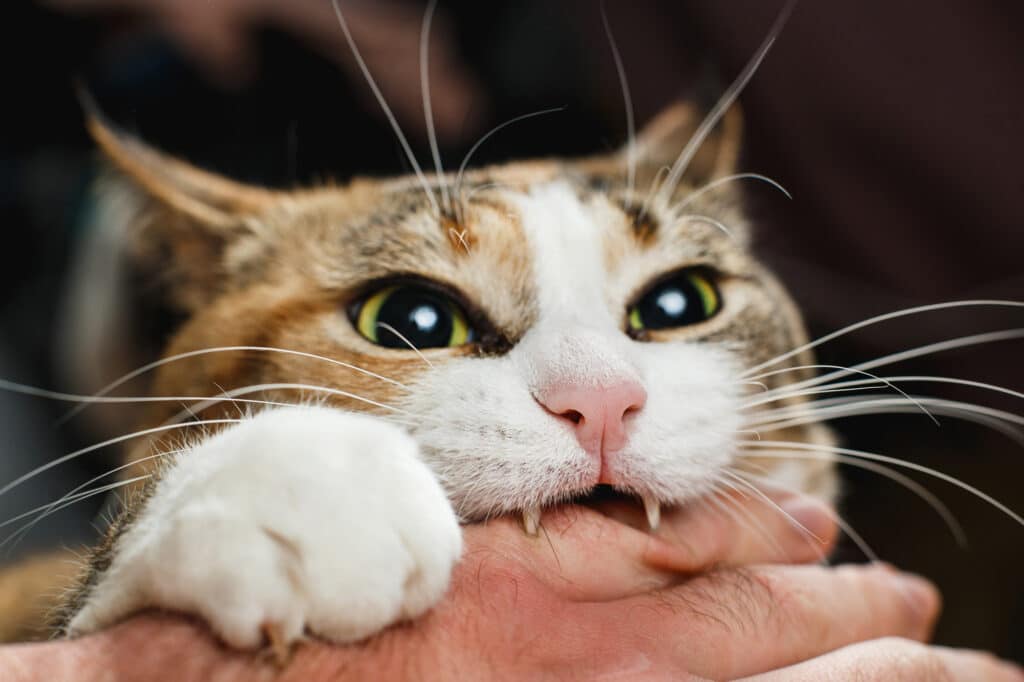
You’re stroking your cat, everything is peaceful, they’re purring — and then out of nowhere they bite your hand and walk away like nothing happened. Sound familiar? The question ‘why does my cat bite me’ is one of the most Googled cat behaviour questions, and it’s completely understandable why.
The frustrating truth is that biting means different things in different situations. A gentle nip while purring is an entirely different message from a hard bite during play. Understanding the type of bite your cat is giving you is the first step to fixing it — or in some cases, realising it doesn’t need fixing at all.
Here are the 8 real reasons cats bite their owners, how to tell which one applies to your cat, and exactly what to do about each one.
If you want to dig deeper, check out our guide on why do cats sleep so much?.
We also have a complete guide on why do cats hate water?.
For more on this, see our guide on why does my cat lick me?.
8 Reasons Your Cat Bites You
1. Overstimulation — the most common reason
This is the number one cause of unexpected bites, and almost every cat owner experiences it. You’re petting your cat, they seem to be enjoying it — then they bite. This is called petting-induced aggression or overstimulation biting. The ASPCA’s guide to common cat behavior issues explains that biting is often a form of communication or redirected play, and identifying the trigger is the first step toward addressing it.
Cats have a threshold for physical contact. When that threshold is crossed, the nervous system essentially overloads and the bite is their way of saying ‘enough, stop now.’ The tricky part is that they often don’t give obvious warnings — or give subtle ones that humans miss.
Warning signs to watch for before the bite: tail beginning to flick or thrash, skin twitching along the back, ears rotating sideways or flattening, body going tense or still, a fixed stare at your hand.
When you see any of these signals, stop petting immediately. Don’t wait for the bite to confirm you’ve gone too far. Over time, learn your individual cat’s tolerance — some cats are happy to be stroked for minutes, others for only seconds.
| 💡 Key tip Keep petting sessions short. Two or three strokes at a time with a pause in between is often more comfortable for cats than continuous stroking. Watch the tail — it tells you more than anything else. |
2. Play aggression — hunting instinct misdirected
Cats are hardwired predators. Even a well-fed indoor cat still has the instinct to stalk, chase, pounce, and bite. When they don’t have appropriate outlets — toys, wand play, puzzle feeders — they redirect that hunting energy onto whatever moves: your hands, your feet, your ankles.
This type of biting is especially common in kittens and young adult cats, and is almost always the result of owners playing with hands and fingers during kittenhood. When a tiny kitten bites your fingers it seems harmless and cute, but they learn that human hands are prey — and that learning follows them into adulthood.
The fix: never use hands as toys. Always use wand toys, feather toys, or crinkle balls that put distance between your skin and their teeth. Give them at least two dedicated 10–15 minute play sessions daily to burn off hunting energy before it gets redirected onto you.
| 🐾 Tip If your cat ambushes your feet, they need more active play. A wand toy session before bed dramatically reduces nighttime ankle attacks. Tire them out properly and they’ll sleep instead of hunt you. |
3. Love bites — affection, not aggression
Not all biting is bad. Many cats give gentle, light nips — often while purring, kneading, or being stroked. These are called love bites or mating bites, and they’re a natural part of cat social behaviour.
In the wild, cats bite each other gently during grooming and social bonding. Your cat is extending this behaviour to you. A love bite typically won’t break the skin, happens in the context of obvious affection, and your cat will continue purring and engaging rather than walking away.
Love bites don’t need to be fixed unless they become too hard. If they escalate, say a calm firm ‘no’, stop engaging briefly, and restart. Never shout or push — this confuses a cat trying to show affection.
4. Fear or defensive biting
A frightened cat bites to protect themselves. This type of bite is typically sudden, sharp, and intense — not a gentle nip. It happens when a cat feels trapped, cornered, or threatened, and cannot escape the situation.
Common triggers: being picked up when they don’t want to be, unfamiliar people or animals, loud sudden noises, being handled in a way that feels threatening. The bite is your cat’s last resort after other signals (hissing, swatting, trying to flee) have been ignored.
The solution is never to force physical contact with a frightened cat. Give them an escape route, let them approach on their own terms, and read the early warning signals so you stop before the situation escalates to biting.
5. Pain biting — a medical signal
If a cat that has never bitten before suddenly starts biting when touched in a specific area, pain is almost certainly the cause. Arthritis, dental pain, skin infections, internal discomfort, or injuries can all make normal handling feel agonising.
Dental pain is particularly common and frequently overlooked. A cat with toothache may bite when touched near their head or face, or when eating. Arthritis cats often bite when their joints are touched or when they’re picked up.
A sudden onset of biting in a previously gentle cat — especially an older cat — should always trigger a vet visit. This is one situation where the bite is a symptom, not a behaviour problem.
6. Redirected aggression
This is one of the most misunderstood forms of cat biting. Your cat sees something through the window — a stray cat, a bird, a dog — and becomes intensely aroused and frustrated that they cannot get to it. In this state, anything that moves near them, including you, may get bitten.
The confusing thing is that the bite seems completely unprovoked from your perspective. You weren’t even interacting with the cat. But they were already in a highly agitated state from the external stimulus, and you walked into that state at the wrong moment.
If your cat ever seems intensely focused on something outside and agitated, don’t approach them or try to pet them. Give them 20–30 minutes to calm down fully before any contact.
7. Attention-seeking biting
Some cats learn that biting gets an immediate reaction — you look at them, you speak to them, you move. For a cat that wants attention, any reaction is better than being ignored. If your cat nips your ankle when you’re on your phone or bites your hand when you stop petting, they may have learned biting is an effective attention tool.
The response is counterintuitive but effective: completely ignore the bite. No reaction whatsoever. Stand up calmly and walk away. The moment biting stops producing results, it reduces. But this only works if you’re consistent — reacting even occasionally reinforces that biting sometimes works.
8. Early weaning or poor socialisation
Kittens learn bite inhibition from their mother and littermates. When a kitten bites too hard during play, the other kitten yowls and stops playing — and the biting kitten learns that hard bites end the fun. Kittens separated from their litter before 8 weeks miss this critical learning window.
Cats hand-raised by humans without litter contact also miss it. These cats often don’t know how to modulate bite pressure and may bite harder than intended without meaning to cause harm. Patient, consistent redirection to toys — and never using hands for play — gradually improves this over time.
How to stop your cat biting — the right way
- Stop petting before the warning signs appear — prevention beats reaction every time
- Never punish a bite with shouting, spraying water, or physical correction — this creates fear and worsens biting
- Always redirect to toys — every time hands become the target, swap in a toy
- Keep play sessions regular and energetic — a tired cat is a less bitey cat
- Respect your cat’s ‘no’ signals — a cat that can always say no rarely needs to escalate to biting
- See a vet if biting is sudden and new — especially in older cats where pain is the likely cause
Frequently asked questions
| Q: Why does my cat bite me gently out of nowhere?A: A gentle, unprovoked bite is usually a love bite or mild overstimulation. Your cat may have hit their contact threshold during petting, or is expressing affection in the cat way. Check whether it happens after sustained petting — if yes, overstimulation is the cause. If it happens out of nowhere with no contact at all, it’s almost certainly a love bite. |
| Q: Why does my cat bite me then lick me?A: This is a classic combination of love bite and grooming. Your cat is treating you like a fellow cat — a little nip as part of social bonding, followed by grooming. It’s an affectionate sequence. If the biting isn’t painful and your cat is calm and purring, enjoy it — you’re being given cat-style affection. |
| Q: Why does my cat bite me when I pet her belly?A: The belly is the most sensitive and vulnerable part of a cat’s body. Showing the belly is a sign of trust — but it’s not usually an invitation to touch. Most cats find belly contact overstimulating very quickly and bite as a reflex. The safest interpretation of a cat rolling onto their back is ‘I feel safe’, not ‘please rub my belly’. |
| Q: Why does my kitten bite so much?A: Kittens bite because they’re teething, playing, and learning. It’s completely normal. The key is to redirect every bite to a toy immediately and never use hands as playthings. Kittens who consistently get a toy instead of a reaction on skin learn quickly. By 12–18 months most kittens significantly reduce biting as they mature. |
| Q: Is my cat biting me because they hate me?A: Almost certainly not. Cats don’t bite out of hatred. They bite because they’re overstimulated, playing, frightened, in pain, or seeking attention. Every bite has a functional reason rooted in instinct or communication — not personal animosity. |
You might also find our guide on why do cats purr? helpful.
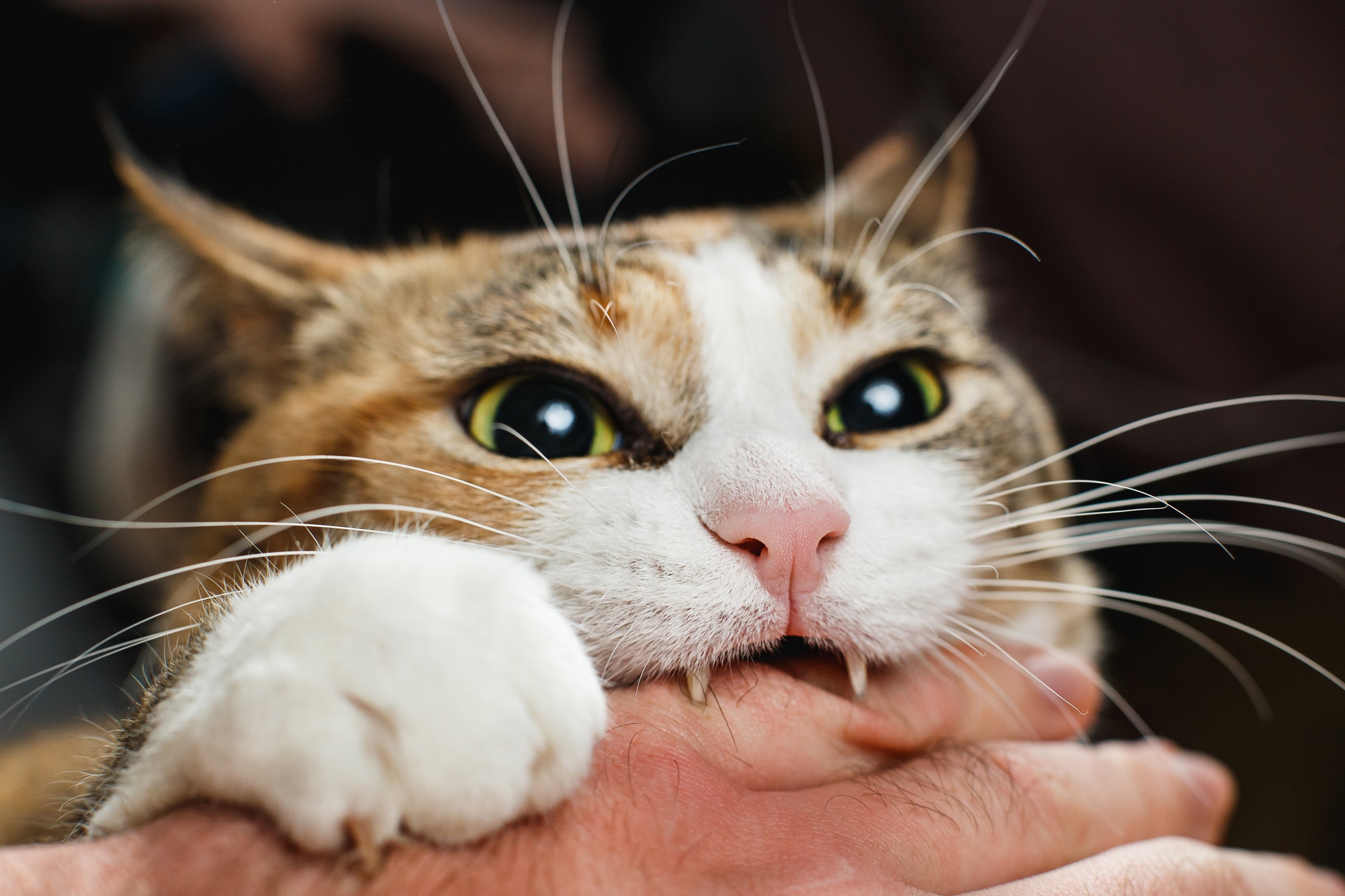


Frequently Asked Questions: Why Does My Cat Bite Me?
Why does my cat bite me when I’m petting them?
This is called petting-induced aggression — one of the most common reasons owners ask why does my cat bite me. Cats have a threshold for physical contact, and when overstimulated, they bite as a signal to stop. Watch for tail flicking, skin rippling, or flattened ears before a bite. Learning your cat’s tolerance level and stopping before they reach that threshold will significantly reduce incidents.
Why does my cat bite me and then lick me?
A bite followed by licking is usually a form of social grooming — your cat is treating you like another cat. This behaviour is typically affectionate rather than aggressive. However, if the bite is hard or the licking seems frantic, it can also indicate overstimulation. Context matters: a gentle nibble followed by grooming is very different from the sharp bites that make you ask why does my cat bite me when I haven’t provoked them.
Why does my cat bite me unprovoked?
What looks unprovoked often has a cause you’ve missed — redirected aggression from seeing another cat outside, pain from an underlying health issue, or pent-up energy with no appropriate outlet. If you’re consistently asking why does my cat bite me without any warning, track when it happens and check for environmental triggers. A vet visit to rule out pain is also a sensible first step.
How do I stop my cat from biting me?
Never use your hands as toys — this teaches cats that hands are acceptable targets. Use wand toys and interactive play daily to burn energy. If your cat bites during petting, end the session calmly without punishment. Consistency is key. Understanding why does my cat bite me in different contexts lets you tailor your response: what works for play biting differs from what helps with fear-based or pain-related aggression.
You may also want to read our guide on why do cats knead?.
This post is part of our complete cat behaviour library. For the full guide covering all 18 cat behaviours in one place, visit our complete cat behaviour guide.
| ⚠️ Disclaimer This article is for informational purposes only and does not constitute veterinary advice. If you are concerned about changes in your cat’s behaviour, please consult your veterinarian. |
This article is written for informational purposes and reflects the personal experience and research of the author. It does not replace professional veterinary or dog training advice. Always consult your veterinarian or a certified trainer for individual guidance.